Securing Your FNP Adult and Gerontology Rotations
Adult and gerontology are the backbone of an FNP program's clinical hours, the two populations you will spend the most time with and, fortunately, the two that are most readily precepted by a single family-medicine or internal-medicine clinician. This page explains what the adult and gerontology rotations cover, why they are usually easier to fill than pediatrics or women's health, who can precept them, and how our independent service secures them, often alongside your harder rotations, for FNP students at any university. We work independently of any university or certification body.
The backbone of your FNP clinical hours
FNP is family and individual primary care across the lifespan. Programs may organize adult and older adult objectives in separate courses or integrated experiences, and the current program plan determines the required hour distribution, clinician scope, and approved settings.
Where pediatrics and women's health are the scarce rotations that most often stall a program, adult and gero are usually the more available ones. A family-medicine or internal-medicine practice, a community health center, or a geriatric clinic will typically carry enough adult and older-adult volume to serve both populations at once. That does not make the search trivial, a qualified preceptor still has to agree, fit your scope, and clear approval, but it is generally the more solvable half of the FNP lifespan.
The exact hours your program assigns to adult and to gerontology are set by your school and vary. Plan around the reality that these two populations will account for a substantial part of your total clinical hours, anchored to the national minimum, and that a single strong primary-care preceptor can often deliver both.
What the adult and gerontology rotations cover
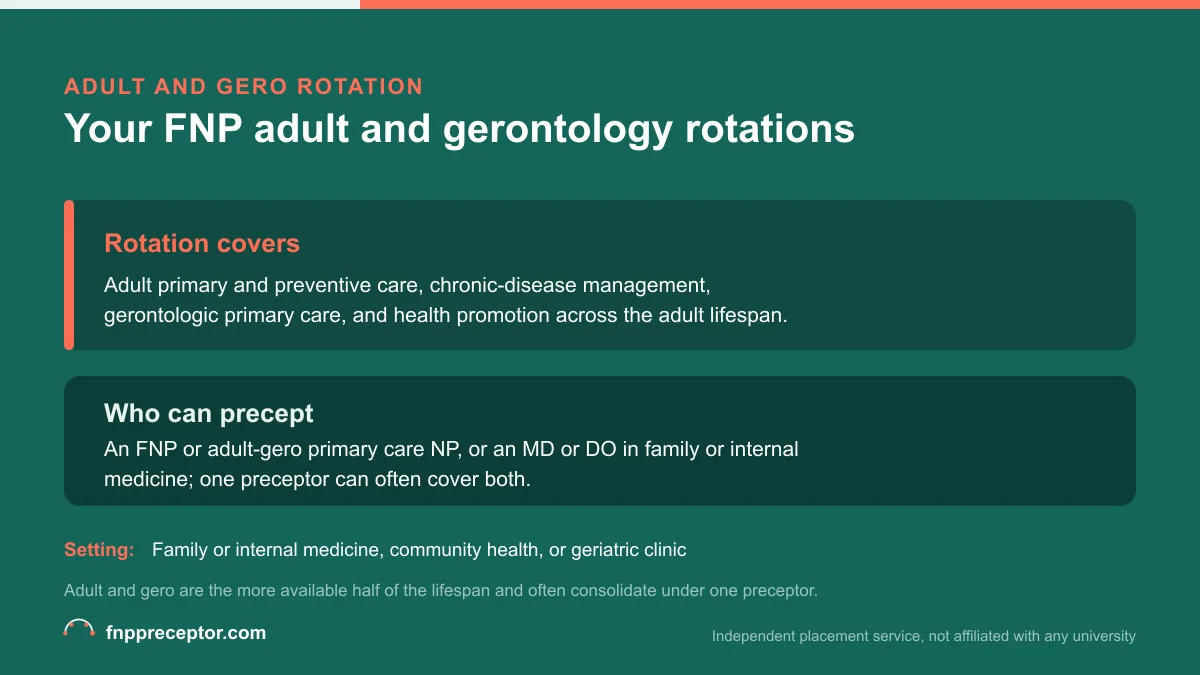
Adult and gerontology primary care for an FNP student is the everyday substance of family practice, prevention, chronic-disease management, and acute care across the adult and older-adult span.
- Adult primary and preventive care. Routine health maintenance, screening, and management of common acute complaints in working-age adults.
- Chronic-disease management. Hypertension, diabetes, hyperlipidemia, and the other ongoing conditions that dominate adult primary care.
- Gerontologic primary care. Care of older adults, including polypharmacy, functional assessment, cognitive screening, and coordination across the continuum.
- Health promotion across the adult lifespan, from young adulthood through advanced age.
The settings that deliver this are among the most common in primary care: family-medicine and internal-medicine practices, community health centers, and clinics serving older adults. Because these settings are widespread, adult and gero are usually where a placement search finds its footing first.
Who can precept adult and gerontology hours
An adult or gerontology preceptor for an FNP student is generally a clinician qualified in adult primary care and acceptable to your program. That commonly includes a board-certified nurse practitioner whose scope covers adults, such as a family nurse practitioner (FNP) or an adult-gerontology primary care NP (AGPCNP), or a licensed physician (MD or DO) in family medicine or internal medicine.
A general primary care practice may see both working-age and older adults, but whether one preceptor can support multiple objectives is the program's decision. The clinician's scope, patient panel, and setting still have to fit, and both the preceptor and site require approval. Confirm the precise eligibility and documentation rules with the program, then use our preceptor requirements guide as planning context.
How we secure your adult and gero placement
Adult and gerontology are often the anchor of the placement plan we build for you, the rotations we can most reliably secure, and frequently the ones we cover with a single primary-care preceptor while we work the scarcer peds and women's-health rotations in parallel.
- Primary-care sourcing. We target family-medicine and internal-medicine practices, community health centers, and geriatric clinics in your area.
- Two populations, one preceptor where possible. We look for a practice that carries both adult and older-adult volume, so a single approved preceptor can cover both.
- Scope-checked and approval-ready. We confirm scope fit and help assemble the CV and affiliation agreement your school requires.
- Planned as part of the whole lifespan. We sequence adult and gero alongside your harder rotations so your full FNP plan comes together, not just the easy half.
Final approval of any preceptor or site rests with your university, not with us, and we never imply a university affiliation. We do not guarantee hours, grades, certification, or outcomes, and nothing here is a tuition refund. What we offer is a secured adult and gerontology placement as the backbone of a plan that covers your entire FNP lifespan. See how it works, or start on the contact page.
Good to know
Can one preceptor cover both my adult and gerontology hours?
Often yes. A general family-medicine or internal-medicine practice sees both working-age and older adults, so a single qualified primary-care preceptor can frequently supervise both your adult and your gerontology hours, provided their scope and setting fit and your program approves. That is one reason adult and gero are usually the more solvable half of the FNP lifespan.
Are adult and gero easier to place than peds and women's health?
Generally yes. Adults and older adults are the bulk of a common primary-care panel, so the settings that see them are widespread and a single preceptor often covers both. Pediatrics and women's health are the two scarcest FNP rotations. That is why we frequently anchor a placement plan on adult and gero while working the harder rotations in parallel.
How many adult and gerontology hours does an FNP program require?
It varies by school. The 2022 NTF standards recommend at least 750 direct patient care hours per NP population track, but that national benchmark does not set a named program's adult or older adult allocation. Confirm the current distribution with your program.
Who can precept my adult or gerontology rotation?
Generally a board-certified nurse practitioner whose scope covers adults, such as an FNP or an adult-gerontology primary care NP, or a licensed physician (MD or DO) in family or internal medicine. The preceptor and site must be approved by your program. Confirm the exact rules against your Nursing Student Handbook.
Are you affiliated with a university?
No. We are an independent placement service that works separately from any university or certification body. We source and prepare your adult and gerontology preceptors and sites; final approval always rests with your school.
Plan the FNP practicum across the lifespan
Tell us your school, city, course, and remaining objectives. We will organize an independent search for possible preceptors and primary care sites, subject to program approval.