Securing Your FNP Pediatric Rotation and Preceptor
Of the four FNP populations, pediatrics is the one that most often stalls a program. Family nurse practitioner students need supervised hours caring for children, from newborns through adolescents, and pediatric preceptors are in genuinely short supply because most primary-care clinicians see adults. This page explains what the pediatric portion of an FNP program actually requires, who can serve as a pediatric preceptor, and how our independent service secures that rotation for students at any university. We work independently of any university or certification body.
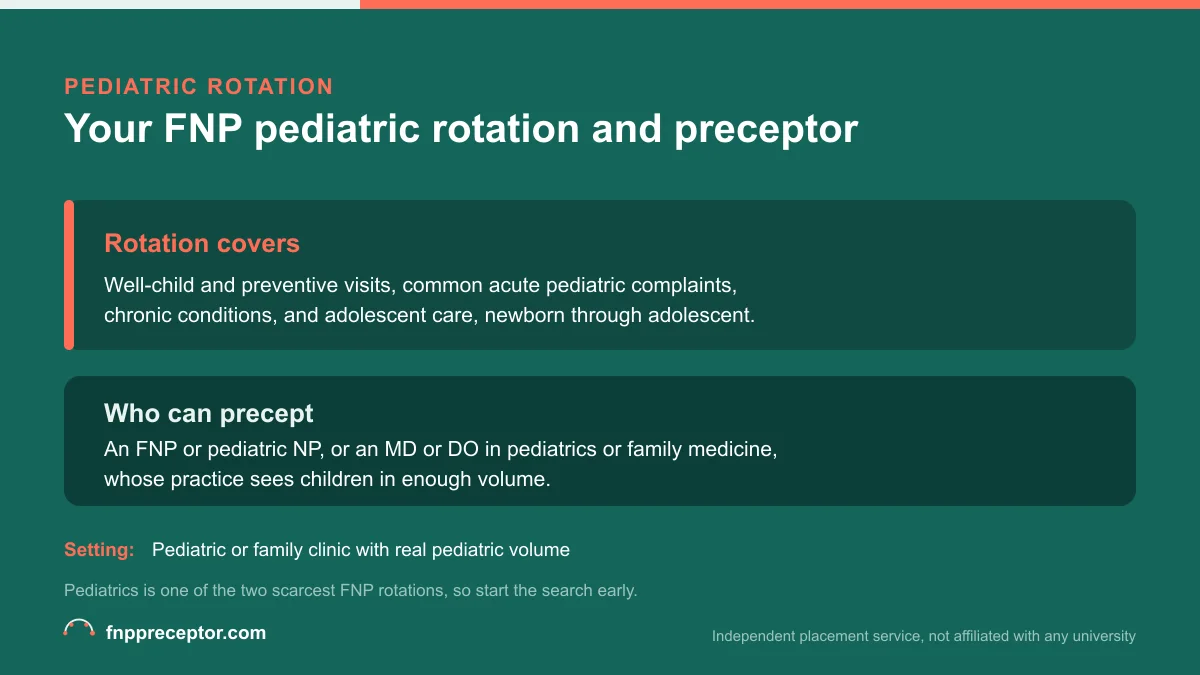
Why pediatrics is the hardest FNP rotation to fill
FNP is the family and individual across the lifespan track, which means your clinical hours have to span pediatrics, adult, gerontology, and women's health. Of those four, pediatrics and women's health are consistently the scarcest, and for the same underlying reason: most primary-care practices that welcome an FNP student see a predominantly adult panel, so a preceptor who works meaningfully with children is a smaller pool to begin with.
That scarcity is what turns pediatrics into the rotation that slips. A student can line up adult and gerontology hours through a single family-medicine or internal-medicine preceptor, then discover, weeks before a term, that no one nearby will take them for children. Because peds hours are competitive and often geographically thin, this is the population where starting the search early matters most, and the one we are asked to solve most often.
The exact number of pediatric hours your program requires comes from your school, and it varies. Rather than a fixed figure, plan around the reality that your program will carve out a meaningful block of your total clinical hours for children, and that block has to happen with a qualified pediatric preceptor in an appropriate setting.
What the FNP pediatric rotation covers
Pediatric primary care for an FNP student is broad by design, because a family nurse practitioner is expected to care for children across the developmental span, not a narrow age band. In practice, a peds rotation is built to expose you to the full range of well and acute pediatric care.
- Well-child and preventive visits. Growth and development monitoring, immunizations, anticipatory guidance, and screening across infancy, early childhood, school age, and adolescence.
- Common acute pediatric complaints. Respiratory infections, otitis media, gastrointestinal illness, rashes, and the everyday presentations of a pediatric or family clinic.
- Chronic pediatric conditions. Asthma, allergies, and other ongoing conditions managed in primary care.
- Adolescent care. The distinct needs of teenagers, including confidentiality, behavioral and mental-health screening, and sports and school physicals.
The setting that delivers this is usually a pediatric practice, a family-medicine clinic with a healthy pediatric panel, a community health center, or a school-based health program. What matters is that you see enough children, across enough ages and complaints, for the hours to serve the learning goals your program set.
Who can precept your pediatric hours
A pediatric preceptor for an FNP student generally needs to be a clinician qualified to supervise pediatric primary care and acceptable to your program. In most programs that means a board-certified nurse practitioner whose scope covers children, such as a family nurse practitioner (FNP) or a pediatric nurse practitioner (PNP), or a licensed physician (MD or DO) practicing pediatrics or family medicine.
The key idea is scope and setting fit: the preceptor's practice has to actually include children in enough volume for you to meet the rotation's goals, and their credentials have to satisfy your program's rules. A wonderful internist who never sees patients under eighteen cannot precept your peds hours no matter how willing they are. Your school's Nursing Student Handbook and clinical faculty set the precise eligibility rules, and our preceptor requirements guide walks through them in detail.
Every pediatric preceptor and site also has to clear your program's approval, which typically means a preceptor CV and a signed affiliation agreement between the site and your school. A willing pediatrician is not the same as an approved one, and that gap is where a lot of peds placements fall through when students arrange them alone.
How we secure your pediatric rotation
Pediatric availability varies by location, course objective, setting, and program approval. Tell us your school, city, confirmed pediatric objectives, and timeline, and we can run a focused search for possible clinicians and sites. The program decides whether any option is eligible.
- Peds-specific sourcing. We target pediatric practices, family clinics with real pediatric volume, community health centers, and school-health programs in your area.
- Scope-checked. We confirm the preceptor's practice actually includes children in the volume your program needs, not just a willingness to host you.
- Approval-ready. We help assemble the CV and affiliation agreement your school requires, so a good preceptor clears review instead of stalling on paperwork.
- Early. Peds slots are competitive, so we start sooner than feels necessary and line up more than one option where your program allows.
Final approval of any preceptor or site rests with your university, not with us, and we never claim or imply a university affiliation. We do not guarantee hours, grades, certification, or outcomes, and nothing here is a tuition refund. What we offer is a secured pediatric rotation so the hardest population does not become the reason your FNP program slips a term. See how it works, or start on the contact page.
Good to know
Why is the pediatric rotation so hard to find for FNP students?
Because most primary-care clinicians who host FNP students see a predominantly adult panel, so preceptors who work meaningfully with children are a smaller pool. Pediatrics and women's health are the two scarcest FNP populations, which is why the peds rotation is the one that most often stalls a program and the one worth starting earliest.
How many pediatric hours does an FNP program require?
It varies by school. There is no single national pediatric number. The 2022 NTF standards recommend at least 750 direct patient care hours per NP population track, but that national benchmark does not set your pediatric allocation. Confirm the current requirement with your program.
Who can be my pediatric preceptor?
Generally a board-certified nurse practitioner whose scope covers children, such as an FNP or a pediatric NP, or a licensed physician (MD or DO) practicing pediatrics or family medicine, whose practice sees children in enough volume for the rotation. The preceptor and site must be approved by your program. Confirm the exact rules against your Nursing Student Handbook.
Can I do peds hours at a family clinic instead of a pediatric office?
Often yes, as long as the family-medicine clinic sees enough children across enough ages for the rotation to meet its learning goals, and the preceptor's scope and your program approve it. What matters is pediatric volume and scope fit, not the sign on the door. We screen for that before we place you.
Are you affiliated with a university?
No. We are an independent placement service that works separately from any university or certification body. We source and prepare your pediatric preceptor and site; final approval always rests with your school.
Plan the FNP practicum across the lifespan
Tell us your school, city, course, and remaining objectives. We will organize an independent search for possible preceptors and primary care sites, subject to program approval.