FNP Preceptor Requirements and Eligibility
Not every willing clinician can precept your family nurse practitioner hours. A preceptor has to hold the right credentials, practice in a scope that matches the population, and clear your program's approval, and the requirements shift across pediatrics, adult, gerontology, and women's health. This page explains who qualifies as an FNP preceptor, how eligibility differs by population, and what approval actually involves, so you do not commit to a preceptor whose hours will not count. We are an independent placement service that works separately from any university or certification body.
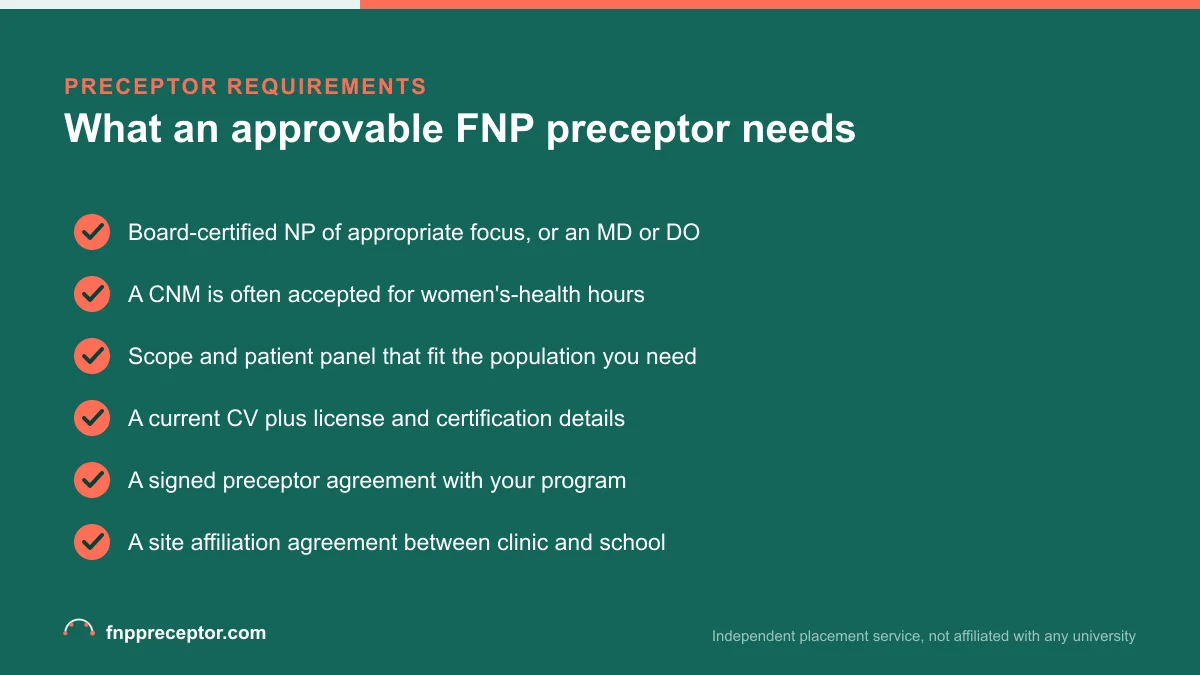
The general rule for an FNP preceptor
Across the FNP lifespan, the general eligibility rule is consistent: your preceptor should be a board-certified nurse practitioner in a focus appropriate to the population you are covering, or a licensed physician (MD or DO) practicing in that area, with the experience your program requires. For women's-health hours specifically, a certified nurse midwife (CNM) is often accepted, because a CNM's practice centers on the reproductive and gynecologic care that rotation is about.
Two qualifiers sit under that rule. The first is scope: the preceptor's actual practice has to include the population you need in enough volume for the hours to serve their purpose. A board-certified NP who only sees adults cannot precept your pediatric hours, credentials alone are not enough without the right patient panel. The second is program acceptance: your school's Nursing Student Handbook and clinical faculty set the precise credential and experience thresholds, and those are the rules that govern your graduation. Everything here is a planning guide; confirm the specifics with your program.
Eligibility population by population
Because FNP primary care spans the lifespan, the preceptor scope you need can change with the course objective. Programs organize those objectives differently, so confirm the current plan before evaluating a clinician.
| Population | Eligible preceptor | Scope focus |
|---|---|---|
| Pediatrics | FNP or pediatric NP, or MD/DO in peds or family medicine | Children, newborn through adolescent |
| Adult | FNP or adult-gero primary care NP, or MD/DO in family or internal medicine | Primary care of adults |
| Gerontology | FNP or adult-gero primary care NP, or MD/DO in family or internal medicine | Older-adult primary care |
| Women's health | FNP or women's-health NP, MD/DO, or a certified nurse midwife | Prenatal, gynecologic, and reproductive primary care |
Notice that a single family-medicine NP or physician can often precept adult and gerontology together, and sometimes pediatrics too if the practice sees children, which is why those rotations consolidate. Pediatrics and women's health more often require their own scope-matched preceptor, which is a large part of why they are the scarcest rotations to fill.
What program approval actually requires
Meeting the credential bar is necessary but not sufficient. Every preceptor and site also has to be approved by your program before you log an hour, and a willing, qualified clinician is not the same as an approved one. Approval generally involves a few common elements.
- Preceptor documentation. Typically a current CV or resume and license and certification details, so the program can verify credentials and scope.
- A signed preceptor agreement. A formal agreement between the preceptor and your program setting out the supervision arrangement.
- A site affiliation agreement. Many clinics and health systems require an affiliation agreement between the site and your school, which can add time, especially at larger organizations.
- Your own clearances. Background checks, immunizations, and similar requirements usually have to be in place before you start.
None of these are unusual, but together they are why approval takes longer than students expect, and why a qualified preceptor who cannot produce a CV or sign an agreement before a deadline is functionally unusable. Planning for the paperwork is as important as finding the clinician.
How we verify preceptor eligibility for you
Getting eligibility right up front is exactly what keeps your hours from being wasted, so it is central to what we do. We do not just find a willing clinician, we confirm the fit and prepare the approval before you commit.
- We match scope to population. We confirm the preceptor's actual practice covers the population you need in enough volume, not just their title.
- We check credentials against your program. We screen certification, licensure, and experience against your school's stated requirements.
- We assemble the approval package. We help gather the CV, agreements, and documentation your program needs, so a good preceptor clears review rather than stalling.
- We flag site-level hurdles early. Where a health system routes placements through a central office, we work that channel before it becomes a surprise.
We aim for an approvable preceptor, but final approval always rests with your university, and we never claim or imply a university affiliation. We do not guarantee hours, certification, or outcomes, and nothing here is a tuition refund. What we offer is confidence that the preceptor you commit to will actually count. See how it works, or start on the contact page.
Good to know
Who can be an FNP preceptor?
Generally a board-certified nurse practitioner in a focus appropriate to the population, or a licensed physician (MD or DO) practicing in that area, with the experience your program requires. For women's-health hours, a certified nurse midwife is often accepted. The preceptor's scope has to fit the population and setting, and every preceptor and site must be approved by your program. Confirm the exact rules against your Nursing Student Handbook.
Can a certified nurse midwife precept FNP hours?
Often, for women's-health hours specifically. A CNM's practice centers on the prenatal, gynecologic, and reproductive care the women's-health rotation covers, so many programs accept a certified nurse midwife for those hours. Whether a CNM qualifies, and in what scope, is your program's decision.
Does the preceptor's specialty have to match each rotation?
Yes. The preceptor's scope has to fit the population you are covering. A clinician who only sees adults cannot precept your pediatric hours no matter how qualified they are. A single family-medicine preceptor can often cover adult and gerontology together, and sometimes pediatrics if they see children, but pediatrics and women's health frequently need their own scope-matched preceptor.
What documentation does preceptor approval need?
Commonly the preceptor's CV and license and certification details, a signed preceptor agreement, and often a site affiliation agreement between the clinic and your school, plus your own clearances such as background checks and immunizations. Requirements vary by program; confirm yours against your Nursing Student Handbook. A willing preceptor is not the same as an approved one.
Are you affiliated with a university?
No. We are an independent placement service that works separately from any university or certification body. We verify eligibility and prepare your preceptor and site for approval; the university makes the final decision.
Plan the FNP practicum across the lifespan
Tell us your school, city, course, and remaining objectives. We will organize an independent search for possible preceptors and primary care sites, subject to program approval.