Securing Your FNP Women's Health Rotation and Preceptor
Women's health is the other FNP rotation, alongside pediatrics, that students most often cannot fill on their own. A family nurse practitioner is expected to provide primary and preventive care for women across the lifespan, which means supervised hours in prenatal, gynecologic, and reproductive care, and preceptors for that work are limited. This page explains what the women's-health portion of an FNP program requires, who can precept it, including the certified nurse midwife, and how our independent service secures the rotation for students at any university. We work independently of any university or certification body.
Why women's health is one of the two scarcest rotations
As the across-the-lifespan track, FNP requires clinical hours spanning pediatrics, adult, gerontology, and women's health. Pediatrics and women's health are consistently the two hardest to secure. For women's health the reason is specialization: much prenatal, gynecologic, and reproductive care happens in dedicated OB-GYN and midwifery practices rather than the general primary-care clinics that most readily host FNP students.
That means a student can assemble adult and gerontology hours with a single family-medicine preceptor and still be short the women's-health block, because the general clinic does not carry the volume or the scope. Like pediatrics, women's health is a rotation that rewards an early, targeted search rather than a hopeful late one, and it is one of the two populations we are asked to solve most.
The precise number of women's-health hours your program requires is set by your school and varies. Plan around the reality that your program dedicates a defined portion of your total clinical hours to women across the lifespan, and that portion needs a qualified preceptor in a setting that actually delivers this care.
What the FNP women's health rotation covers
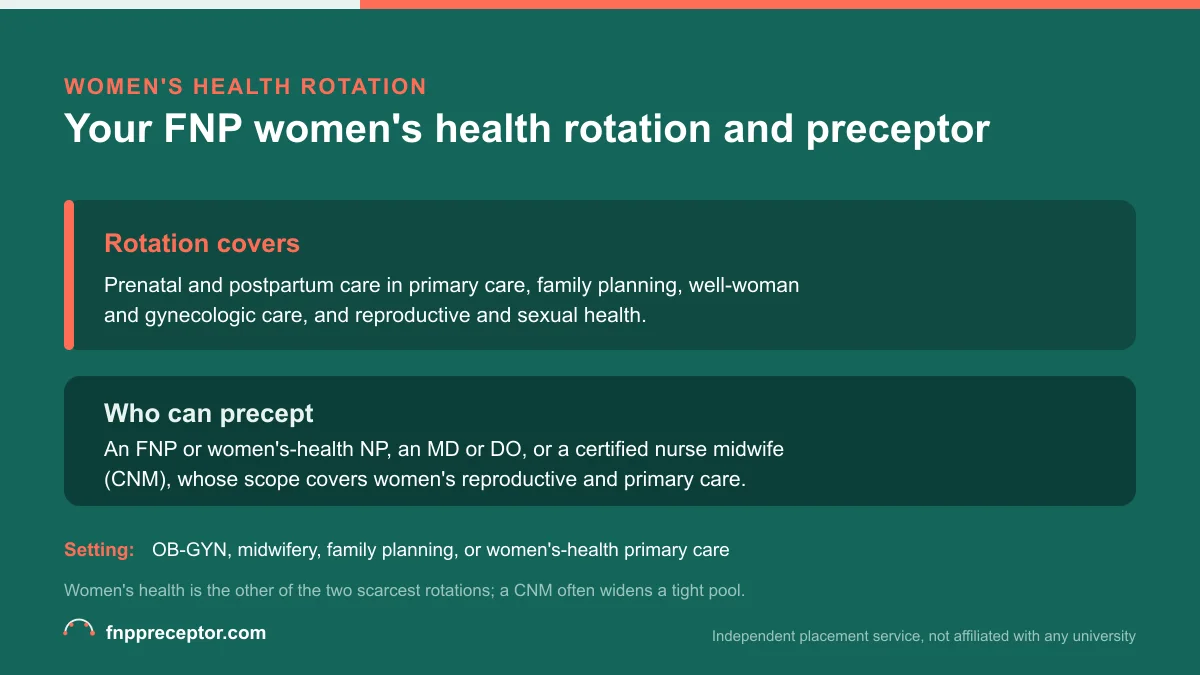
Women's health in an FNP program is primary-care oriented, covering the reproductive and gynecologic needs a family nurse practitioner encounters, not the surgical scope of an OB-GYN specialist. A typical rotation exposes you to the range of care women seek in primary and preventive settings.
- Prenatal and postpartum care in the primary-care context, including routine assessment and coordination with obstetric providers.
- Family planning and contraception, counseling, prescribing, and management.
- Gynecologic care, well-woman exams, cervical and breast screening, and common gynecologic complaints.
- Reproductive and sexual health, including sexually transmitted infection screening and treatment and menstrual and menopausal concerns.
Settings that deliver this include OB-GYN and women's-health practices, midwifery services, family-planning and community health clinics, and family-medicine practices with a strong women's-health component. What the rotation needs is enough volume of women's primary and reproductive care for the hours to meet your program's goals.
Who can precept women's health, including the CNM
A women's-health preceptor for an FNP student is generally a clinician qualified in women's reproductive and primary care and acceptable to your program. That commonly includes a board-certified nurse practitioner whose scope covers women's health, such as an FNP or a women's-health NP (WHNP), or a licensed physician (MD or DO) in family medicine or obstetrics and gynecology.
One option students often overlook: a certified nurse midwife (CNM) is frequently accepted to precept women's-health hours, because a CNM's practice centers on exactly the prenatal, gynecologic, and reproductive care the rotation is about. Where your program allows it, a CNM can be one of the most natural fits for this population, and it widens a pool that is otherwise tight. Whether a CNM qualifies, and in what scope, is your program's decision, set out in your Nursing Student Handbook.
As with every rotation, the preceptor's scope and setting have to fit, and the preceptor and site have to clear your program's approval. Confirm the current documentation and agreement process with your school. Our preceptor requirements guide covers planning across the lifespan.
How we secure your women's health rotation
Because women's health is one of the two scarcest FNP populations, it is a rotation our service is regularly built to solve. You tell us your school, your city, and the women's-health hours you still owe, and we run a focused, local-first search for a qualified preceptor and an approvable site, including midwifery and OB-GYN practices, early enough that the rotation is settled before the course begins.
- Women's-health-specific sourcing. We target OB-GYN and women's-health practices, midwifery services, family-planning and community clinics, and family-medicine practices with real women's-health volume.
- CNM aware. Where your program accepts a certified nurse midwife, we include midwifery practices to widen a limited pool.
- Scope-checked and approval-ready. We confirm the preceptor's scope fits and help assemble the CV and affiliation agreement your school requires.
- Early. Women's-health slots are competitive, so we start early and line up more than one option where your program allows.
Final approval of any preceptor or site rests with your university, not with us, and we never imply a university affiliation. We do not guarantee hours, grades, certification, or outcomes, and nothing here is a tuition refund. What we offer is a secured women's-health rotation so one of the two hardest populations does not stall your FNP program. See how it works, or start on the contact page.
Good to know
Why is women's health hard to place for FNP students?
Because much prenatal, gynecologic, and reproductive care happens in specialized OB-GYN and midwifery practices rather than the general primary-care clinics that most readily host FNP students. Along with pediatrics, women's health is one of the two scarcest FNP rotations, so it rewards an early, targeted search.
Can a certified nurse midwife be my women's health preceptor?
Often yes. A CNM's practice centers on the prenatal, gynecologic, and reproductive care the women's-health rotation is about, so many programs accept a certified nurse midwife to precept these hours. Whether a CNM qualifies, and in what scope, is your program's decision, set out in your Nursing Student Handbook. Where allowed, a CNM widens an otherwise tight pool.
How many women's health hours does an FNP program require?
It varies by school. There is no single national women's health number. The 2022 NTF standards recommend at least 750 direct patient care hours per NP population track, but that national benchmark does not set your reproductive health allocation. Confirm the current requirement with your program.
What does the FNP women's health rotation include?
Primary-care oriented women's health: prenatal and postpartum care in the primary-care context, family planning and contraception, well-woman and gynecologic care, screening, and reproductive and sexual health. It is not the surgical scope of an OB-GYN specialist. The setting needs enough volume of women's primary and reproductive care to meet your program's goals.
Are you affiliated with a university?
No. We are an independent placement service that works separately from any university or certification body. We source and prepare your women's-health preceptor and site; final approval always rests with your school.
Plan the FNP practicum across the lifespan
Tell us your school, city, course, and remaining objectives. We will organize an independent search for possible preceptors and primary care sites, subject to program approval.