How to Find an FNP Preceptor Across Every Population
Placement responsibilities vary by school and course. When a family nurse practitioner student is responsible for identifying candidates, the search must begin with the current requirements confirmed with the program and account for primary care objectives across the lifespan. This page explains how an independent FNP preceptor search can be organized without assuming a universal population split, delivery format, or school policy. We work independently of any university or certification body, and the program keeps every approval decision.
Why the FNP preceptor search starts with program rules
Placement responsibilities vary by program and course. Some programs provide more support than others, so first confirm who identifies candidates, which documents control the search, and when the program must review a proposed clinician and site. That prevents a search from being built on an unsupported assumption about school policy.
FNP centers on family and individual primary care across the lifespan. Programs may organize pediatric, adult, older adult, reproductive health, or other experiences differently, and the number of preceptors depends on the approved objectives, settings, and clinician scopes. Confirm the current plan before searching.
The students who struggle are rarely unqualified. They are the ones who started late, approached a preceptor whose scope did not match the population they needed, or lined up a willing clinician whose paperwork never cleared approval. Time, scope fit, and paperwork, not effort, are the usual failure points.
What qualifies a preceptor, population by population
A preceptor has to match the population you need, and the match differs sharply across the FNP lifespan. Getting it wrong is the most common reason hours do not count.
| Population | Typical qualified preceptor | Setting |
|---|---|---|
| Pediatrics | FNP or pediatric NP, or MD/DO in peds or family medicine | Pediatric or family clinic with real peds volume |
| Adult | FNP or adult-gero NP, or MD/DO in family or internal medicine | Primary care of adults |
| Gerontology | FNP or adult-gero NP, or MD/DO in family or internal medicine | Older-adult primary care |
| Women's health | FNP or women's-health NP, MD/DO, or a certified nurse midwife | OB-GYN, midwifery, family planning, or women's-health primary care |
Two things are true across every row. First, the general rule is a board-certified nurse practitioner of appropriate focus or a licensed physician (MD or DO), with a certified nurse midwife often accepted for women's-health hours. Second, willing is not the same as approved: every preceptor and site has to clear your program's approval, generally a preceptor CV and a signed affiliation agreement. The table is a planning guide; your Nursing Student Handbook and clinical faculty set your actual eligibility rules, covered in our preceptor requirements guide.
How a good FNP search actually goes
Done well, an FNP preceptor search is a coordinated plan across the lifespan. It starts from the program's current course documents, the student's city, and the objectives that remain, because each one narrows the field.
- Pin down each population's requirement from your handbook, hours, scope, and setting for peds, adult, gero, and women's health.
- Map your local market for each population, and identify which settings are most likely to approve.
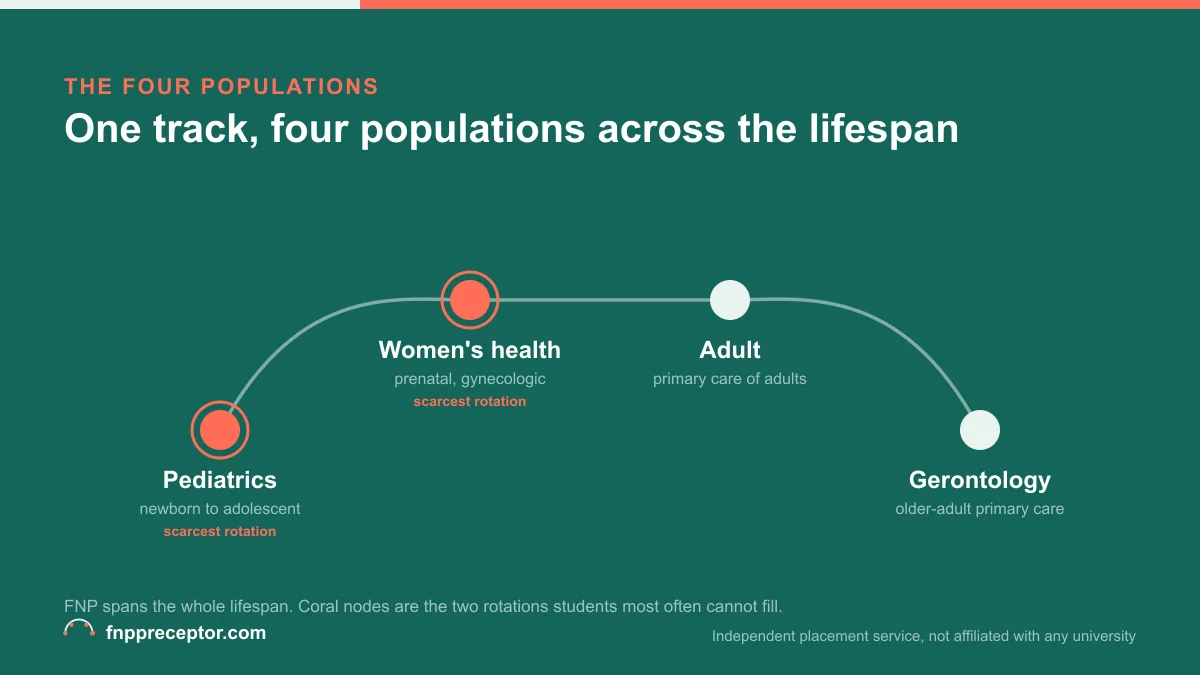
- Prioritize the scarce rotations first. Start pediatrics and women's health early, because they are the ones most likely to fall through late.
- Consolidate where you can. One primary-care preceptor can often cover adult and gerontology together, freeing effort for the hard rotations.
- Prepare each approval package, CV and affiliation agreement, so the university's review moves quickly, and line up backups where your program allows.
Competition is real: students from many programs court the same limited pool of pediatric and women's-health preceptors, so the prepared, early applicant tends to win the slot. That is the whole argument for starting sooner than feels necessary, on the hard rotations first.
How we run the whole-lifespan search for you
Our service organizes an independent search across the FNP lifespan. You tell us your school, city, course, and remaining approved objectives, and we look for possible clinicians and settings whose scope may fit those confirmed requirements.
- Objective-matched sourcing. We search for clinicians whose current scope fits the course objectives the student confirms.
- Local context. We consider the student's geography and the settings allowed by the program.
- One coordinated plan. We track each remaining objective without assuming every program uses the same categories.
- Approval preparation. We organize available candidate information for the program's review.
We aim for approvable preceptors and sites, but your university makes the final approval, and we never claim or imply a university affiliation. We do not guarantee hours, certification, or program outcomes, and nothing here is a tuition refund. You are matched first and pay when the placement is secured. See how it works and what it costs, or start on the contact page.
Good to know
Does my FNP program find my preceptors for me?
It depends on the program and course. Confirm whether your program identifies placements, expects student participation in the search, or uses another process. If you are allowed or expected to identify candidates, we can independently search for possible preceptors and sites, subject to program approval.
How many preceptors does an FNP student need?
There is no universal number. It depends on the program's course design, approved objectives, setting rules, hour distribution, and the scope of each clinician. Confirm the current plan with your program before treating any number as a requirement.
Who qualifies as an FNP preceptor?
The general rule is a board-certified nurse practitioner of appropriate focus for the population, or a licensed physician (MD or DO), with a certified nurse midwife often accepted for women's-health hours. The preceptor's scope must fit the population and the setting, and every preceptor and site must be approved by your program. Confirm the rules against your Nursing Student Handbook.
Which rotations should I start looking for first?
Pediatrics and women's health, the two scarcest FNP populations. They are the ones most likely to fall through late and the ones worth starting earliest. Adult and gerontology are generally more available and can often be consolidated under one primary-care preceptor, so lead with the hard rotations.
Do you guarantee you will find a preceptor?
We do not guarantee a specific clinician, hours, or program outcomes, and nothing we do is a tuition refund. What we offer is a systematic, early, population-matched search and approval-prep across the whole FNP lifespan that materially reduces placement risk. You are matched first and pay when the placement is secured.
Are you affiliated with a university?
No. We are an independent placement service that works separately from any university or certification body. Final approval of any preceptor or site always rests with your school.
Plan the FNP practicum across the lifespan
Tell us your school, city, course, and remaining objectives. We will organize an independent search for possible preceptors and primary care sites, subject to program approval.