Clinical Rotations for Family Nurse Practitioner Students in Alabama
Alabama is a reduced practice authority state, so the nurse practitioner who precepts you almost certainly works under a written collaborative agreement with a physician. That affects your paperwork, not what makes a preceptor good. Geography decides whether you finish on schedule: metro practices field requests from several programs at once, while the counties with the deepest shortages have clinicians nobody has asked.
Where FNP students actually get placed in Alabama
The volume sits in five markets: Birmingham, Huntsville and the Tennessee Valley, Montgomery and the River Region, Mobile and Baldwin County on the Gulf Coast, and Tuscaloosa in the west. Below those, Dothan and the Wiregrass, the Shoals, Gadsden, Anniston, and the Auburn and Opelika corridor carry real volume without metro student traffic.
About 22 percent of Alabamians live in nonmetro counties, and that is where the supply math flips. A rural clinic may have a nurse practitioner with fifteen years behind her who has never once been asked by a student. The cost is windshield time, sharpest in the Black Belt, where counties like Wilcox, Lowndes, Perry, and Pickens carry some of the worst provider ratios in the country and several have no hospital. Plan lodging rather than a daily commute.
The settings that tend to say yes
Community health centers are the most productive category here. The state primary care association reports a network reaching roughly 80 percent of Alabama counties, and they carry a teaching culture because their own staffing depends on the pipeline. They also see the full lifespan in one building. Rural health clinics come next: Alabama has 177 of them plus 129 federally qualified health center sites outside its larger urban areas, built around nurse practitioner staffing by design.
- Independent family practice in mid-size towns, often the fastest yes because one owner decides
- Health system primary care and convenient care, routed through a placement office
- Urgent care and retail clinics for episodic volume across ages
- County health departments: immunizations, screening, family planning
- Student health services on larger campuses, strong for young adults
- Correctional and occupational health, overlooked and heavy on adult chronic disease
- Tribal health: the Poarch Band of Creek Indians, Alabama's only federally recognized tribe, runs a health department in Atmore
Pediatrics and women's health are the two to start on first
The FNP track is across the lifespan: pediatrics, adult, gerontology, and women's health. Two come easily here, since adult and gerontology hours accumulate in almost any family practice panel, with long term care if you fall short. See adult and gero rotations.
Pediatrics is harder here for a structural reason. Dedicated pediatric practices concentrate in Birmingham, Huntsville, Montgomery, and Mobile, and every program calls them first. In rural counties children are seen inside general family practice, so peds hours arrive mixed into a normal clinic day rather than a clean block. Ask what share of the panel is under eighteen, and whether the preceptor will sign the population as pediatric. See our pediatric rotation page.
Women's health is the other pinch point, and Alabama offers a route most students miss. Obstetric services have thinned outside the metros, so prenatal care concentrates in regional hospitals and fewer practices. Meanwhile the state health department lists 81 clinics statewide offering family planning services: contraception, screening, and well woman visits, which is what a women's health log needs. Certified nurse midwives can also precept these hours. See women's health rotations.
What reduced practice authority changes
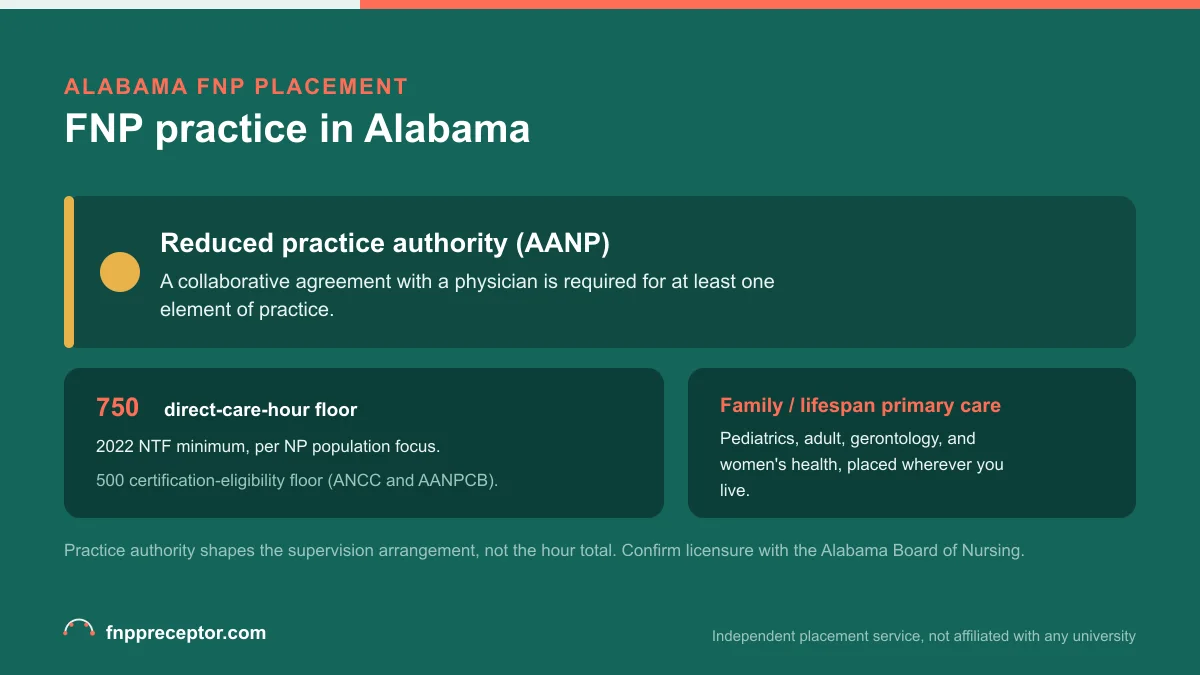
AANP places Alabama in the reduced practice category. The state title is CRNP, or Certified Registered Nurse Practitioner, and a CRNP must hold a collaborative practice agreement with an Alabama licensed physician. It rests on a written standard protocol specific to the specialty, signed by both, naming every site where the CRNP practices. The physician side registers with the Alabama Board of Medical Examiners.
Three consequences for a student. The site where you log hours should already appear in that protocol, so a preceptor cannot take you to a side clinic on Fridays. The collaborating physician is often part of the yes, so add a week to your timeline. And collaboration is capped at a cumulative 360 hours per week per physician, so a busy practice may already sit at its ceiling.
None of this changes what qualifies your preceptor: current Alabama licensure, current national certification, and active practice in the population you are logging. A CRNP with under two years of experience has the physician on site for at least ten percent of scheduled hours, which can work in your favor. See preceptor requirements.
Hours: confirm your own program's number
There is no Alabama specific hour requirement; the number comes from your program, and the range is wider than students expect. The 2022 National Task Force standards published through AACN recommend a minimum of 750 direct patient care hours per population track. Certification through AANP or ANCC requires at least 500 faculty supervised hours. Accredited FNP programs commonly publish totals of roughly 540 to 800, and many sit below 750, so confirm yours rather than borrowing a classmate's. See FNP clinical hours.
Most students here finish across two to four sites, since one family practice rarely delivers all four populations at volume. Build backward from your final term, then add lead time for onboarding and the physician signature.
Getting a yes in Alabama, and where we fit
Successful requests share a shape: they arrive a full term ahead, name specific dates, a weekly hour count, and the exact population being logged, and they come with school paperwork in hand. They also reach the right person, usually the practice manager in a rural clinic and a placement office in a health system.
If that search has eaten more of your term than you can afford, that is our work. We are independent, we serve FNP students at any university, and we contact Alabama practices directly, confirming licensure and population fit first. We assist with placement; we do not guarantee it, or that your school will approve a given preceptor or site. Send your city, open populations, and term dates through the form at #match or via contact. Pricing is at cost.
Good to know
Does my Alabama preceptor have to be a nurse practitioner?
Often not. Many programs accept a CRNP, a physician holding an MD or DO, and a certified nurse midwife for women's health hours. What stays constant is current Alabama licensure and active practice in the population you log. Your clinical handbook is the final word.
Does the collaborative practice rule stop a nurse practitioner from precepting me?
No. Collaborative practice governs how a CRNP delivers patient care, not whether they teach. The Board of Nursing even maintains a Faculty Only designation for CRNPs whose sole nurse practitioner activity is teaching. Inside a working clinic, expect the collaborating physician to weigh in on hosting you.
I live in Birmingham. Should I look outside the metro?
For at least one rotation, usually yes. Metro practices absorb requests from many programs at once, so replies are slow. Clinics an hour or two out are far likelier to have never been asked. The tradeoff is fuel and driving time, so cost it out first.
Which rotation should I lock in first?
Pediatrics or women's health. Those are the scarcest FNP populations almost everywhere, and Alabama sharpens both: peds concentrates in the metros, and obstetric access outside them has narrowed. Adult and gerontology hours can be added late.
How far ahead should I start looking?
Plan on one full term, and more for a metro site or a pediatric block. Alabama adds a step full practice states do not, since the collaborating physician frequently signs off alongside the nurse practitioner. Sites also run onboarding and screening on their own schedule.
Plan the FNP practicum across the lifespan
Tell us your school, city, course, and remaining objectives. We will organize an independent search for possible preceptors and primary care sites, subject to program approval.