Lining up FNP clinical hours in Alaska
Alaska gives nurse practitioners full practice authority, so an experienced NP here can take an FNP student on their own license with no collaborating physician written into the arrangement. What makes placement hard in this state is not the law, it is distance. Most clinical volume sits along the road system, while many communities that need family providers most are reachable only by plane or ferry, and that shapes every rotation plan here.
Where FNP students in Alaska actually log hours
Family practice is the backbone of any FNP rotation, and in Alaska it covers more ground than it does in the Lower 48. One provider in a smaller community may see a newborn, a pregnant patient, an adult with poorly controlled diabetes, and an elder with heart failure before lunch. That breadth is why a small Alaska clinic can be strong training.
- Family and internal medicine practices in Anchorage, the Mat-Su, Fairbanks, Juneau, and on the Kenai Peninsula
- Community health centers: Alaska has roughly 29 federally qualified health centers and look alike organizations, serving about one in six Alaskans
- Clinics in the Alaska Tribal Health System, from the Anchorage medical center to regional hub and village field clinics
- Urgent care and convenient care sites in the larger towns
- Correctional, occupational, and student health services
- Federal and military facilities near Anchorage and Fairbanks, which run their own affiliation process
None of these settings onboard students the same way. Tribal health organizations, federal sites, and hospital owned clinics generally want a signed agreement with your school before anyone discusses start dates, while an independent practice may decide in one conversation. Ask what a site needs on paper first.
The road system, the hubs, and everything past them
Most of the state's population sits along the road system: Anchorage, the Mat-Su boroughs around Wasilla and Palmer, Fairbanks in the Interior, and the Kenai Peninsula towns of Soldotna, Kenai, and Homer. Southeast is different, since Juneau, Sitka, and Ketchikan have clinics but no road link out. Living in these places means options within driving distance and the stiffest competition, because medical, PA, and nursing students all ask the same practices.
Past the road system, care runs through regional hubs. Bethel, Nome, Kotzebue, Utqiagvik, and Dillingham each serve a wide region of villages whose clinics are staffed by community health aides with hub providers behind them. Those rotations can be the best weeks of a program, but they involve flights, housing, and a willing site. The tradeoff runs opposite to expectations: rural sites are often willing but costly to reach, while the Anchorage bowl is close and crowded. With flexible dates, a hub block can be easier to land than a fall term in midtown Anchorage.
The four populations, and which ones run thin here
FNP is the across the lifespan track, so your hours have to span pediatrics, adult, gerontology, and women's health. Pediatrics and women's health are the two hardest to fill in nearly every state, and Alaska has its own version of that: dedicated pediatric practices and OB GYN groups cluster in Anchorage, Fairbanks, and a few larger towns, while smaller communities fold both into family practice.
That cuts both ways. If your program lets a family practice preceptor count toward pediatric hours when the panel truly includes infants and children, a rural or tribal clinic can be excellent for that exposure, because there is nowhere else for those families to go. If your program insists on a dedicated peds site, plan on Anchorage, the Mat-Su, or Fairbanks, and start early. The same holds for women's health: prenatal care, contraception, and well woman visits sit inside a family clinic in one town and a midwifery or OB practice in the next. Certified nurse midwives can precept those hours in many arrangements.
Adult and gerontology hours are the easiest to arrange statewide, since chronic disease fills most primary care schedules. Skim our pediatric and adult and gero guides before locking a term plan.
Full practice authority, and what it changes for you
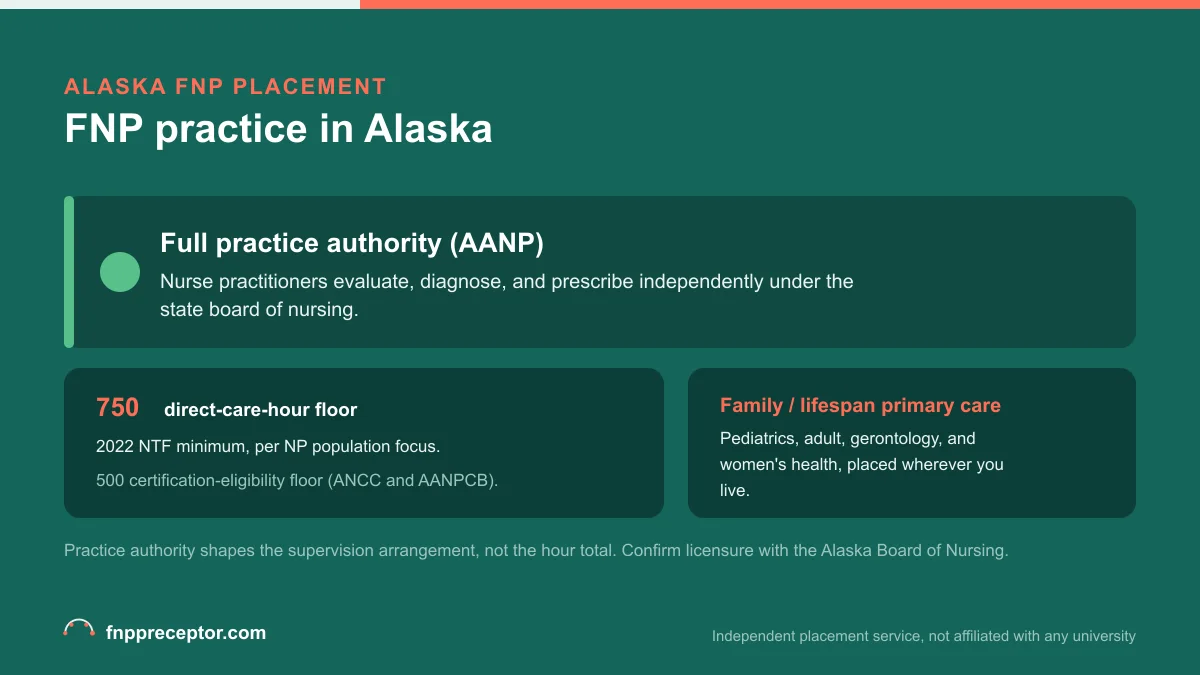
The AANP State Practice Environment lists Alaska as full practice. Under state nursing regulations an APRN is a licensed independent practitioner, and prescriptive authority comes from the Board of Nursing through its own application, not through a contract with a physician. No career long collaborative or supervisory agreement is required for an NP to see patients here.
For your rotation that changes the supervision arrangement, not your preceptor's core qualifications. An experienced Alaska NP can sign on without pulling a physician into the paperwork, a step that slows placements in reduced and restricted states. Your preceptor still needs a current Alaska license in good standing, active practice in the population you are logging, and willingness to complete your school's evaluations. Physicians, and certified nurse midwives for women's health, may also qualify depending on your program. Our preceptor requirements page has the checklist.
Hours, paperwork, and lead time
Hour totals are not uniform. The 2022 NTF Standards recommend a minimum of 750 direct patient care hours per NP track, while AANP and ANCC certification eligibility requires at least 500 faculty supervised hours. Accredited FNP programs publish totals from roughly 540 to 800, and plenty sit below 750. Pull your own handbook rather than a message board, and confirm the total, the per population minimums, and whether telehealth counts. Our FNP clinical hours page explains the difference.
Alaska adds two scheduling pressures. Affiliation agreements with tribal health organizations, federal facilities, and hospital systems can take weeks to route, and onboarding may include background checks, immunization records, fit testing, and badging before day one. Cancelled flights are a real risk for winter blocks in the west and north. Build slack into the timeline and keep signed copies of every form.
Getting help with the search
We are an independent placement service for FNP students at any university, and Alaska is a state where one warm introduction beats a hundred cold emails. Tell us your term dates, the populations you still need, whether you can fly, and what your school requires on paper. We work our provider network, confirm licensure and population fit, and hand you a preceptor who has already agreed to the paperwork. We assist with the search; we do not guarantee placement or your school's approval of any site. Start with the match form, read how it works, or see what it costs.
Good to know
Does my Alaska preceptor need a supervising physician?
No. Alaska is a full practice authority state and an APRN here is licensed as an independent practitioner, so an experienced NP can precept you with no physician attached to the agreement. Your school may still set rules about who signs evaluations, so read the handbook first.
Can I finish all four populations in one Alaska clinic?
Sometimes. A hub clinic where one provider sees infants through elders covers a lot of ground, and some programs accept that when the documented visits show the mix. Others require separate pediatric or women's health sites. Ask faculty first, and log by patient age and visit type from day one.
How many clinical hours will I need?
That depends on your program, not on the state. AANP and ANCC certification requires at least 500 faculty supervised hours, the 2022 NTF Standards recommend at least 750 per track, and accredited FNP programs commonly publish totals between roughly 540 and 800. Confirm your total and population breakdown with your program office.
Is Anchorage or rural Alaska easier for placement?
Anchorage and the Mat-Su hold the most sites and the most students chasing them. Hub communities often have providers open to teaching but fewer of them, plus travel and housing to solve. Students who can travel tend to have more options; those tied to the road system should start earlier.
Plan the FNP practicum across the lifespan
Tell us your school, city, course, and remaining objectives. We will organize an independent search for possible preceptors and primary care sites, subject to program approval.