Finding an FNP Preceptor in Arizona
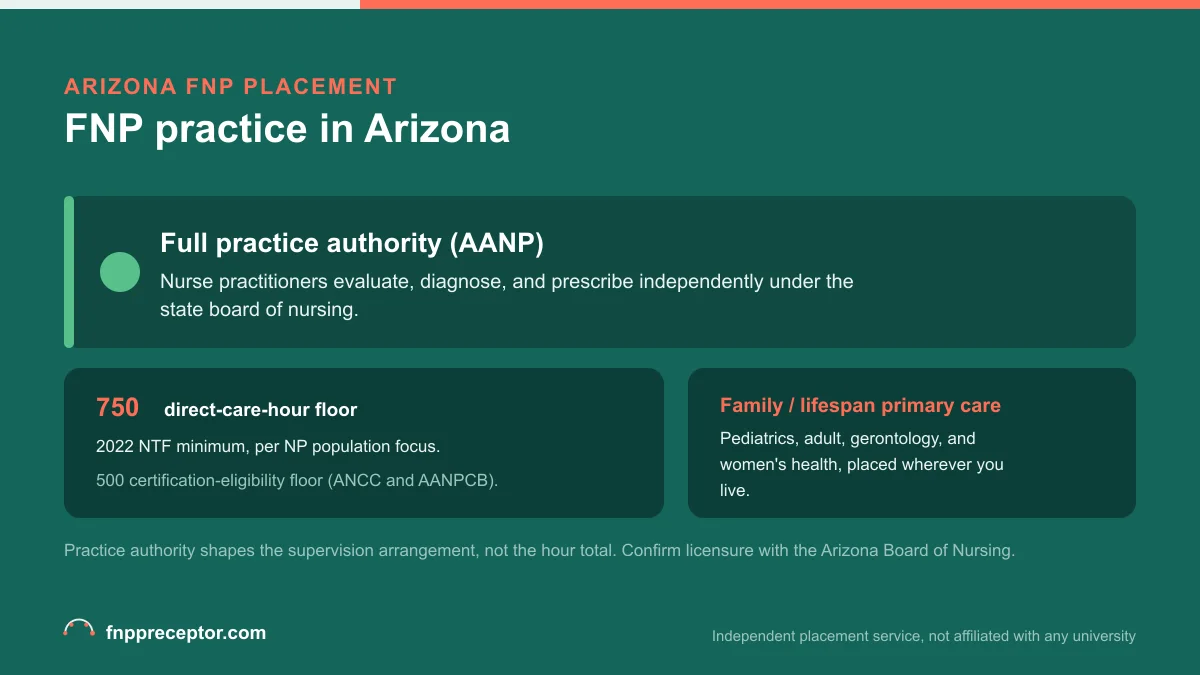
The American Association of Nurse Practitioners lists Arizona as a full practice state, so an experienced NP here can precept you without a physician written into the arrangement. That clears one obstacle but not the harder one: your program logs hours across pediatrics, adult, gerontology, and women's health, and Arizona does not hand those four out evenly.
Where FNP students actually land here
Nearly every completed Arizona rotation comes from a short list of setting types. Knowing what each can and cannot give you beats messaging every clinic in the county.
- Independent family practice offices, including NP owned practices, which full practice authority makes possible here.
- Federally qualified health centers and community health centers, seeing children, adults, elders, and prenatal patients in one building.
- Rural health clinics and critical access hospital outpatient departments in the smaller counties.
- Urgent care, good for volume and acute presentations, thin on continuity.
- IHS, tribally operated, and urban Indian health programs, full spectrum family medicine by design.
- Student health services, useful but almost entirely young adult.
- Correctional health, adult heavy, with essentially no pediatrics or women's health.
Community health centers deserve extra attention here. Because they serve whoever walks in, one well chosen site can cover three of your four populations without three separate site agreements.
Two metros, and then a very large remainder
Maricopa County holds Phoenix, Mesa, Chandler, Gilbert, Glendale, Scottsdale, Tempe, Peoria, and Surprise. Pima County holds Tucson, Oro Valley, Marana, and Sahuarita. Between them sits most of the state's clinic capacity and, inconveniently, most of the nursing, physician assistant, and medical students chasing the same preceptors. Good metro sites are often booked a term or two out.
Everything else is a different problem. Yuma, Flagstaff, Prescott, Sierra Vista, Casa Grande, Kingman, Lake Havasu City, Show Low, Safford, Nogales, and Page all have real primary care, and clinicians there say yes more often because fewer students ask. The Arizona Alliance for Community Health Centers counts dozens of health center sites and rural health clinics outside the urbanized areas.
The tradeoff is distance: a rural block can mean a long drive each way or a rented room for the term, so students who make it work stack fewer, longer clinic days. Along the border corridor near Nogales, Douglas, and San Luis, Spanish language demand is heavy, and a student who can take a history in Spanish is a more useful pair of hands.
The population problem looks different in Arizona
In most states, adult and gerontology hours are the ones students work at. Arizona inverts that. Retirement heavy communities in the West Valley, Green Valley south of Tucson, Prescott, Lake Havasu City, and the Yuma winter visitor population mean many family practices carry panels that skew distinctly older. Adult and gero hours tend to arrive on their own.
Pediatrics is what costs you time. Dedicated peds practices cluster in the family heavy suburbs, the East Valley around Gilbert, Chandler, and Mesa, north Phoenix and Scottsdale, and the Tucson foothills, and those offices field requests from every student in the state. Better odds sit off the obvious path: health centers with pediatric panels, school based clinics, tribal facilities, and urgent care in young family suburbs rather than retiree towns. Book this block first. See pediatric rotations.
Women's health is scarce for a different reason. OB-GYN and midwifery concentrate in the larger hospital systems and in health centers running prenatal programs, and standalone offices thin out fast outside the metros. The compensation is that rural counties fold women's health into the family practice or the health center, so one rural clinic day can produce well woman and prenatal encounters inside an ordinary family rotation. More at women's health rotations.
None of the four are optional: the AANP Certification Board's FNP examination blueprint spans newborn through older adult, and your logging mirrors that whether or not scheduling cooperates.
Arizona has a season, and it moves clinic volume
Winter visitors change the arithmetic here in a way they do not elsewhere. From late fall into early spring, census swells in Yuma, Green Valley, the West Valley, and Lake Havasu City, then falls back over the summer. A preceptor who says no in February may have room in July, and a summer block in a winter visitor town may not deliver the volume your plan assumed.
Federal and tribal sites run on their own clock. The IHS Phoenix Area, the Navajo Area across the northeast, and the IHS Tucson Area serving the Tohono O'odham Nation and the Pascua Yaqui Tribe involve credentialing, background checks, and sometimes an affiliation agreement with your school. Excellent full spectrum settings, but plan in months rather than weeks.
What full practice authority changes, and what it does not
Arizona NPs are regulated by the Arizona State Board of Nursing, which certifies on the basis of an active RN license, a graduate degree in the NP role and population focus, and national certification in that role. Because no collaborating physician is attached to an Arizona NP's practice, an experienced NP can precept on their own authority, and you are not hunting for a physician to co-sign the arrangement the way students in reduced and restricted states must.
It does not lower your school's bar. Programs still want a current Arizona license in the population being logged, a CV, usually a stretch of independent practice, and a signed site agreement before the first hour counts. Physicians and, for women's health, certified nurse midwives can precept in many arrangements, but that call belongs to your program. Details at preceptor requirements.
Hours, and the number your own program set
The 2022 NTF Standards published through AACN recommend a minimum of 750 direct patient care hours per NP population focus. Certification eligibility sits lower: AANP and ANCC require at least 500 faculty supervised hours. Accredited FNP programs commonly publish totals of roughly 540 to 800, and a real number land below 750. Pull your own handbook rather than borrowing a classmate's number.
Whatever the total, it spreads across four populations, and Arizona will cheerfully hand you several hundred adult and gero hours before you secure one pediatric week. Sequence the scarce blocks first. See FNP clinical hours and adult and gero rotations.
If you want help with the Arizona search
We place FNP students at any university and work independently of any school. We do not guarantee placement, and we cannot promise your program will approve a given preceptor or site, because that approval is always your school's decision.
Tell us the counties you can reach, the populations you still owe, and your start window, using the form at #match or contact. Pricing is at cost, the process at how it works.
Good to know
Does my Arizona preceptor need a supervising physician?
No. AANP lists Arizona as a full practice state, so an NP practices without a required collaborating or supervising physician and can precept on their own authority. Your school may still add conditions, such as a minimum period of independent practice.
Can a physician or nurse midwife precept my FNP hours here?
Often, yes. Physicians commonly precept FNP students, and certified nurse midwives are frequently used for the women's health block, which helps given how concentrated OB services are here. Your program decides that, not the state.
How many clinical hours will I need?
The 2022 NTF Standards recommend a minimum of 750 direct patient care hours per population focus, and AANP and ANCC certification requires at least 500 faculty supervised hours. Accredited FNP programs publish totals commonly from about 540 to 800, and many sit below 750, so confirm your own requirement.
Is it easier to find a preceptor in Phoenix or in rural Arizona?
Rural counties bring more willingness and less competition but cost you travel and sometimes lodging. The metros have more clinics and more students asking. Many students mix the two: a metro site for adult hours, a rural or tribal site for peds or women's health.
How do I verify a preceptor is licensed in Arizona?
Check the credential with the Arizona State Board of Nursing at azbn.gov first. Confirm it is active, that the population focus matches the hours you plan to log, and that the setting sees those patients. A neighboring state's license cannot cover Arizona hours.
Plan the FNP practicum across the lifespan
Tell us your school, city, course, and remaining objectives. We will organize an independent search for possible preceptors and primary care sites, subject to program approval.