Finding an FNP preceptor in Arkansas, region by region
Arkansas sits in the reduced practice category, so many nurse practitioners here still work under a collaborative practice agreement with a physician. That affects who signs off on your rotation, not whether an experienced FNP can teach you. The harder problem is geography: preceptor supply, student competition, and drive time look nothing alike in Little Rock, in Northwest Arkansas, and out in the Delta.
Which Arkansas settings actually take FNP students
Family practice carries most of the load. Family medicine offices and hospital owned primary care groups in Little Rock, Conway, Fort Smith, Jonesboro, and Rogers give you adults, older patients, and some children in one panel, which is why a good family clinic beats two specialty placements.
- Community health centers, federally funded for underserved counties.
- Rural health clinics attached to small hospitals.
- Urgent and convenient care: acute volume, thin on continuity and prenatal visits.
- Campus student health in towns such as Fayetteville and Russellville.
- Correctional health in the state prison system, heavy on chronic disease.
- Home based and long term care, the fastest yes for gerontology hours.
The community health center network is the piece students overlook. Member centers reach Corning and Paragould in the northeast, West Memphis and Dermott across the Delta, Mena and Ratcliff in the west, Pine Bluff and Rison in the southeast, and Springdale in Benton and Washington counties. Whether one site can host you turns on its staffing that quarter and on whether medical or PA students already have the room, so treat the network as a map of where to ask.
Geography sets your competition and your commute
Central Arkansas has the deepest bench. Little Rock, North Little Rock, Benton, and Conway hold the most clinics per square mile, but local nursing and PA programs draw from the same offices and residencies have first claim in teaching sites, so apply early and wide. Northwest Arkansas is crowded for another reason: Fayetteville, Springdale, Rogers, and Bentonville added residents faster than clinic capacity, leaving preceptors busy and short on slack.
Outside those corridors the odds often improve. The Delta counties, Ozark towns like Mountain Home and Harrison, the River Valley through Russellville and Van Buren, and south Arkansas from El Dorado to Texarkana all have clinicians who rarely get asked. The price is travel, so get the terms in writing first: days per week, start and end dates, and who covers the weeks your preceptor is away.
The four populations, and where Arkansas gets tight
An FNP logs across the lifespan, so pediatrics, adults, gerontology, and women's health all have to appear in your hours. Adults and older adults are rarely the obstacle here: chronic disease volume is high, long term care and home based practices operate statewide, and most family clinics fill those columns. See adult and gerontology rotations.
Pediatrics is tighter than students expect. Dedicated pediatric care is concentrated in the children's hospital system based in Little Rock with a northwest campus in Springdale, and standalone peds practices cluster in the same metros. In rural counties, children are seen in family practice and community health centers instead, which works if you confirm the age mix of the panel first. More in pediatric rotations.
Women's health is the hardest ask here. Obstetric services have pulled toward larger hospitals and bigger cities, leaving many counties without a delivering provider nearby, so routine prenatal and gynecologic care lands in family practice, health department clinics, and community health centers. Expect your hours from a family clinic with a strong female panel rather than a dedicated OB-GYN office, and ask about certified nurse midwives where your program accepts them. Plan this one first, as we explain in women's health rotations.
Reduced practice, and what it does to your arrangement
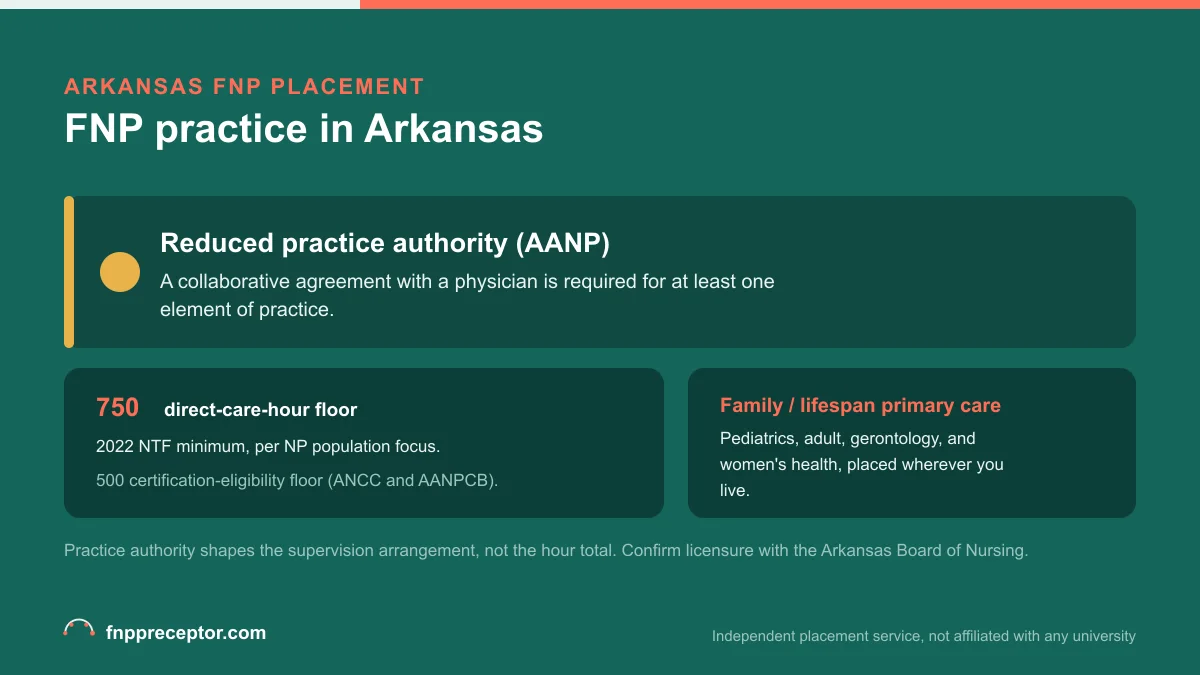
The AANP State Practice Environment places Arkansas in the reduced category, meaning state law limits at least one element of NP practice. The limit here is the collaborative practice agreement: an APRN with prescriptive authority keeps a current agreement on file with the Arkansas State Board of Nursing naming a collaborating physician. There is a path out. Under Act 412 of 2021 a certified nurse practitioner may apply for full independent practice after 6,240 hours worked under that agreement, and Act 872 of 2023 extended the route to clinical nurse specialists.
For you the effect is modest but real. An NP with full independent practice can usually agree to precept on their own authority, while one still under a collaborative agreement is often asking a physician and a practice manager too, so expect a slower yes. The substance does not change: a current Arkansas license, active practice in your population, and your school's rules on degree and certification. See our preceptor requirements page.
Take your hour count from your own handbook
Do not borrow a number from a forum thread. The 2022 National Task Force standards published through AACN recommend a minimum of 750 direct patient care hours per nurse practitioner population track, while certification through AANP or ANCC requires at least 500 faculty supervised hours. Accredited FNP programs publish totals that commonly land around 540 to 800, and plenty sit below 750. The only figure that governs your graduation is the one in your handbook.
Then do the arithmetic before you accept anything. A rural site offering one day a week will not clear a 200 hour block inside a 15 week term; a preceptor who gives you three days will. That math is in FNP clinical hours. Leave room for paperwork too: an affiliation agreement, preceptor CV and license verification, immunization and liability proof, often a background check and EHR access.
Where we come in
We are an independent placement service. We work with FNP students at any university, we work independently of any school, and we do not guarantee placement or a school's approval of any preceptor or site. What we do is the part that eats your semester: building a realistic target list by region and population, making the outreach, and chasing the paperwork.
If you are short a rotation here, tell us your hour total, the populations you still owe, your term dates, and how far you can travel. Use the form at #match or reach us through contact. Pricing sits on the cost page, and how it works covers the sequence.
Good to know
Does an Arkansas preceptor have to be a nurse practitioner?
Not necessarily. Depending on your school's rules, an FNP student here may be precepted by a nurse practitioner, by a physician (MD or DO), and for women's health by a certified nurse midwife. The constants are a current Arkansas license and practice in the population you are logging.
Can an NP who still has a collaborative practice agreement precept me?
Yes. That agreement governs the NP's prescriptive authority, not their ability to teach. It does mean the decision may involve the collaborating physician or practice leadership, so the answer can take longer than in a full practice state.
Do I have to be in Little Rock or Northwest Arkansas to get a rotation?
No, and those metros are sometimes harder, because nursing, PA, and residency programs compete for the same clinics. The Delta, the Ozarks, the River Valley, and the southern counties often have willing clinicians and fewer students asking. The tradeoff is drive time, so set your travel limit early.
How early should I start looking for an Arkansas placement?
Four to six months before the term for adult and gerontology hours, and earlier for pediatrics and women's health. Add time for health systems and correctional sites, where credentialing is slower. Late requests are worth sending, but your options narrow to whoever has an unexpected opening.
Plan the FNP practicum across the lifespan
Tell us your school, city, course, and remaining objectives. We will organize an independent search for possible preceptors and primary care sites, subject to program approval.