Getting your FNP clinical hours covered in California
California has plenty of primary care that fits a family nurse practitioner rotation, and a crowded field of nursing programs chasing the same clinics. The path that works usually runs through community health centers, rural clinics, and the inland counties rather than the coastal practices every student emails first. Here is where FNP students log hours, which populations get tight, and how state rules shape the supervision arrangement.
Where California FNP students land hours
Family practice is the spine of the plan, but rarely all of it. The community clinic system here is deep: federally qualified health centers cared for about 5.8 million patients in 2024, and roughly seven in ten were covered by Medi-Cal. Those clinics see infants, pregnant patients, working adults, and elders in the same corridor on the same afternoon, the mix an across-the-lifespan track needs.
- Community health centers and FQHCs. The California Primary Care Association represents more than 2,300 nonprofit health centers and clinics, many with pediatric and women's health services in house.
- Rural health clinics in the Sierra foothills, the north state, and the agricultural counties.
- Urgent care, good for volume, though some programs cap the hours it can supply.
- Student health on the large public campuses (young adult panels) and correctional health tied to the state prison system (adult heavy, heavy chronic disease).
- Indian Health Service and tribal health programs, concentrated in the northern counties.
- Hospital affiliated and academic primary care: strong teaching, longest onboarding.
Metros, valleys, and the far north behave differently
Los Angeles, Orange County, San Diego, the Bay Area, and Sacramento have volume: hundreds of primary care practices within a short drive. They also hold the heaviest concentration of nursing programs, so one well known clinic fields requests from several schools in a term and stops answering student email. The metro problem is competition, not supply.
Inland and northern California invert that. The shortage runs deepest in the north and the San Joaquin Valley, where six of the valley's eight counties, including Fresno, Kings, Madera, Merced, San Joaquin, and Tulare, carry federal shortage designations for primary care. Some cannot spare a preceptor; others welcome an extra set of hands and a possible future hire. Widen the map to Bakersfield, Visalia, Modesto, Stockton, Redding, Chico, Eureka, and Salinas, and remember Riverside and San Bernardino counties are commutable from Los Angeles yet far less picked over. Price the mileage in.
What California practice rules change, and what they do not
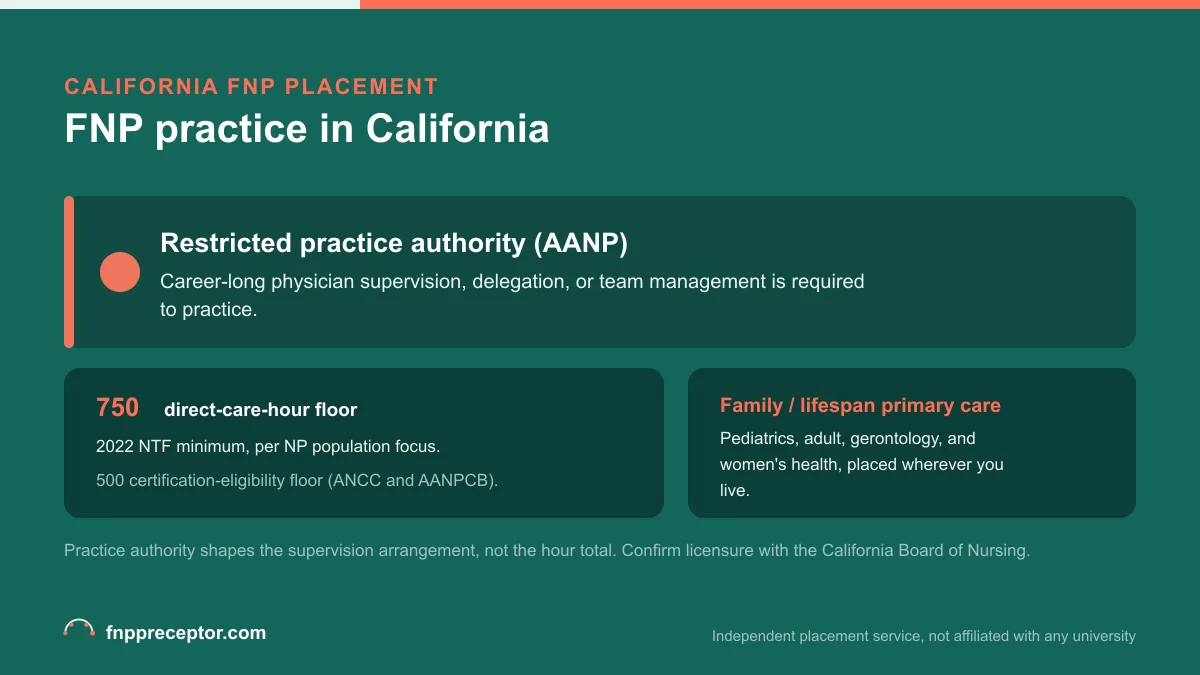
AANP places California in the restricted category, meaning state law requires supervision, delegation, or team management by another provider for at least one element of nurse practitioner practice. Most California NPs work under standardized procedures, the written protocols developed with physicians and the organization. Assembly Bill 890 added two certifications: a 103 NP may practice without standardized procedures in a group setting that includes at least one physician and surgeon, and a 104 NP, available after three full time equivalent years or 4,600 hours in good standing as a 103 NP, may do so outside that setting.
For a student, that shapes the arrangement around your rotation, not its substance. A collaborating or supervising physician is often in the picture even when your daily teacher is an experienced NP, and at some sites signs the paperwork. What your preceptor needs does not change: a current California license, active practice in the population you are logging, and your program's approval. Confirm the rules with the California Board of Registered Nursing and your school's preceptor requirements.
Pediatrics and women's health stall the most students
These two are the scarce halves of an FNP plan here as elsewhere. In the coastal metros, pediatrics sits mostly inside dedicated pediatric groups and children's hospital networks that give first call to pediatric nurse practitioner and medical students. Inland and up north, pediatrics more often lives inside family practice or a health center's pediatric service, the better target for an FNP student because the schedule is already mixed. See our pediatric rotation page.
Women's health concentrates in OB-GYN groups, family planning clinics, and certified nurse midwife services attached to hospitals and health centers. Many schools accept a CNM for those hours, which widens the field because midwifery is well established in California. Health centers running prenatal and well woman visits in house will often take an FNP student when a specialty practice will not. See women's health rotation.
Adult and gerontology hours fill most easily statewide, between internal medicine, health center adult panels, skilled nursing, and retirement heavy areas like the Coachella Valley. Fill them last; see adult gero.
Your hours total is your program's total
The 2022 National Task Force standards recommend a minimum of 750 direct patient care hours per nurse practitioner population focus, while ANCC certification requires at least 500 faculty supervised hours and AANP sets a comparable floor. Accredited FNP programs land across a wide band, commonly between roughly 540 and 800 hours, and plenty sit below 750.
So do not build a California plan around a figure from a study group. Open your own clinical handbook, find your required total and any per population minimums, and work backward. The hours must span pediatrics, adult, gerontology, and women's health, and that distribution trips students up more often than the raw count. See FNP clinical hours.
Timing, paperwork, and where we come in
Start two terms ahead for a coastal metro and one full term anywhere else. What eats a California calendar is not the preceptor saying yes; it is everything after: background checks, immunization records, EHR access, and the affiliation agreement between the site and your school. Larger systems take weeks on that agreement, so ask your clinical coordinator whether one already exists with a site.
We are an independent placement service, separate from any university, and we work with FNP students from any program. Tell us the counties you can reach, your term dates, and the populations you still need, and we will work the list across family practice, health centers, and rural clinics. Process and pricing are on how it works and cost; start at #match or contact. We assist with placement; we cannot guarantee one, or a school's approval of any preceptor or site.
Good to know
Does my preceptor in California have to be a nurse practitioner?
Usually not. Schools commonly accept nurse practitioners, physicians (MD or DO), and, for women's health hours, certified nurse midwives. The preceptor must hold a current California license and practice in the population you are logging. Your program's approved list is the final word.
California is a restricted practice state. Can an NP still precept me?
Yes. Experienced nurse practitioners precept students across California every term. Restricted describes the practice arrangement, meaning most NPs work under standardized procedures with physician involvement, or under the newer 103 and 104 certifications. It affects paperwork, not teaching.
How far ahead should I start looking for a California preceptor?
Two terms out in Los Angeles, Orange County, San Diego, the Bay Area, or Sacramento, and one full term at minimum elsewhere. Chase pediatrics and women's health first; leaving those two for last is what pushes a rotation to the next term.
Can I complete every hour at one California clinic?
Sometimes. A family practice or health center that genuinely sees children, pregnant and postpartum patients, adults, and elders can carry most of a plan if your program allows it. More often students use one main site plus a short pediatric or women's health block.
I am enrolled online and live outside California. Does that matter?
What matters is where you complete the hours and where the preceptor is licensed. If you are logging hours at a California site, the preceptor needs a current California license and the site must be acceptable to your program. We work with students at any university.
Plan the FNP practicum across the lifespan
Tell us your school, city, course, and remaining objectives. We will organize an independent search for possible preceptors and primary care sites, subject to program approval.