Building your FNP clinical rotations in Colorado
Colorado is a full practice authority state, so an experienced nurse practitioner here can precept an FNP student on their own license with no physician attached to the arrangement. That widens who can teach you. It does not solve Colorado's real constraint, which is distance: preceptors and competing students are both packed into the Front Range, while much of the open capacity sits two or three hours west or east.
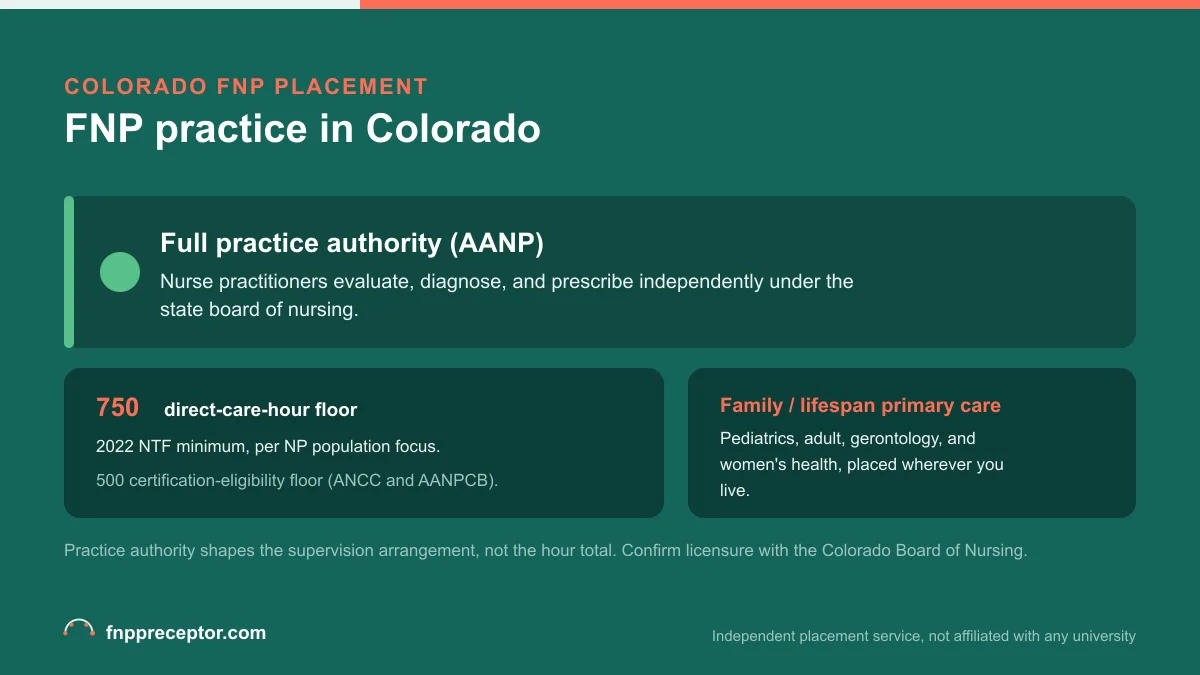
What full practice authority changes, and what it does not
Colorado nurse practitioners are licensed under the exclusive authority of the state board of nursing. They diagnose, order and interpret tests, and prescribe without a collaborative agreement. For you that means a solo NP, an NP owned family practice or an NP staffing a rural clinic are all legitimate preceptors, and no physician has to countersign your evaluations.
One Colorado detail confuses students, so name it up front. Newly licensed APRNs here hold provisional prescriptive authority until they finish a 750 hour prescribing mentorship. That rule governs your preceptor's licensure, not your student hours, and the matching number is a coincidence. Your school can also be stricter than the state is, so read your clinical handbook before promising a site anything. Licensure questions belong to the Colorado State Board of Nursing at the Department of Regulatory Agencies.
The Front Range has the volume and the queue
The corridor running from Fort Collins and Greeley down through Longmont, Boulder, Denver, Aurora, Colorado Springs and Pueblo holds most of the state's population and most of its family practices, urgent care, retail clinics and academic affiliated primary care. It also holds nearly every other NP student chasing the same rotation.
Strong Front Range preceptors are commonly booked one to two semesters out. Two habits help. Ask outward instead of inward, because Brighton, Commerce City, Windsor, Monument, Fountain and Pueblo West have primary care demand and a fraction of the requests. And stay flexible on days: two sites at two days each finish your hours sooner than one perfect site that never opens.
Where the room actually is
West of the corridor and out on the plains the ratio flips. Grand Junction, Montrose, Craig, Durango, Cortez, Rifle, Glenwood Springs, Steamboat Springs, Gunnison, Alamosa, Monte Vista, La Junta, Lamar, Sterling, Fort Morgan and Burlington all have primary care that sees a full cross section of ages with almost nobody competing for it. The price is travel, not competition.
Book those as blocks, not scattered days. Mountain passes and I-70 close in winter, and a round trip from Denver to the San Luis Valley or the far eastern plains eats most of a day. Plenty of students rent a room for a six to eight week block and come out ahead of the mileage.
Rural Colorado also carries an incentive worth mentioning. The state offers an income tax credit to primary care preceptors, advanced practice nurses included, who host qualifying students in designated rural and frontier counties, available to a limited number of preceptors each tax year. It will not create capacity, but it answers the clinic that asks what it gets. Southwestern Colorado adds tribal health through the Southern Ute Indian Tribe near Ignacio and the Ute Mountain Ute Tribe near Towaoc, arranged through the tribes' own health programs.
Settings that host FNP students here
Colorado's safety net suits this track well. Community health centers coordinated through the Colorado Community Health Network run more than 250 clinic sites and serve more than 850,000 Coloradans. One community health panel can hand you infants, working adults, elders and gynecologic visits in the same week.
- Family and internal medicine practices, independent and system affiliated
- Community health centers and Rural Health Clinics
- Urgent and convenient care, heavy acute volume, light on continuity
- Student health in college towns such as Boulder, Fort Collins, Greeley, Durango and Gunnison
- School based health centers, which a number of Colorado districts operate
- Migrant and seasonal farmworker health in the San Luis and Arkansas valleys
- Correctional health near Sterling, Limon and Buena Vista, where your program allows it
Pediatrics and women's health are the two to book first
Your hours have to span pediatrics, adults, gerontology and women's health. Adult and gero take care of themselves in Colorado. Any family practice, urgent care or community clinic supplies adults in volume, and the older skew around Grand Junction, Montrose, Pueblo and Loveland, plus skilled nursing and assisted living, covers gerontology. See adult and gero rotations.
Pediatrics is thinner. Dedicated pediatric practices cluster in the Denver metro, Colorado Springs and Fort Collins. Elsewhere children are seen inside family practice, which counts but arrives a few at a time. If your program wants concentrated peds, ask a semester ahead and look hard at community health centers and school based clinics, where the pediatric share of the panel runs higher. Our pediatric rotation page covers what to request.
Women's health is the other pinch point. Obstetric and gynecologic care concentrates in hospital affiliated practices along the Front Range and in a handful of regional hospitals on the Western Slope and in the south, and several rural counties have no local obstetric service. Colorado does have a strong nurse midwifery presence and an established family planning clinic network, and many programs accept a certified nurse midwife for these hours. Confirm that with your coordinator first. Women's health rotations lists the usual routes.
Hours, paperwork, and where we come in
Colorado does not set your hour total; your program and its accreditor do. The 2022 NTF Standards recommend a minimum of 750 direct patient care hours per population focus, while AANP and ANCC certification eligibility requires at least 500 faculty supervised hours. Accredited FNP programs commonly publish totals between roughly 540 and 800, and many sit below 750, so confirm your own figure. FNP clinical hours and preceptor requirements cover what schools verify.
Lead time sinks more Colorado placements than anything else. Larger systems route students through a central education office with its own deadlines, and an affiliation agreement can take weeks after your preceptor says yes. Start that paperwork the day you get a verbal commitment.
We are an independent service working with FNP students at any university. Send us your term, your remaining hours by population, and how far you can drive, using the form at match or through contact. We help you find and confirm a preceptor. We do not guarantee placement, and approval of any site is your school's decision.
Good to know
Colorado is full practice. Can my preceptor be a nurse practitioner alone?
As far as the state is concerned, yes. An experienced Colorado NP can precept you with no physician in the arrangement. Your school is the other half of the answer, since some programs still want a physician of record on file or limit which populations an NP may sign for.
How far will I really have to drive for a Colorado rotation?
It depends on how flexible you are. Inside the Denver metro or Colorado Springs a site may be twenty minutes away, but the wait can run a semester. Take a block rotation in Grand Junction, Alamosa, Sterling or the Western Slope and capacity opens fast. Students who make those work schedule long consecutive days and leave a buffer for winter road closures.
Can a certified nurse midwife precept my women's health hours?
Often, yes. Colorado has an established nurse midwifery presence, and many FNP programs accept a CNM for the women's health portion when the midwife is licensed here and practicing in that population. This is a school rule rather than a state rule, so get it in writing from your coordinator first.
Is there anything in it for a Colorado clinic that takes a student?
In rural and frontier counties there is. Colorado offers a state income tax credit to primary care preceptors, advanced practice nurses included, who host qualifying students in designated rural and frontier areas, capped at a limited number of preceptors each year. It does not reach most of the Front Range, but it is worth raising with a rural practice.
Plan the FNP practicum across the lifespan
Tell us your school, city, course, and remaining objectives. We will organize an independent search for possible preceptors and primary care sites, subject to program approval.