FNP Clinical Placement in Connecticut, Region by Region
Connecticut gives nurse practitioners full practice authority, so an experienced NP here can precept you with no physician written into the arrangement. The more useful fact is geography: this is the third smallest state in the country, and a student based in Hartford can reach Waterbury, Middletown, Norwich, or Torrington inside an hour. Your problem is not distance. It is finding pediatric and women's health capacity where many programs chase the same preceptors.
Plan the search by drive time, not by town
Connecticut runs roughly 110 miles across and about 70 north to south. Three roads carry the clinical map: I-95 along the shoreline through Bridgeport and New Haven, I-91 up the middle to Hartford, and I-84 on the diagonal from Danbury through Waterbury. From most addresses, a 45 to 60 minute radius covers two or three separate healthcare markets.
That changes the usual math. Elsewhere you pick between rural areas with preceptors but punishing drives, and metros with volume and heavy competition. Here you can work both in one semester, with no relocation. Build the list by drive time, then sort by which populations each site can cover.
The settings that actually take FNP students here
Independent and small group family practice is still the backbone, and Connecticut keeps a meaningful number of two to six provider offices, especially outside Fairfield County. They offer real continuity across adult and older adult panels, and they usually decide about a student in one conversation.
Community health centers are the other spine. The state primary care association's map covers Hartford through Charter Oak Health Center, New Haven through Fair Haven Community Health Center and Hill Health Center, Bridgeport through Optimus Health Care, Waterbury through StayWell Health Center, and the eastern towns through Generations Family Health Center and United Community and Family Services, with more centers in Norwalk, Middletown, and Torrington. These see a wide payer mix and often run pediatrics, women's health, and adult care in one building, the closest thing to a single site covering most of an FNP log. Each sets its own student policy, so ask its education contact directly.
Students here also place into urgent care, college student health, correctional health, occupational health, home based primary care, and skilled nursing for the gerontology side. Large hospital owned networks route students through a central education office and an affiliation agreement rather than the individual practice, so ask your school whether an agreement already exists before cold calling an office inside one.
Which of the four populations will cost you time
FNP is the across the lifespan track, so your hours must span pediatrics, adult, gerontology, and women's health. Adult and gerontology are the straightforward part in Connecticut. The population skews older, and almost any family practice, health center, or long term care setting will fill those logs.
Pediatrics is what catches students out. Pediatric primary care here sits largely in dedicated pediatric groups and children's hospital affiliated practices rather than inside family practices, so you cannot pick it up incidentally. It needs its own site and its own ask. Start there first, and see /pediatric-rotation/.
Women's health is the second tight spot, concentrated in hospital affiliated OB-GYN groups, nurse midwifery practices, family planning clinics, and the women's health lines inside community health centers. Where your school allows it, a CNM can precept that portion, which widens the pool. See /womens-health-rotation/. Lock both first; adult and gerontology is the block you can backfill.
Full practice authority, and the wrinkle behind it
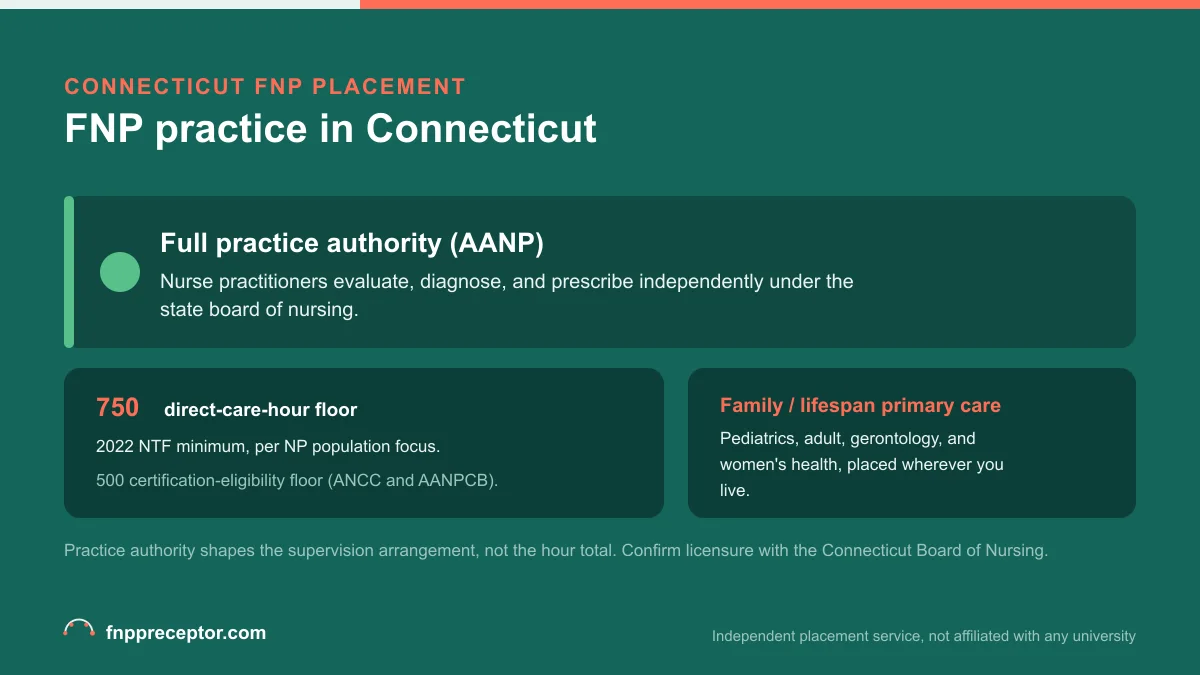
The AANP State Practice Environment lists Connecticut as a full practice state. NPs evaluate patients, diagnose, order and interpret tests, and initiate and manage treatment including prescribing, under the state board of nursing's authority.
One detail underneath that heading matters for your search. Connecticut does not hand independent practice to a new APRN. Under Section 20-87a of the Connecticut General Statutes, an APRN must have held the license at least three years and practiced in collaboration with a physician for at least three years and not less than 2,000 hours before practicing without that collaboration.
For you it translates cleanly. A seasoned NP preceptor supervises you on their own license. A newer NP is still collaborating, so a physician's name may appear on the practice side of your affiliation paperwork. That shapes the arrangement, not the preceptor's clinical qualifications. Clarify it early so your school's forms match the office. Licensure sits with the Board of Examiners for Nursing.
Hours: get your own program's number in writing
The 2022 National Task Force standards published through AACN recommend a minimum of 750 direct patient care hours per NP population track, and AANP or ANCC certification requires at least 500 faculty supervised hours. Accredited FNP programs publish totals of roughly 540 to 800, and many sit below 750. There is no single national number, so get your own program's total, any per population minimums, and its cap on hours from one site in writing. See /fnp-clinical-hours/.
On eligibility, your preceptor must be licensed in Connecticut, since that is where you are logging hours, and must practice in the population you are logging. NPs qualify, many schools accept physicians, and CNMs are commonly accepted for women's health. See /fnp-preceptor-requirements/.
A regional read, and where we fit
- Fairfield County (Greenwich, Stamford, Norwalk, Danbury, Bridgeport): dense and busy, and these practices also field requests from New York programs. Better odds at health centers and urgent care.
- Greater Hartford and central Connecticut (Hartford, New Britain, Manchester, Meriden, Middletown): the deepest mix of settings, and the best base if you owe several populations.
- New Haven and the Naugatuck Valley (New Haven, Waterbury, Derby): academic medicine plus a strong health center presence. Heavier paperwork, real capacity.
- Eastern and northeastern Connecticut (Norwich, New London, Groton, Willimantic, Putnam): the quietest corner, often the most receptive.
- Litchfield County (Torrington, Winsted, the hill towns): small practices and low competition if you will drive.
If that reads like a long run of phone calls, it is, and that is the part we take over. We place FNP students at any university, match against Connecticut licensed preceptors in the population you still owe, and hand your school a named preceptor and site to review. We assist; we never guarantee a placement, and your school holds final approval. Start at #match or through /contact/, with pricing on /cost/.
Good to know
Connecticut is a full practice state. Can any NP precept me on their own?
Not automatically. Connecticut requires an APRN to hold the license at least three years and practice in collaboration with a physician for at least three years and not less than 2,000 hours before practicing independently. An experienced preceptor is usually well past that point; a newer NP is still collaborating, so a physician may appear on your paperwork.
Does my preceptor need a Connecticut license specifically?
Yes, and they must practice in the population you are logging. If you live near the Rhode Island, Massachusetts, or New York line and are eyeing a site across the border, confirm with your program first, because a second state usually means a second affiliation agreement.
How many clinical hours will I need for my Connecticut rotations?
That depends on your program, not the state. The 2022 NTF standards recommend at least 750 direct patient care hours per track and certification requires at least 500 faculty supervised hours, but accredited FNP programs publish totals from roughly 540 to 800 and many sit below 750. Get your own total in writing first.
Pediatrics keeps falling through. What works here?
Treat it as a separate search, because pediatric primary care in Connecticut sits mostly with dedicated pediatric groups. Two things help: start peds first, while your calendar is open and you can take whatever days a practice offers, and widen the geography, since an office in Torrington or Putnam is less picked over than one in Fairfield County.
Are the community health centers realistic, or already full?
Realistic, and often the best value, because pediatrics, women's health, and adult care can sit in one building. They are also popular, so timing matters more than persistence. Ask one to two semesters ahead, write to the student placement contact rather than an individual provider, and name the populations you still need.
Plan the FNP practicum across the lifespan
Tell us your school, city, course, and remaining objectives. We will organize an independent search for possible preceptors and primary care sites, subject to program approval.