Florida FNP Clinical Placements, From the Panhandle to Miami
Florida is one of the easier states for logging adult and geriatric primary care hours, and one of the harder ones for pediatrics. That imbalance shapes most family nurse practitioner placements here. Below is where FNP students actually earn lifespan hours, which populations run short, and how the state's practice authority rules change the arrangement around your preceptor.
Settings that host FNP students in Florida
The most reliable answer here is the community health center network. Florida's federally qualified health centers run more than 800 locations across all 67 counties, per the Florida Association of Community Health Centers. Many keep family medicine, pediatrics, and women's health under one roof, so a student placed there can cover three of the four FNP populations without changing buildings.
- Independent and small group family practices, the most common placement statewide.
- Health centers serving agricultural communities such as Immokalee, Belle Glade, and Homestead.
- Rural health clinics in the Panhandle, the Big Bend, the Suwannee River region, and the inland Heartland counties.
- Urgent and convenient care, unusually dense here because of tourism. Strong for acute volume, thin for chronic follow up.
- Student health centers on the large public university campuses.
- Correctional health, a large adult primary care employer statewide.
- Tribal health programs run by the Seminole Tribe of Florida and the Miccosukee Tribe.
Florida's age curve works for you, then against you
Florida has one of the highest shares of residents aged 65 and over of any state, and for the adult and gerontology part of your rotation that is a gift. Chronic disease management, polypharmacy, and cognitive screening are everywhere. The trouble is at the other end of the lifespan. In retiree heavy counties such as Sarasota, Charlotte, Sumter, Collier, and Indian River, a practice that calls itself family medicine may see almost no children. Students finish the semester with excellent adult numbers and a pediatric log their program rejects. Ask any Florida preceptor one question before committing: how many patients under 18 do you see in a typical week? A vague answer means the number is small.
Seasonality is the other local quirk. Counties with large winter populations fill from January through April and empty out in summer, so a summer rotation there can be slow while a January start has volume but stretched preceptors.
The four populations, and which ones run short here
Pediatrics is hardest to fill in Florida, and it is solved by going where the children already are rather than hoping a family practice supplies them. Dedicated pediatric offices, health center pediatric clinics, and school based health programs are the realistic openings. Children's hospital services skew specialty and fit primary care hours poorly. See pediatric rotations.
Women's health is second tightest. Across most Florida metros, prenatal and well woman visits sit inside dedicated OB-GYN groups and hospital affiliated women's centers rather than family practice. Certified nurse midwives are a genuine option where your school accepts a CNM preceptor. See women's health rotations.
Adult and gerontology hours are the easiest to secure here, which is why you should schedule them last. Lock in pediatrics and women's health while your calendar is flexible, then backfill the adult block. More in adult and gero rotations.
What restricted practice authority actually changes
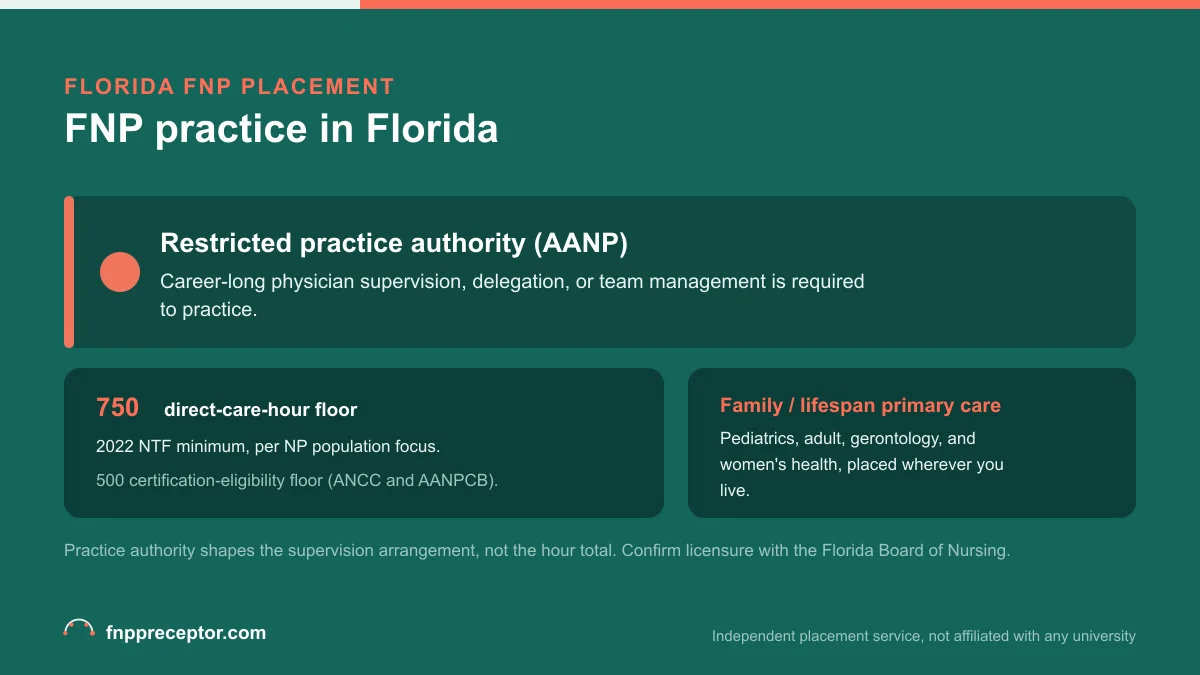
The American Association of Nurse Practitioners classifies Florida as a restricted practice state, meaning state law requires another provider to supervise, delegate to, or manage the nurse practitioner on a career long basis. Day to day, most Florida NPs work under a protocol filed at their practice location with a supervising physician.
There is a narrower path as well. An APRN meeting the requirements in state law, including at least 3,000 physician supervised clinical hours within the previous five years plus graduate coursework in differential diagnosis and pharmacology, may register for autonomous practice, limited to primary care.
None of this changes what makes a good preceptor. It changes the structure around them. In a full practice authority state an experienced NP can often take a student on their own signature. In Florida a physician is likelier to sit somewhere in the chain, on the protocol or on your affiliation paperwork. Physician preceptors are common and widely accepted here, so check your school's rule on MD and DO.
Metro competition against rural drive time
The market splits cleanly. Miami, Fort Lauderdale, West Palm Beach, Tampa Bay, Orlando, and Jacksonville hold most of the clinical volume, most of the nursing programs, and a large share of the online FNP students. A preceptor in Broward or Hillsborough county fields several requests a semester and has learned to decline.
Outside those metros the arithmetic flips. Ocala, Gainesville, Lakeland, Fort Myers, Tallahassee, Pensacola, and Panama City carry fewer competing students per clinic. Rural counties often have willing preceptors alongside a real primary care shortage, which cuts both ways: they want the help, and they are already busy. The price is your commute, and in a state this long a rural placement can mean an hour each way or a rented room for the semester.
Hours, paperwork, and lead time
Confirm your required total with your own program first. The 2022 National Task Force standards recommend a minimum of 750 direct patient care hours per track, and certification eligibility through AANP or ANCC requires at least 500 faculty supervised hours. Accredited FNP programs publish totals that commonly land between about 540 and 800, and plenty sit below 750. Only your program's number matters. See FNP clinical hours.
Your preceptor needs an active Florida license and must practice in the population you are logging, so verify it through the Florida Department of Health's official license verification rather than taking a business card at face value. Schools also want a CV, proof of certification, and a signed affiliation agreement, which at hospital owned groups is usually the long pole. Our preceptor requirements page lists the usual asks. Start early: an August placement is generally worked in April.
Getting help with a Florida placement
We are an independent placement service for FNP students at any university, independent of any school, and we do not guarantee placement or that your program will approve a given preceptor or site. What we do is find licensed, practicing clinicians in a Florida county you can reach, confirm they will take a student for the population you still need, and hand you the paperwork your school asks for. When pediatrics or women's health is the block holding up graduation, that is where we save the most time. Send your county, remaining hours by population, and start date via #match or contact, or read how it works and cost.
Good to know
Does an FNP preceptor in Florida have to be a nurse practitioner?
Not necessarily. Depending on your school's policy, a licensed NP, a physician (MD or DO), or a certified nurse midwife for women's health hours can qualify. The preceptor must hold an active Florida license and practice in the population you are logging.
Can I complete all of my Florida hours at one site?
Sometimes, if it is a community health center or a genuinely mixed family practice that sees children and does well woman care. More often students use two or three sites: a general practice for the bulk, plus a shorter pediatric or women's health block.
Does Florida's restricted practice status limit what I can do as a student?
No. Your scope as a student comes from your program and your preceptor's direct supervision, not from the state's practice authority category. Restricted status changes the arrangement your preceptor works under, which often puts a supervising physician in the approval chain.
Is it easier to find a preceptor in South Florida or in a rural county?
Rural counties usually offer more willing preceptors per student, while the metros have more volume and much more competition for it. The trade is travel. If you can drive 45 minutes each way or relocate for a semester, your options widen considerably.
Plan the FNP practicum across the lifespan
Tell us your school, city, course, and remaining objectives. We will organize an independent search for possible preceptors and primary care sites, subject to program approval.