Finding an FNP Preceptor Across Georgia's 159 Counties
Georgia has no shortage of primary care practices willing to take an FNP student, and a real shortage of the two settings most students still need: pediatrics and women's health. Because the state is a restricted practice environment, a Georgia nurse practitioner who precepts you usually works under a nurse protocol agreement with a delegating physician. That changes who weighs in on accepting you, not what your preceptor has to be qualified to do.
Where Georgia FNP students actually log hours
Most FNP hours here happen in ordinary outpatient primary care: independent family practice offices, physician groups, and the primary care arms of the big hospital systems. Those cover adult and gerontology easily, but a busy suburban practice is often already hosting students from other programs.
- Federally qualified health centers. Roughly 205 locations statewide, weighted toward rural and underserved communities, with the widest age range of any outpatient setting.
- Rural health clinics. About 93 sites, most of them small and often the only practice in their county.
- County health departments. Georgia's 18 public health districts cover all 159 counties, and district clinics are a well worn route to family planning, immunization, and child health visits.
- Urgent care, student health, correctional health. Good for volume, but all three skew acute or adult.
Metro Atlanta volume against everywhere else
Georgia's capacity is lopsided. The Atlanta metro, running through Fulton, DeKalb, Gwinnett, Cobb, Clayton, and Henry counties, holds most of the state's practices and nearly all its subspecialty depth. It is also where most Georgia NP students are hunting, which is why a metro only request is the slowest to fill.
The mid-size cities are the sweet spot: Augusta, Columbus, Macon, Savannah, Athens, and Gainesville each anchor a regional system with a teaching habit and fewer competing students, while Warner Robins, Rome, Dalton, and Statesboro sit a tier below with capacity nobody has asked about. Farther south, around Albany, Valdosta, Tifton, and Waycross, a clinic that says yes is often the only one asked all semester. You pay for that in drive time.
Pediatrics and women's health are the real bottleneck
Every FNP program fights to place these two, because the track runs across the lifespan while pediatrics and women's health sit in the specialty practices that host the fewest students. In Georgia it is a supply problem, not just a scheduling one, and it shows in the county data.
State figures for 2024 counted no obstetrician gynecologist practicing in 82 of Georgia's 159 counties, and no pediatrician in 63 of them. Of the 126 counties and partial counties that federal designations treat as rural, 108 have no birthing facility. Whole regions do not contain the practice type your women's health hours are supposed to come from.
So women's health hours here come from a metro or regional obstetrics and gynecology group, a nurse midwife practice, a health department family planning clinic, or an FQHC women's health line. Outside the metros, pediatric hours come more often from a family practice with a young panel, an FQHC pediatric session, or a school based health program than from a standalone pediatric office, because in much of the state that office does not exist. Line both up before you touch adult hours. Our pediatric rotation and women's health rotation pages cover the workarounds.
Adult and gerontology hours tend to fill themselves
The other half of the lifespan is easier. Adult and older adult visits dominate nearly every primary care panel in Georgia, and the mountain counties up north and the coast around Brunswick draw enough retirees that real geriatric complexity turns up on its own. These hours stack up faster than students expect, which is why your early effort belongs elsewhere. Our adult and gero rotation page covers the split.
What restricted practice changes, and what it does not
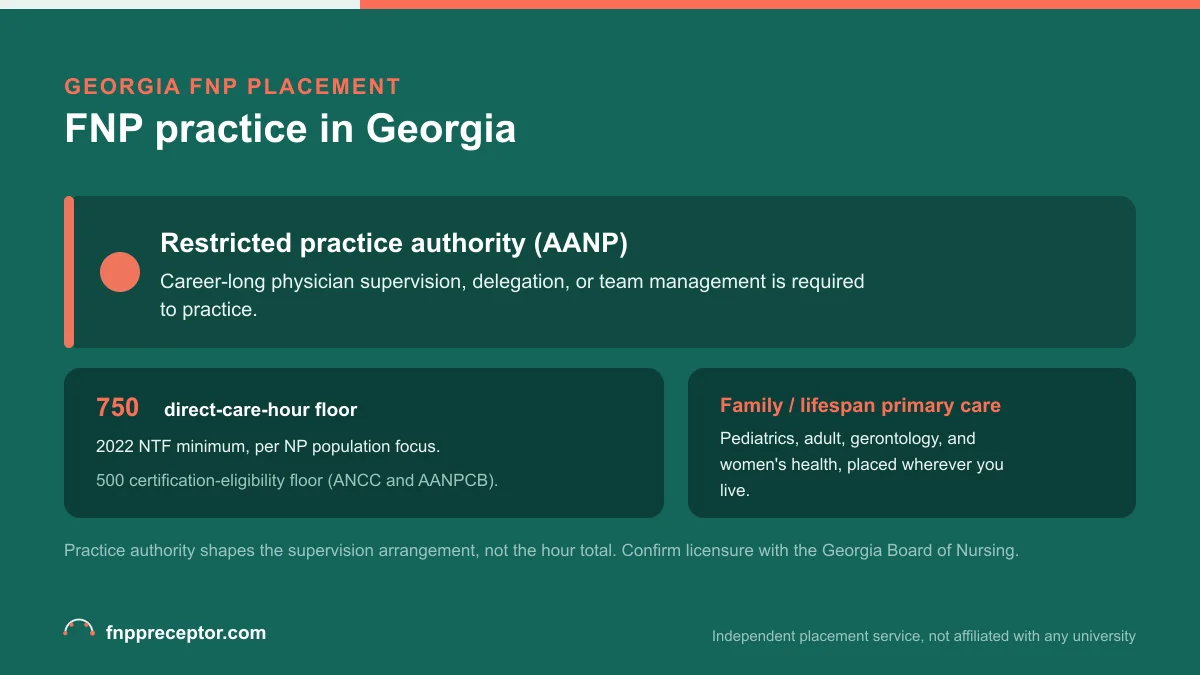
The American Association of Nurse Practitioners classifies Georgia as a restricted practice state, its most limited category. A Georgia APRN is authorized by the Georgia Board of Nursing, under the Secretary of State, and one who prescribes works through a nurse protocol agreement with a delegating physician filed with the Georgia Composite Medical Board. Those rules keep consultation available, schedule physician review of a share of records, and generally keep Schedule II drugs off the APRN's list.
For your rotation the translation is short. Your preceptor still needs a current Georgia license and active practice in the population you are logging, and that does not shift with practice authority. What shifts is the arrangement around you: in a full practice state an experienced NP often takes a student on their own say so, while here the delegating physician is commonly part of the decision. Build an extra step into your timeline, and confirm current rules with the Board of Nursing.
How many hours you actually owe
Do not assume a number. The 2022 National Task Force standards published through the American Association of Colleges of Nursing recommend a minimum of 750 direct patient care hours per nurse practitioner population focus, while certification through AANP or ANCC requires at least 500 faculty supervised hours. Accredited FNP programs publish totals commonly landing between about 540 and 800, and a fair number sit below 750. Pull your own number from your current clinical handbook.
One Georgia item to settle early: if your program is online and based elsewhere, your preceptor still has to be licensed here, and your school will usually need an affiliation agreement with the site before hours count. Our clinical hours page explains how totals get divided, and preceptor requirements covers who can sign your evaluations.
Where we come in
We are an independent placement service, separate from any university, working with FNP students wherever they are enrolled. In Georgia we focus on what actually stalls people: pediatric and women's health sites beyond the metros. We assist. We do not guarantee placement or your school's approval of a given preceptor or site.
Send your county, your hour total, and the populations you still owe through the match form on this page or by contacting us, and we will come back with an honest read on what your part of Georgia supports. Pricing is on the cost page.
Good to know
Can a physician precept me in Georgia, or does it have to be a nurse practitioner?
Both are common. FNP students here are precepted by nurse practitioners and by physicians, and certified nurse midwives often cover the women's health portion. What matters is a current Georgia license, active practice in the population you are logging, and a credential your program accepts.
Does Georgia's restricted status make preceptors harder to find?
Indirectly, and less than students fear. The category disqualifies nobody from teaching. It adds a person to the decision, since a prescribing Georgia APRN works under a protocol agreement with a delegating physician who often has a say in taking a student. Expect one more conversation, not a closed door.
Where do Georgia students get pediatric hours if their county has no pediatrician?
Three routes work. A family practice with a young panel produces real pediatric volume if you build your days around well child visits. County health department clinics handle immunizations and child health screening. FQHCs often run pediatric sessions in counties with no private pediatric office. None of it substitutes for asking a term early.
How far do Georgia FNP students usually travel to clinical?
It depends where you start. Inside metro Atlanta most students find something within 45 minutes, though it takes longer to secure. In the mid-size cities an hour is typical. In rural south Georgia students often drive an hour each way, stacking clinical into two long days. Widening your radius usually beats waiting another month.
Plan the FNP practicum across the lifespan
Tell us your school, city, course, and remaining objectives. We will organize an independent search for possible preceptors and primary care sites, subject to program approval.