Clinical placement for FNP students across the Hawaiian Islands
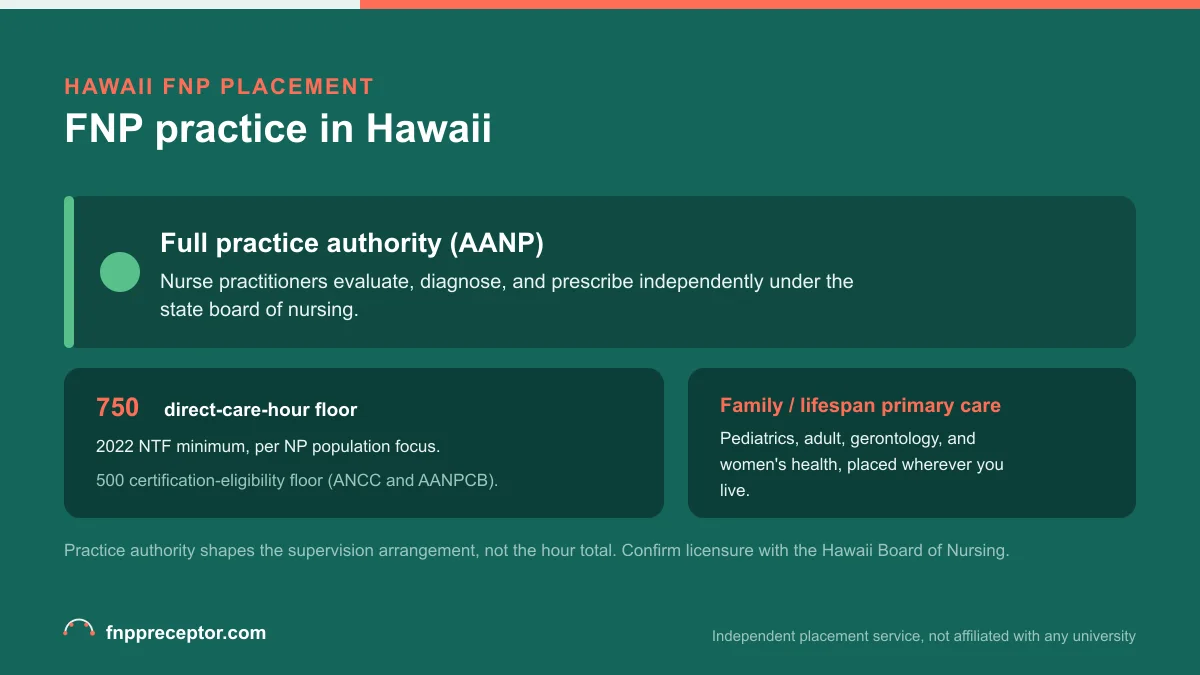
Hawaii is a full practice authority state, so an experienced nurse practitioner licensed here can precept you on her own license, with no physician written into the arrangement. The harder part of placement here is not the law, it is the water. Each island is its own clinical job market, and a site eighty miles away is a flight, not a drive.
Your island decides your options first
Oahu holds the large majority of the state's residents and nearly all of its clinical density: the Honolulu urban core, Kapolei and the Ewa plain, Pearl City and Aiea, Kailua and Kaneohe on the windward side, and the Waianae coast. That cuts both ways. There are more clinics within reach than anywhere else, and more medical, PA, and nursing students asking for the same desks.
The neighbor islands invert the problem. Hawaii Island spreads a modest population across a very large area, from Hilo and Puna to Kailua-Kona, Waimea, and Kau. Maui County covers Kahului and Wailuku, the Kihei corridor, west Maui near Lahaina, plus Molokai and Lanai, small enough that one clinic can be most of the primary care on the island. Kauai runs from Lihue and Kapaa around to Waimea. Preceptors here are often willing; there are simply few of them, and one with a full panel may have no partner to cover a teaching day.
So plan around the island you live on. A weekly inter-island clinical day is fragile, and a cancelled flight becomes a missed rotation. If you can relocate, say so early.
Where FNP students in Hawaii tend to land
Volume is not the only currency here. Being the only clinic in a district often matters more.
- Community health centers. Hawaii's 14 federally qualified health centers reach every major island and serve more than 150,000 residents a year. They see the full lifespan in one session, which is what an FNP log needs.
- Native Hawaiian Health Care Systems. Five federally funded systems anchored across Kauai, Oahu, Molokai, Maui, and Hawaii Island, delivering primary care and prevention.
- Family and internal medicine groups. More independent small groups on Oahu, more hospital-affiliated clinics on the neighbor islands.
- Urgent and convenient care. Steady in Honolulu and the visitor corridors of Maui and Kona. Strong acute volume, thin continuity.
- Rural and remote clinics. Hana, Molokai, Lanai, Kau, and north Kohala style sites, where one clinic covers a district.
- Student, occupational, and correctional health. Smaller pools that sometimes have room when family practice does not.
- Federal and military facilities on Oahu. Own affiliation and credentialing processes. Assume months of lead time.
The annual Hawaii physician workforce report keeps documenting a primary care shortfall sharpest in the neighbor island counties. That is why a preceptor may say no, and why one who says yes usually means it.
The four populations, and which two get tight
FNP is an across-the-lifespan track, so your supervised hours have to span pediatrics, adult, gerontology, and women's health. In Hawaii, as almost everywhere, pediatrics and women's health fill last.
On Oahu, pediatrics sits mostly in dedicated pediatric practices, the same ones every other health professions program asks first. Women's health concentrates in OB-GYN groups, midwifery practices, and the women's health lines inside larger health centers. Ask for both months ahead, and treat them as short focused blocks rather than full semesters. See pediatric rotations and women's health rotations.
On the neighbor islands the math turns in your favor. A rural family clinic may see a toddler, a pregnant patient, and an 80-year-old with three chronic conditions in one morning, because there is nowhere else to send them. Adult and gerontology hours are the easiest of the four to fill statewide; see adult-gero rotations. Splitting a term between a generalist site and a focused one is normal here if you ask in advance.
What full practice authority changes, and what it does not
AANP places Hawaii in the full practice category. Licensing sits with the Board of Nursing, housed in the state Department of Commerce and Consumer Affairs, which licenses LPNs, RNs, and APRNs; prescriptive authority is applied for separately. Confirm current requirements on the board's own site, since these details change faster than summary pages get updated.
For your rotation, the effect is on structure rather than on who is qualified. An experienced NP can take you on under her own license, without a collaborating or supervising physician written into the arrangement the way reduced and restricted states require. The baseline does not change: your preceptor must hold a current Hawaii license and practice in the population you are logging. Physicians (MD or DO) can precept in many arrangements, and certified nurse-midwives are common for women's health, but your school's list governs. See preceptor requirements.
Hours: confirm your own program's number
The 2022 NTF Standards recommend a minimum of 750 direct patient care hours per nurse practitioner track, while AANP and ANCC certification eligibility requires at least 500 faculty-supervised hours. Accredited FNP programs commonly publish totals of roughly 540 to 800, and a fair number sit below 750. Do not assume yours is 750. Open your handbook and build around the real number. FNP clinical hours explains how totals get divided.
One pacing note specific to Hawaii: small sites are interruptible. When one of two providers in a remote clinic is out, the schedule can close for a week. Build a few weeks of buffer into your timeline, and log hours as you go.
Start earlier than feels necessary
Lead time is the best predictor of a smooth Hawaii placement. Four to six months ahead of your term is not early, particularly for pediatrics, women's health, or anything on a neighbor island. Have your affiliation agreement process, preceptor credential requirements, hour total, and term dates ready before you ask, because a preceptor inclined to say yes wants all of it in the first conversation.
That is where we help. We are independent, we work with FNP students at any university, and we handle the outreach, matching, and paperwork chase so you are not calling clinics between shifts. We do not guarantee placement or your school's approval of any preceptor or site, since that decision belongs to your program. If you want us searching, use the form at #match or reach us through contact. How it works covers the steps; cost is upfront.
Good to know
Does full practice authority mean one NP can precept me alone in Hawaii?
Structurally, yes. Hawaii's full practice classification means a qualified NP can practice and precept under her own license, with no collaborating physician required by the state. Your school can still add conditions, so read your handbook first.
Can I split my clinical hours between two islands?
Most programs allow more than one site, and two placements is common when you need a focused pediatrics or women's health block. Across islands it works as a short intensive block you fly to, rarely as a weekly commute. Get approval in writing.
Are community health centers realistic placements for students here?
They are among the most common settings in the state, since the network reaches every major island and sees the whole lifespan in one panel. Capacity varies by site and season, and larger centers want the affiliation agreement finished early.
How many clinical hours will I actually need?
It depends on your program. National guidance recommends a minimum of 750 direct patient care hours, certification bodies require at least 500 faculty-supervised hours, and published program totals commonly land between about 540 and 800. Your handbook is the authority.
Can a physician or a nurse-midwife precept me in Hawaii?
Often yes. Many programs accept an MD or DO for family practice hours and a certified nurse-midwife for women's health, provided they hold a current Hawaii license and practice in that population. Your school sets that policy, not the state.
Plan the FNP practicum across the lifespan
Tell us your school, city, course, and remaining objectives. We will organize an independent search for possible preceptors and primary care sites, subject to program approval.