Clinical placement for FNP students across Idaho
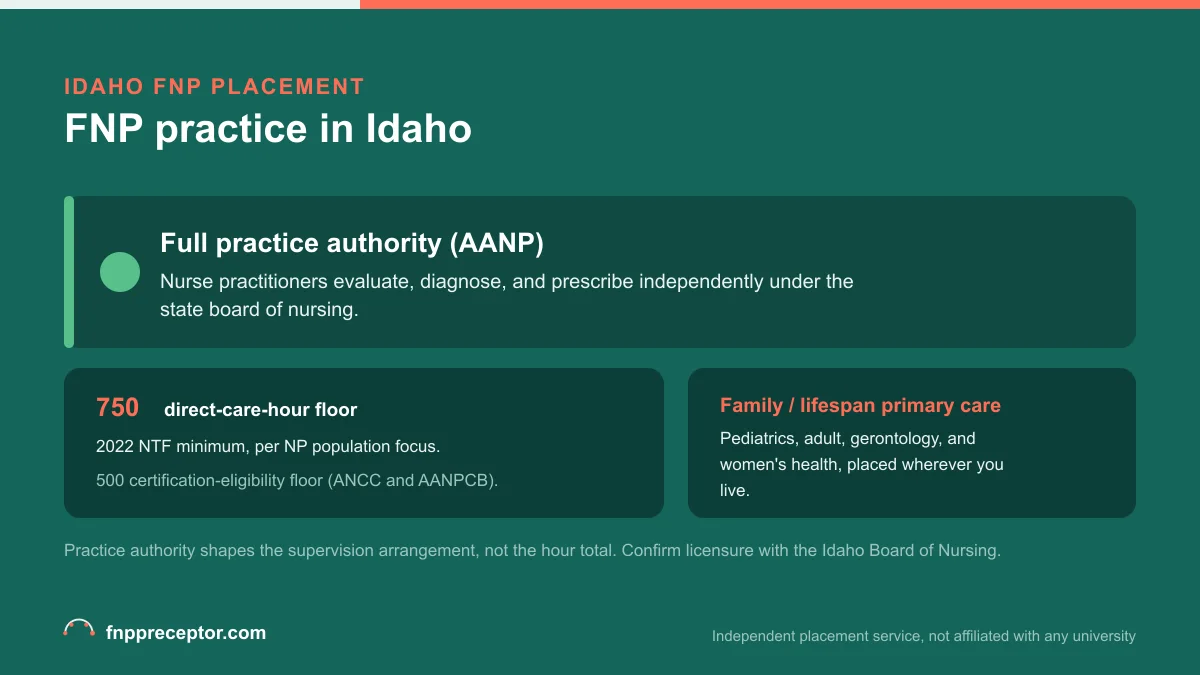
Idaho is a full practice authority state, so an experienced nurse practitioner here can carry a panel, prescribe, and precept you without a physician attached to the arrangement. That removes a layer of paperwork, but it does not touch the real Idaho constraint, which is distance. Nearly the whole state carries a primary care shortage designation, the clinics that host students sit in five very different regions, and the two rotations FNP students fight for, pediatrics and women's health, cluster in a short list of towns.
Idaho in five regions, and where the clinics sit
Idaho runs about 480 miles north to south, and each stretch of it works differently:
- Treasure Valley (Boise, Meridian, Nampa, Caldwell): most of the state's outpatient volume, and the heaviest student traffic.
- Magic Valley (Twin Falls, Jerome, Burley): agricultural, strong safety net, large Spanish-speaking population.
- Eastern Idaho (Idaho Falls, Pocatello, Rexburg, Blackfoot): family practice heavy, young panels near Rexburg, older ones in farm towns.
- North Idaho and the Palouse (Coeur d'Alene, Sandpoint, Lewiston, Moscow): a separate market that leans toward Spokane.
- Central and frontier Idaho (Challis, Salmon, McCall, Grangeville): small clinics, long drives, preceptors nobody has asked.
About 26 percent of Idahoans live outside a metro area, and the state supports 26 critical access hospitals, 57 rural health clinics, and 54 federally qualified health center sites. Idaho's health department reports roughly 98.7 percent of the state as a primary care shortage area. Shortage areas still hold preceptors; they are simply busy, so a specific ask beats a broad one.
What full practice authority changes, and what it does not
Idaho's Nurse Practice Act, Title 54, Chapter 14, puts advanced practice licensure under the Board of Nursing, now housed in the Division of Occupational and Professional Licenses. Idaho NPs diagnose, order and interpret tests, and prescribe, including controlled substances, under that board's authority alone. No collaborating physician is required, so a nurse practitioner running her own clinic in Sandpoint or Salmon can be your sole preceptor. In a reduced or restricted state, that clinic would usually have to name a physician first.
The preceptor standard does not change. Whoever teaches you holds an active Idaho license and practices in the population you are logging, and most programs want a year or more of independent experience, which is a school rule rather than a state one. Physicians, and certified nurse-midwives for women's health, are commonly accepted too. Our preceptor requirements page has the checklist.
Safety net clinics, rural sites, and tribal health
Fifteen community health center organizations run those 54 sites, in towns including Nampa, Caldwell, Payette, Twin Falls, Pocatello, Rexburg, Coeur d'Alene, Bonners Ferry, and Challis. That work fits FNP scope closely: whole families on one schedule, with enough volume for a usable log. Many of the 57 rural health clinics sit beside a critical access hospital with one or two NPs or PAs on staff, so a day can run from a newborn weight check to a Medicare wellness visit to a laceration.
Tribal health adds more primary care sites: the Shoshone-Bannock Community Health Center and the Indian Health Service unit at Fort Hall, Nimiipuu Health in Lapwai and Kamiah, and Marimn Health in Plummer. Credentialing there runs on its own calendar, so ask months ahead. Hours also come from urgent care in the metros, student health in Boise, Pocatello and Moscow, correctional health, and home-based primary care.
Pediatrics and women's health are the tight ones here
Your hours must span pediatrics, adult, gerontology, and women's health. Adult and geriatric hours are the easy part in Idaho, because the rural counties skew older and almost any family practice or critical access clinic covers both. See our adult and gero rotation page.
Pediatrics is tighter than the map suggests. Dedicated pediatric practices concentrate in the Treasure Valley, Idaho Falls, Twin Falls, and Coeur d'Alene, and those offices hear from every program with students in the state. Elsewhere children are seen by the same family clinicians who see everyone else. Get written confirmation that peds encounters inside a family practice rotation count for you before committing a semester. See our pediatric rotation guide.
Women's health follows the same shape. OB-GYN offices and nurse-midwifery services cluster in Boise, Meridian, Idaho Falls, Pocatello, Twin Falls, and Coeur d'Alene, while in smaller counties contraception, prenatal care, and gynecologic complaints are folded into family practice schedules. A certified nurse-midwife is often an accepted preceptor here, which widens the pool where no OB-GYN practices. See the women's health rotation page.
Competition, driving distance, and lead time
The Treasure Valley trade is volume against saturation. Boise and Meridian clinics field steady requests from in-state nursing, physician assistant, and medical programs, plus online students living in the valley. Those preceptors are not unwilling, just booked a semester out.
Rural Idaho inverts that. A clinic in Grangeville, Salmon, or Council may have capacity and a preceptor who would enjoy teaching, and the cost moves to travel: long drives, winter passes, lodging on you. Most students solve it with block scheduling, four or five consecutive days for two or three weeks rather than one day a week from 150 miles out. Ask early whether your school allows that, and give yourself six to nine months.
Confirm your hour total, then hand off the calling
Confirm your own program's number before you count anything. The 2022 National Task Force standards published through AACN recommend a minimum of 750 direct patient care hours per nurse practitioner track, while AANP and ANCC certification eligibility requires at least 500 faculty-supervised hours. Accredited FNP programs commonly publish totals of roughly 540 to 800, and a good many sit below 750, so only your handbook governs your graduation. See our FNP clinical hours page.
Larger Idaho systems also will not let a preceptor say yes until a signed affiliation agreement with your school is on file, so ask your placement office which sites already have one. If you would rather not spend a winter calling clinics from Bonners Ferry to Preston, that is our job. We are independent and work with students at any university. Send your term dates, city, and remaining populations through the form at #match, or read how it works first. We assist with placement and never guarantee it, and your school still approves the preceptor.
Good to know
Does Idaho require a physician to supervise my FNP preceptor?
No. Idaho nurse practitioners practice and prescribe under the Board of Nursing's authority with no collaborating physician agreement, so an experienced Idaho NP can be your sole preceptor. Your school may still set its own conditions, such as minimum years in practice.
Can a physician or certified nurse-midwife precept me in Idaho?
Usually yes. Most FNP programs accept MDs and DOs, and many accept certified nurse-midwives for women's health hours. That matters in Idaho, where in a number of counties prenatal and gynecologic care comes from a midwife or family physician rather than an OB-GYN.
Do I have to be in Boise to find a good rotation?
No, and the Treasure Valley is often harder to get into. Rural health clinics and community health centers in Twin Falls, Pocatello, Sandpoint, Payette, and Challis frequently have more room than Boise offices. The trade is driving distance and lodging.
How many clinical hours will I need for my FNP program?
The 2022 NTF standards recommend at least 750 direct patient care hours per track, certification bodies require a minimum of 500 faculty-supervised hours, and published program totals commonly range from about 540 to 800, with many below 750. Check your own handbook.
How early should I start looking for an Idaho preceptor?
Six to nine months out, and earlier for pediatrics, women's health, tribal facilities, or any system with a centralized placement office. Affiliation agreements and onboarding paperwork often take longer than the search itself.
Plan the FNP practicum across the lifespan
Tell us your school, city, course, and remaining objectives. We will organize an independent search for possible preceptors and primary care sites, subject to program approval.