Finding an FNP Preceptor in Illinois, Chicago to Carbondale
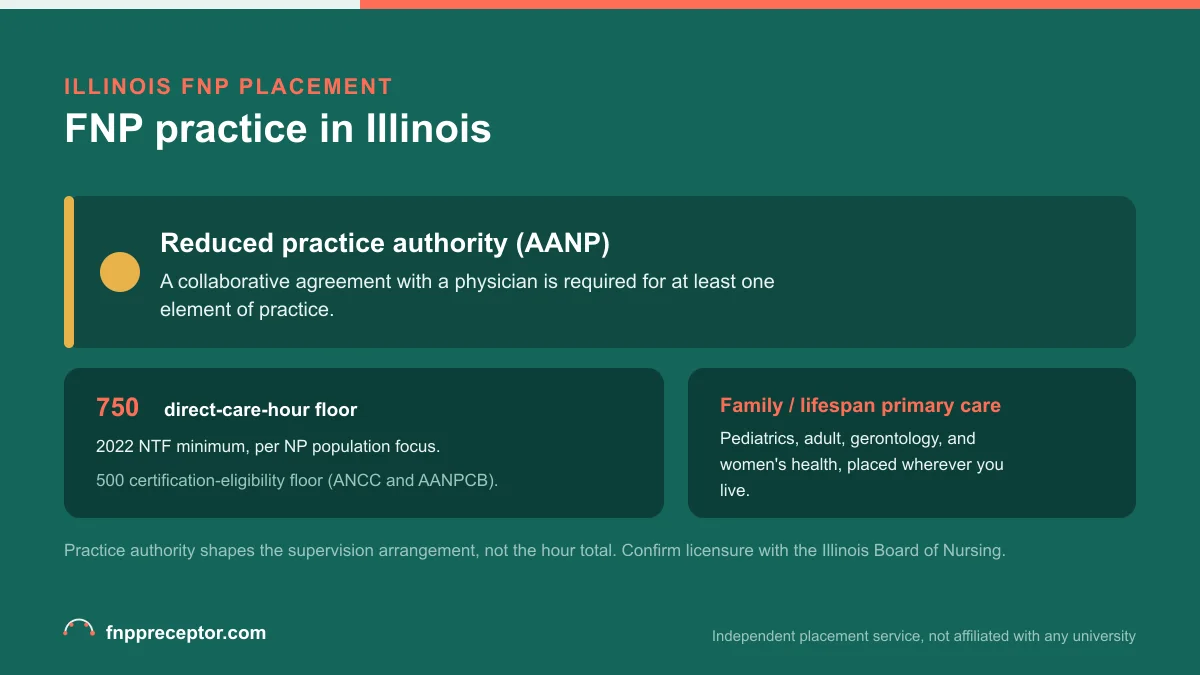
Illinois is a reduced practice authority state, so most nurse practitioners here work under a written collaborative arrangement with a physician unless they hold the state's separate full practice authority credential. That matters less to an FNP student than you would expect, because it shapes the paperwork around a rotation rather than what your preceptor has to be. The harder problem in Illinois is geographic: the Chicago metro holds most of the clinical volume and most of the competition, while a lot of the open preceptor capacity sits two to five hours south.
Illinois is really two placement markets
About 12.7 percent of Illinois residents live in nonmetro counties, and nearly everyone else is packed into Chicago, the collar counties, and a few mid-size downstate cities. Cook, DuPage, Lake, Will, Kane, and McHenry hold the densest supply of family practices, health centers, and urgent care in the state, and the densest competition for them.
Downstate is the mirror image. Springfield, Peoria, Rockford, Bloomington-Normal, Champaign-Urbana, Decatur, the Quad Cities, the Metro East communities across from St. Louis, and the southern corridor through Effingham, Marion, and Carbondale all have practices that take students. Statewide there are 280 Rural Health Clinics and 56 Critical Access Hospitals, and rural sites say yes faster because fewer students ask. The tradeoff is travel, so price the drive before you accept.
Settings that host FNP students here
- Family and internal medicine practices, independent and system-owned, which carry the bulk of FNP hours statewide
- Federally qualified health centers and community health centers, serving roughly 1.5 million Illinois patients a year
- Rural health clinics across western, central, and southern Illinois
- Urgent care and convenient care clinics, heaviest in the metro and larger downstate cities
- Campus student health services in Champaign-Urbana, Normal, Carbondale, DeKalb, and Macomb
- Correctional health and occupational health sites, most of them downstate
Health centers deserve a mention. Because they take whoever walks in, one preceptor can often cover pediatric, adult, gerontology, and women's health encounters in a single rotation. Their formal student agreement process means a slower start and a cleaner one.
One route available elsewhere is missing here: Illinois has no reservation-based Indian Health Service system, so tribal health is not part of the picture.
Where the four populations get thin
FNP is the across-the-lifespan track, so your logged hours have to span pediatrics, adult, gerontology, and women's health. Adult and gerontology are rarely the sticking point in Illinois. The other two are.
In the Chicago metro, pediatrics sits mostly in dedicated pediatric groups and academic children's programs where residents and fellows already fill the teaching slots. Downstate the picture flips: a rural health clinic or small-town family practice often carries the whole family, so a student picks up genuine pediatric encounters without a separate rotation. If your program allows a split placement, a downstate block is the quickest way to close a peds gap. See what counts toward pediatric hours first.
Women's health is tighter than it looks. Obstetric services have thinned in parts of downstate Illinois, and OB-GYN care concentrates in hospital-based groups and larger practices. That pushes many students toward well-woman care inside family practice and health centers rather than a dedicated OB office. Most programs accept that and some do not, and certified nurse midwives can precept these hours. Check how those hours are counted first.
What reduced practice authority actually changes
The AANP State Practice Environment lists Illinois as a reduced practice state. Day to day, an advanced practice registered nurse works under a written collaborative arrangement with a physician unless that APRN holds the separate full practice authority credential, which Illinois grants after national certification plus at least 4,000 hours of clinical experience and 250 hours of continuing education in the certified specialty.
For your rotation this changes the supervision arrangement, not your preceptor's core qualifications. Under a collaborative arrangement, the collaborating physician is often part of the decision to accept a student and the paperwork collects more signatures. With full practice authority, that layer drops away. Either way the preceptor must be licensed in the state where you complete the hours and practicing in the population you are logging.
Licensure, title, and scope questions belong with the Illinois Board of Nursing under the Illinois Department of Financial and Professional Regulation, not with a site.
Hours: check your own number before you plan
The 2022 National Task Force standards recommend a minimum of 750 direct patient care hours per NP population focus, and AANP and ANCC certification eligibility calls for at least 500 faculty-supervised hours. Accredited FNP programs publish totals in roughly the 540 to 800 range, and many of them sit below 750. Do not assume your program lands above that line, and do not assume it lands below. Pull the figure from your own clinical handbook, then see how FNP hour totals break out. That number also decides whether a long drive is worth it.
Start earlier than feels necessary
Chicago-area systems commonly want the affiliation agreement, immunization records, background check, and sometimes a drug screen finished well before your first clinical day, routed through a central office on its own schedule, so two full semesters of lead time is not excessive in Cook County. Independent downstate practices can move in a couple of weeks, because the person you are asking is the person who decides. Spring and summer starts also pull students from every program in the state at once.
If you would rather not do this alone
We are an independent placement service working with FNP students at any university. We source Illinois preceptors, confirm licensure and population fit, and hand you a site your school can review. We do not guarantee a placement or your school's approval, and no honest service would. See how it works and what it costs, then send your county, populations, and term start at #match or through contact.
Good to know
Does reduced practice authority make an Illinois preceptor harder to find?
It rarely makes one harder to find, but it can slow the setup. If your preceptor works under a written collaborative arrangement, the collaborating physician and practice administration are often part of the decision to take a student. If your preceptor holds full practice authority, that step usually disappears. The preceptor's own qualifications do not change either way.
Can I cover all four FNP populations at one Illinois site?
Sometimes, and health centers are your best shot. They see infants through elders on the same panel, so one preceptor may cover every population. Specialty-heavy metro practices almost never work that way. Confirm with your program regardless, since some schools require distinct rotations.
My program is based in another state. Can I still do hours in Illinois?
Usually yes. What matters is that the preceptor is licensed in the state where you complete the hours and practices in the population you are logging, and that your school holds an affiliation agreement with the site. Ask your placement office early, since a new agreement can take longer to build than the search did.
Can a physician precept my FNP hours in Illinois?
In many arrangements yes. Physicians holding an MD or DO can precept FNP students, and certified nurse midwives can precept women's health hours. Whether your school accepts a physician preceptor for a given rotation is a school policy question, so check your clinical handbook first.
How far ahead should I start looking in Illinois?
For Chicago and the collar counties, roughly two semesters ahead is realistic once you account for onboarding through a large system. Downstate independent practices turn around much faster. Either way, start before your program's official deadline.
Plan the FNP practicum across the lifespan
Tell us your school, city, course, and remaining objectives. We will organize an independent search for possible preceptors and primary care sites, subject to program approval.