How FNP students line up clinical preceptors across Indiana
Indiana sits in the AANP's reduced practice category, so the nurse practitioner who teaches you here almost always works alongside a collaborating physician. That shapes who signs off on your rotation more than it shapes the teaching. The wider picture is friendlier than students expect, with family practice in nearly every county seat and a community health center network that served roughly 676,000 patients in 2024. The pinch points are pediatrics and women's health.
Where Indiana FNP students actually land
Most FNP hours in this state happen in ordinary outpatient primary care. A two or three provider family practice in a county seat shows you infants, working adults, prenatal patients and nursing home residents in the same week, which is the lifespan mix your logs need.
- Family practice, independent and system affiliated. The largest source of FNP hours here, and the setting most likely to cover all four populations at once.
- Community health centers. HRSA counted 26 health center organizations operating in Indiana in the 2024 reporting year.
- Rural health clinics. Common across southern and west central Indiana, often staffed by an NP with a physician reachable by phone.
- Urgent and convenient care. Dense along the I-65, I-69 and I-70 corridors, but thin on continuity, so most programs cap those hours.
- Campus, correctional and occupational health. All exist at scale; the last two take far longer to clear.
Indiana has no meaningful Indian Health Service network, so advice about tribal health filling scarce populations does not travel here.
The geography that decides your commute
Indianapolis and the Hamilton County ring of Carmel, Fishers and Noblesville hold the deepest concentration of sites and the heaviest competition, since every program within driving distance points students at the same practices. Fort Wayne anchors the northeast. Northwest Indiana, through Gary, Hammond and Merrillville, orients toward Chicago and competes with Illinois students. South Bend and Elkhart form a north central cluster, Evansville serves a tri-state area, and New Albany sits inside the Louisville metro. In Lafayette, Bloomington, Terre Haute, Muncie and Kokomo, a single yes can carry your term.
Rural counties trade supply for cost. Orange, Crawford, Perry and Brown counties often have preceptors with open capacity because fewer students ask, but the price is mileage and sometimes a weekly stay. Practices serving the Amish settlements around LaGrange and Elkhart counties see care patterns and family sizes you will not meet in a suburban clinic.
Pediatrics and women's health are the two that stall Indiana students
Your track runs across the lifespan, so hours must span pediatrics, adult, gerontology and women's health. Adult and gerontology are the easy part here, since internal medicine, family practice and long term care exist in volume in every region. See adult and gero rotations.
Pediatrics is harder. Dedicated pediatric practices cluster in Indianapolis and the larger metros, where children's hospital affiliated networks absorb students from many programs at once. In rural counties there is often no separate pediatric practice at all, because the family practice down the street sees the children. That is your opening: a small town family panel with a healthy share of kids can cover pediatric hours at the same site giving you adult hours, if your program accepts the encounter mix. Our pediatric rotation page covers that case.
Women's health is the tightest of the four. Obstetric services have consolidated toward regional hospitals and a number of rural counties no longer have a practice that delivers, so well woman care, contraception and prenatal visits concentrate in metro women's health groups. Certified nurse midwives are a legitimate route when your school allows a CNM to sign. More in women's health rotations.
What reduced practice authority changes for you
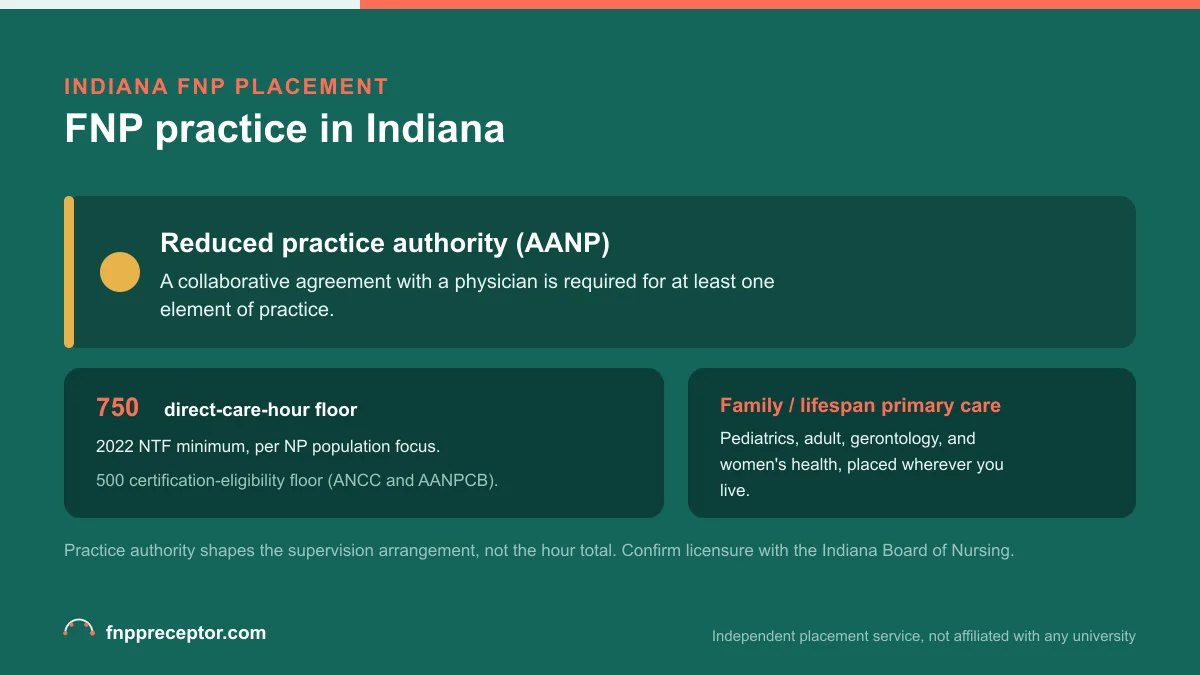
The AANP places Indiana in reduced practice, meaning state law requires a regulated collaborative agreement with a physician for at least one element of NP practice. Here that centers on prescribing: an advanced practice nurse seeking prescriptive authority files a written agreement with a licensed practitioner under the Board of Nursing's rules, covering how the two work together, coverage during absences, and physician review of prescribing. The rule sets a floor for that review, with documentation submitted within seven days covering at least a five percent random sampling of charts and medications prescribed.
None of this changes what makes a good preceptor. It changes the shape of the yes, since the physician's name is already on the NP's agreement, so your request often passes through them too. An enthusiastic NP who goes quiet is usually waiting on a sign-off, not ghosting you.
Verify licensure before investing in a site. Your preceptor needs current Indiana authority in the advanced role and must practice in the population you intend to log. Indiana joins the nurse licensure compact at the RN level, but a multistate RN privilege carries no advanced practice authority, so an NP whose home state is Ohio or Kentucky still needs Indiana standing. See our preceptor requirements page.
Your hours number is your program's number, not a statewide one
Students arrive with a figure in their head, usually 750. The 2022 National Task Force standards published through AACN recommend a minimum of 750 direct patient care hours per population focus. Certification eligibility through AANP and ANCC sits lower, at a minimum of 500 faculty supervised hours. Accredited FNP programs land across a wide band in practice, commonly publishing totals between roughly 540 and 800, and plenty sit below 750. The only number governing your planning is the one in your own handbook. Our FNP clinical hours guide explains how the three fit together.
Starting an Indiana search that does not cost you a term
Give yourself four to six months. The clinic's yes is only the first gate. Next comes the affiliation agreement between site and school, which quietly eats the most calendar when a health system's legal office is involved. Ask what the paperwork chain looks like in the first conversation, not the fifth.
That last part is what we do. We work Indiana requests directly with practices across the state, target the populations you are short on, and serve FNP students at any university, since we are independent of any school. We assist with placement; we never guarantee a placement or a school's approval of a preceptor or site. Send your city, remaining populations and term dates through the form at #match or via contact. For process and pricing, read how it works and cost, or compare states from the states index.
Good to know
Does Indiana's reduced practice status mean a nurse practitioner cannot precept me?
No. An experienced NP can absolutely be your preceptor here. Reduced practice describes that NP's own arrangement with a physician, not a limit on who may teach students. The effect lands on approval, since the collaborating physician is often part of the decision.
Can a physician precept my FNP clinical hours in Indiana?
Often yes, but it is your school's call rather than the state's. Many programs accept MD and DO preceptors, and many accept certified nurse midwives for women's health. Some require part of your hours be NP supervised, so check your handbook first.
How do I verify an Indiana preceptor's license?
Use the license lookup run by the Indiana Professional Licensing Agency for the Indiana State Board of Nursing. Confirm the credential is current and that the person practices in the population you plan to log, then save a dated screenshot for your approval packet.
Where do Indiana FNP students usually find pediatric hours?
Two routes work. In Indianapolis, Fort Wayne, Evansville and South Bend, dedicated pediatric practices exist but are heavily requested, so apply early. Outside the metros the more reliable route is a family practice with a strong pediatric share of its panel.
Do I have to attend an Indiana school to get placed in Indiana?
No. We are independent and work with FNP students at any university, online or campus based, in state or out of state. What matters is that the preceptor holds current Indiana authority and that your school will approve the site and sign an agreement with it.
Plan the FNP practicum across the lifespan
Tell us your school, city, course, and remaining objectives. We will organize an independent search for possible preceptors and primary care sites, subject to program approval.