Family Nurse Practitioner Preceptors Across Kansas
Kansas gives nurse practitioners full practice authority, so an experienced NP here can precept you without a physician attached to the arrangement. The harder problem is supply: finding a family practice, health center, or rural clinic with room for a student and a signed agreement with your school. Here is how FNP placement actually works across the state.
Where Kansas puts FNP students
Kansas spreads its primary care thin over a lot of ground. Nearly three in ten Kansans live outside a metro area, and the facility mix shows it: 82 Critical Access Hospitals, roughly 179 rural health clinics, and about 63 federally qualified health center sites, most of it primary care seeing the full age range in one day.
- Family practice and internal medicine offices, independent and system owned.
- Federally qualified health centers, usually the broadest patient panel in town.
- Rural health clinics attached to Critical Access Hospitals in central and western Kansas.
- County health departments running family planning, prenatal intake, and immunization clinics.
- Urgent care, student health in the university towns, correctional health, and tribal clinics in the northeast.
- Long-term care, the quickest route to gerontology contact.
Veterans clinics and military installation sites can host students, but federal credentialing runs on its own calendar; with a fixed start date, treat those as a stretch.
The metro squeeze and the rural trade
Most clinical volume sits in three places: Wichita and Sedgwick County, the Kansas side of the Kansas City metro through Johnson and Wyandotte counties, and the Topeka to Lawrence corridor, with Manhattan a fourth pocket. Competition is worst there, because nursing, medical, and physician assistant students all chase the same offices.
Outside them the math flips. Salina, Hutchinson, Emporia, Hays, Junction City, Pittsburg, Dodge City, Garden City, and Liberal have working primary care and few students chasing it. Southwest Kansas runs busy clinics serving a large Spanish-speaking population, and southeast Kansas has long-standing health center coverage. Preceptors there are often willing; the cost is yours, in mileage and sometimes lodging.
Many Kansas students anchor one long rural block that covers several populations at once, then fill the narrow gaps closer to home.
Peds and women's health are what stall people
Pediatrics and women's health hold up FNP students almost everywhere, and Kansas is no exception, though here the reason is geographic. Dedicated pediatric practices cluster in Wichita, Johnson County, and Topeka. Elsewhere children are seen inside family practice, next to their parents and grandparents.
Settle one question early: does your program require pediatric hours at a dedicated pediatric site, or can they be logged by patient age at a family practice or health center? If the second is acceptable, and for many FNP programs it is, rural Kansas gets far easier, because one clinic day in a small town can yield infant, adolescent, adult, and geriatric encounters. See our pediatric rotation guide.
Women's health is tighter. Many rural counties no longer have local labor and delivery, so obstetric care concentrates in regional centers. Well-woman visits, contraception, screening, and prenatal intake more often come from a health center, a county health department family planning clinic, or a family practice that still does prenatal care than from a dedicated OB office. Certified nurse midwives can precept it in many arrangements, so search wider than NPs and physicians. See women's health rotation.
Adult and gerontology hours are the easy end here, produced in volume by family practice, internal medicine, urgent care, and long-term care. See adult gero rotation.
What full practice authority changes, and what it does not
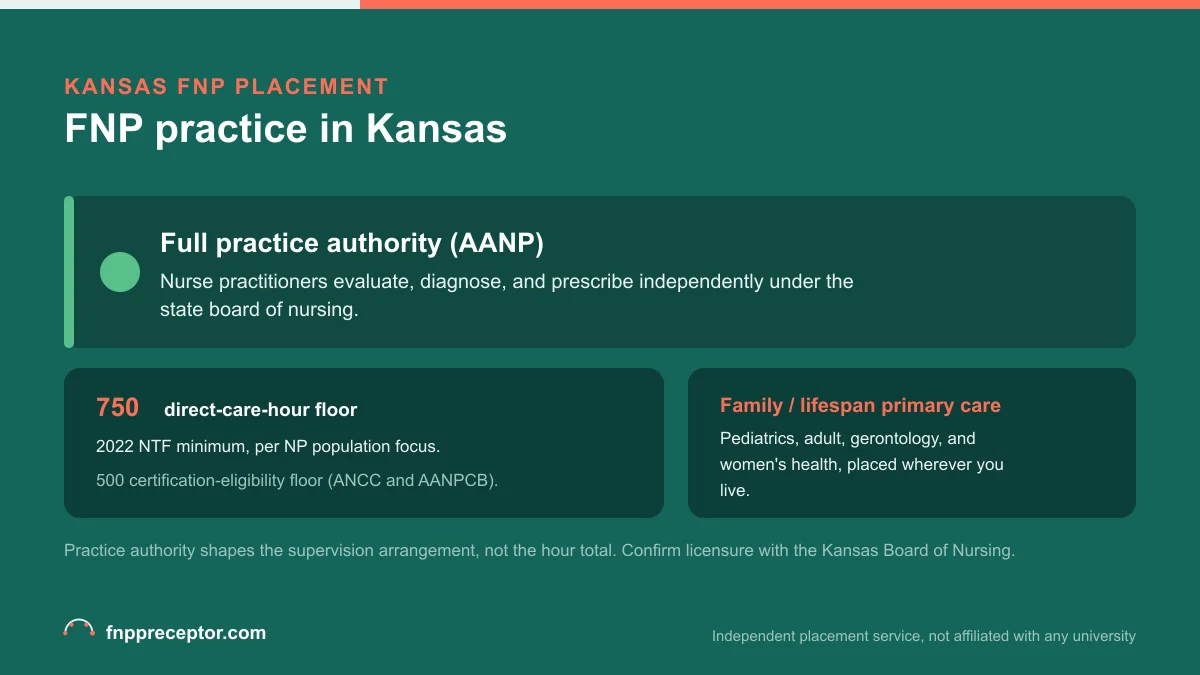
Kansas moved to full practice authority when Senate Substitute for House Bill 2279 took effect on July 1, 2022. It stripped physician supervision and collaboration language out of the APRN statute, including the written prescribing protocol NPs previously needed to prescribe. Licensure stays with the Kansas State Board of Nursing, and the American Association of Nurse Practitioners lists Kansas as full practice.
For a student the effect is narrow but real. An experienced Kansas NP can precept you on their own authority, with no physician layered in to satisfy state law; in reduced and restricted states that extra layer is often what kills a placement. Physicians still precept plenty of FNP students here.
It does not change the preceptor's qualifications: an active Kansas license, current practice in the population you are logging, and whatever your program asks on top, often a year or more of experience. Our preceptor requirements page has the checklist.
Hours, agreements, and what actually takes time
Do not assume a number. The 2022 National Task Force standards recommend a minimum of 750 direct patient care hours per NP track, and AANP or ANCC certification eligibility requires at least 500 faculty-supervised hours. Accredited FNP programs publish totals across a wide band, commonly around 540 to 800, and many sit below 750, so yours is whatever your handbook says. We break the arithmetic down on FNP clinical hours.
The slow step is rarely the preceptor saying yes. It is the affiliation agreement between your school and the site. Independent Kansas clinics and small rural practices often have never signed one with your university, and legal review can run weeks, so raise it in the first conversation. A site already hosting in-state students usually has one.
Come prepared: your preceptor form, the hours and populations you still owe, your dates, health and background records, and a note on what the preceptor signs at the end. The clinic manager is usually the gatekeeper.
Getting a Kansas placement moving
If you have worked your own contacts and come up short, that is our job. We are an independent placement service, separate from any university, working with FNP students from any program. We match on the populations you still owe, the counties you can reach, and your start window. We do not guarantee placement, and your school always decides whether to approve a given preceptor or site.
Send your remaining hours by population, your city, and your term dates through the match form on this page or through contact. For mechanics first, see how it works and cost.
Good to know
Is Kansas a full practice authority state for nurse practitioners?
Yes. AANP places Kansas in its full practice category. Senate Substitute for House Bill 2279 took effect July 1, 2022 and removed physician supervision, collaboration, and written prescribing protocol requirements from the APRN statute. Licensure remains with the Kansas State Board of Nursing, where current rules should be confirmed.
Can a physician precept my FNP clinical hours in Kansas?
In most arrangements, yes. Nurse practitioners, physicians holding an MD or DO, and certified nurse midwives for women's health can all precept, depending on your school's rules and the population logged. Full practice authority means a Kansas NP does not need a physician attached, but it does not exclude physicians.
How many clinical hours will I need for an FNP program in Kansas?
There is no single Kansas number, because the requirement comes from your program and its accreditor, not the state. The 2022 National Task Force standards recommend at least 750 direct patient care hours per track, while AANP and ANCC certification eligibility requires a minimum of 500 faculty-supervised hours. Accredited FNP programs publish totals across a broad range, often roughly 540 to 800, and many fall below 750.
Where do FNP students find pediatric hours in rural Kansas?
Usually inside family practice rather than a dedicated pediatric office, since dedicated pediatrics is concentrated in Wichita, Johnson County, and Topeka. Health centers and county health departments also see steady pediatric volume through well child visits, sports physicals, and immunization clinics.
Is it easier to get placed in Wichita and Kansas City or in rural Kansas?
Rural and small-city Kansas is usually easier to get a yes from, and harder to actually do. The metros hold more clinics but far more competing students. Salina, Hays, Emporia, Pittsburg, and Garden City have working primary care and lighter competition. The trade is drive time and lodging.
Plan the FNP practicum across the lifespan
Tell us your school, city, course, and remaining objectives. We will organize an independent search for possible preceptors and primary care sites, subject to program approval.