Clinical placements for FNP students across Kentucky
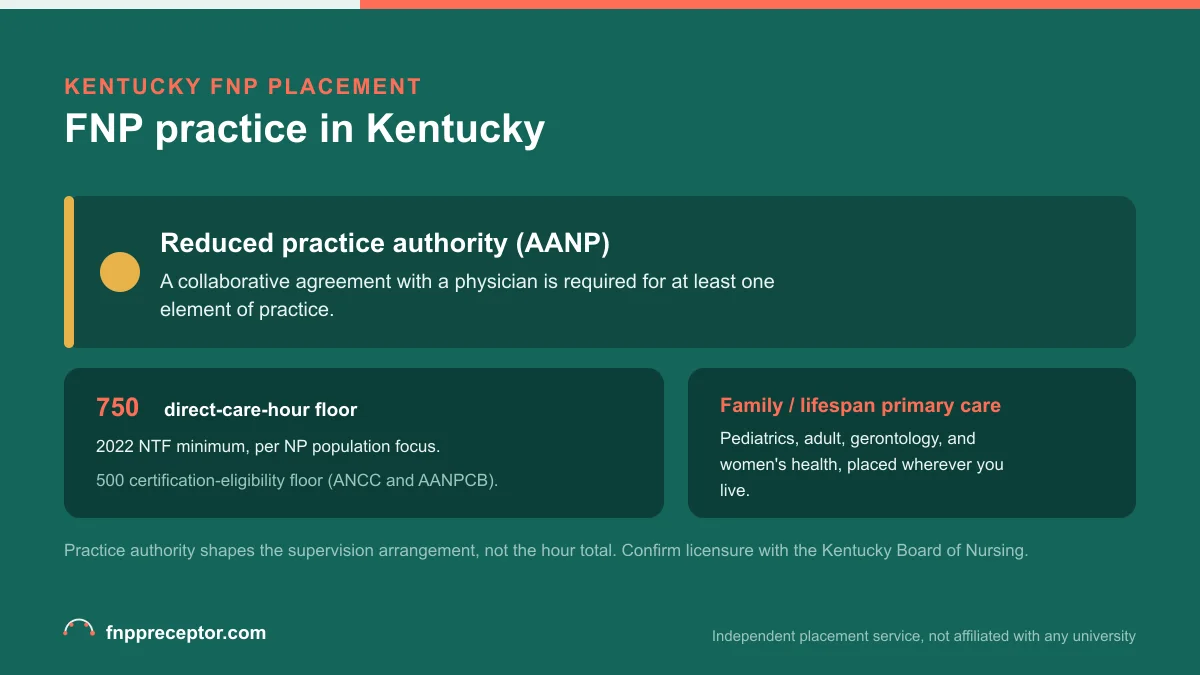
Kentucky sits in the reduced practice category on the AANP State Practice Environment, so a physician is usually somewhere in the structure of a practice that hosts you, while the person teaching you day to day is most often a nurse practitioner. The harder problem here is geography: primary care capacity is spread thin across 120 counties, while the pediatric and women's health sites most programs require sit in a short list of cities.
Where FNP students actually log hours in Kentucky
Kentucky leans on small, community based primary care more than most states do. HRSA site counts compiled by the Rural Health Information Hub list roughly 430 rural health clinic locations and more than 400 federally qualified health center sites outside the larger urban areas, plus 29 critical access hospitals. Those clinics carry much of the state's primary care and most are used to having learners in the building, though capacity shifts each term.
- Family practice offices, independent or employed by a regional system
- Community health centers and FQHCs, many of them members of the Kentucky Primary Care Association
- Rural health clinics attached to small hospitals in the Appalachian and western counties
- County and district health departments, which in much of Kentucky still run family planning, prenatal and immunization clinics
- Urgent care and convenient care along the interstate corridors
- Student health, occupational health at large employers, and correctional health
- Long term care and home based primary care for gerontology hours
Louisville, Lexington and the counties in between
Louisville and Lexington hold most of the specialty volume, the university affiliated primary care and the dedicated pediatric practices. Northern Kentucky runs on the Cincinnati economy through Covington, Newport and Florence. Bowling Green, Owensboro, Paducah, Elizabethtown, Ashland and Somerset anchor their own regions. Everything else is small town and rural; the Kentucky Office of Rural Health in Hazard tracks which counties are underserved.
The tradeoff is consistent. In eastern Kentucky, around Pikeville, Hazard, Prestonsburg, Morehead and Corbin, and in the western Purchase and Pennyrile counties, preceptor supply per student is better because fewer programs compete for it. You pay in drive time, and mountain weather cancels clinic days in January. Metro sites are closer and busier, and every nursing, PA and medical program in the region is already asking them.
The Kentucky rules that touch your rotation
Kentucky ties the physician relationship to prescribing rather than to every clinical decision. APRNs enter a collaborative agreement for prescriptive authority for non scheduled legend drugs, called a CAPA-NS, and a separate agreement for controlled substances, a CAPA-CS. The board allows an APRN in good standing to discontinue the CAPA-NS after four years of prescribing, and experienced prescribers can be exempt from the CAPA-CS, so a seasoned Kentucky NP may hold neither one.
The second rule matters more to you. Kentucky's board does not require out of state programs to be board approved, but it expects anyone who oversees students in a Kentucky clinical setting or precepts there to hold an unencumbered, active Kentucky RN and APRN license. Because Kentucky is a compact state, an APRN living in another compact state needs the Kentucky APRN license but not a separate Kentucky RN license. Details in preceptor requirements.
Pediatrics and women's health are the tight spots
Adult and gerontology hours are the easy part. About 38 percent of Kentuckians live in rural areas, chronic disease burden is high, and family panels, long term care and home based primary care all count. See adult and gero rotations.
Pediatrics behaves differently. Dedicated peds practices cluster in Louisville, Lexington and Northern Kentucky. Elsewhere children are seen inside family practice, which suits an FNP but fails a school that insists on a children only site. Get that ruling from your faculty in writing before you turn down a rural offer. See pediatric rotations.
Women's health is the hardest population to fill almost anywhere, and Kentucky is no exception, since obstetric services have consolidated into regional hubs. The workable routes are health department family planning clinics, the women's health line inside a community health center, and certified nurse midwives where your program accepts one. Start this search first, not last. See women's health rotations.
Count the hours before you book the first site
The 2022 NTF Standards recommend a minimum of 750 direct patient care hours per NP track, while certification eligibility through AANP or ANCC requires at least 500 faculty supervised hours. Accredited FNP programs publish totals that commonly land between roughly 540 and 800, and many sit below 750. Do not assume your number. Pull your clinical handbook and confirm the total plus per population minimums. More in FNP clinical hours.
FNP is an across the lifespan track, so those hours have to span pediatrics, adult, gerontology and women's health. The Kentucky failure pattern is taking the first family practice that says yes, burning a semester on adult hours, then hunting peds and women's health in the final term alongside everyone else. Book the scarce populations first.
Help with a Kentucky placement
We are independent of any school, and we work with FNP students at any university. Tell us the counties you can reach, your hour totals and which populations are still open, and we will run the Kentucky search: sourcing sites, checking licensure and population fit, and chasing paperwork. We assist. We do not guarantee a placement or your school's approval of any preceptor or site.
Use the form on this page at #match, read how it works and cost, or reach us through contact. Other states are listed at states.
Good to know
Does an FNP preceptor in Kentucky have to be a nurse practitioner?
No. Depending on your school and the setting, an NP, a physician, or a certified nurse midwife for women's health can precept. What does not bend is that the preceptor is licensed in the state where the hours are logged and practices in the population you are documenting. Kentucky's board expects an NP precepting here to hold an active, unencumbered Kentucky APRN license.
I live in Kentucky but work in Cincinnati or Evansville. Can I log hours there?
Often, but it moves the rotation under the other state's rules and your program's out of state clearance for that site and preceptor. A preceptor licensed only in Ohio or Indiana cannot cover a rotation your school has set up as a Kentucky placement. Settle which state the hours belong to before you sign.
How many clinical hours does Kentucky require for FNP students?
Kentucky does not set the number. Your program and your certifying body do. The 2022 NTF Standards recommend at least 750 direct patient care hours per NP track, certification eligibility through AANP or ANCC requires a minimum of 500 faculty supervised hours, and accredited FNP programs commonly publish totals from about 540 to 800, with plenty below 750. Confirm your program's figure in writing.
Is it easier to find a preceptor in eastern Kentucky than in Louisville?
For adult and family practice hours, usually yes. Fewer programs compete for the same clinics in the Appalachian and western counties, and small practices there are often open to teaching. You pay in mileage and weather days. Metro practices are convenient and high volume, and already fielding requests from every program nearby.
Does reduced practice status mean a physician must supervise my rotation?
Not the way students usually picture it. Kentucky attaches the physician collaboration requirement to APRN prescriptive authority through the CAPA-NS and CAPA-CS agreements, and experienced prescribers can be released from both. An NP preceptor can teach you, evaluate you and verify your hours. If your school's form asks for a collaborating physician's name, that is a school requirement, so raise it early.
Plan the FNP practicum across the lifespan
Tell us your school, city, course, and remaining objectives. We will organize an independent search for possible preceptors and primary care sites, subject to program approval.