Finding an FNP preceptor across Louisiana's parishes
Louisiana has real clinical capacity for FNP students, but it is thinly spread and not all of it sits in the metros. Hours here come out of family practice, the state's community health center network, rural health clinics in the parishes, and a few settings students rarely think to ask about. Below is where those hours are, which populations run short locally, and how the state's collaborative practice rules shape your preceptor's working arrangement.
Where Louisiana FNP hours actually come from
Start where a full lifespan panel already exists. Family practice is the backbone, and community health centers are the second layer. The Louisiana Primary Care Association counts 41 organizations running more than 470 sites, from Tallulah in the northeast to Thibodaux in the bayou, seeing over 503,000 patients in 2023.
- Family practice and general internal medicine, independent and system owned
- Federally qualified health centers and their satellite sites
- Rural health clinics, which furnish primary care through physicians, physician assistants, or nurse practitioners
- Urgent care, strong on acute volume and weak on continuity
- School based health centers, often the best pediatric door in the state
- Campus student health in the university towns
- Correctional health, steady adult and gerontology exposure
- Clinics run by Louisiana's federally recognized tribes
Rural health clinics repay attention: they exist where a parish could not sustain physician coverage, so nurse practitioners often carry the panel.
Metro volume against parish supply
Density follows the population centers: greater New Orleans, Baton Rouge, Shreveport and Bossier City, Lafayette and Acadiana, Lake Charles, Monroe, Alexandria, Houma and Thibodaux, and the Northshore towns of Covington, Hammond, and Slidell. They hold the most preceptors and the most competition, since local and online programs work the same phone lists.
The parishes behave differently. In the Delta parishes, the Ark-La-Tex, the piney woods near Natchitoches and Winnfield, and Acadiana towns like Eunice, Ville Platte, and Abbeville, a clinician may not have been asked in a year and will often say yes. The cost is driving: 60 miles is rarely 60 minutes, and the bayou parishes are shaped by water crossings rather than straight roads. Plan around hurricane season too, June through November, when one storm can close a clinic for a week.
The two populations that stall a Louisiana plan
Pediatrics and women's health are the hardest FNP hours to fill almost everywhere, and Louisiana is no exception. Dedicated pediatric practices cluster in the metros; elsewhere children are seen inside family practices and rural clinics on a mixed panel. Ask a blunt question before you commit: what share of the daily schedule is under 18, and are well child visits part of it?
One local option gets overlooked. The state health department's Adolescent School Health Program supports school based health centers, 57 of them across 26 parishes in the current directory, sponsored by hospitals, health centers, and school systems and often staffed by nurse practitioners. They follow the school year, so a summer term will not work there. If pediatrics is your gap, read the pediatric rotation guide and send that request first.
Women's health follows similar geography. Obstetric care concentrates in the metros and some rural parishes no longer deliver, so look at women's health services inside community health centers, certified nurse midwives where your program accepts them, and family practices still carrying prenatal patients; the women's health page covers the ask. Adult and gerontology hours are the easy part here, and that guide covers logging them.
How reduced practice authority shapes the arrangement
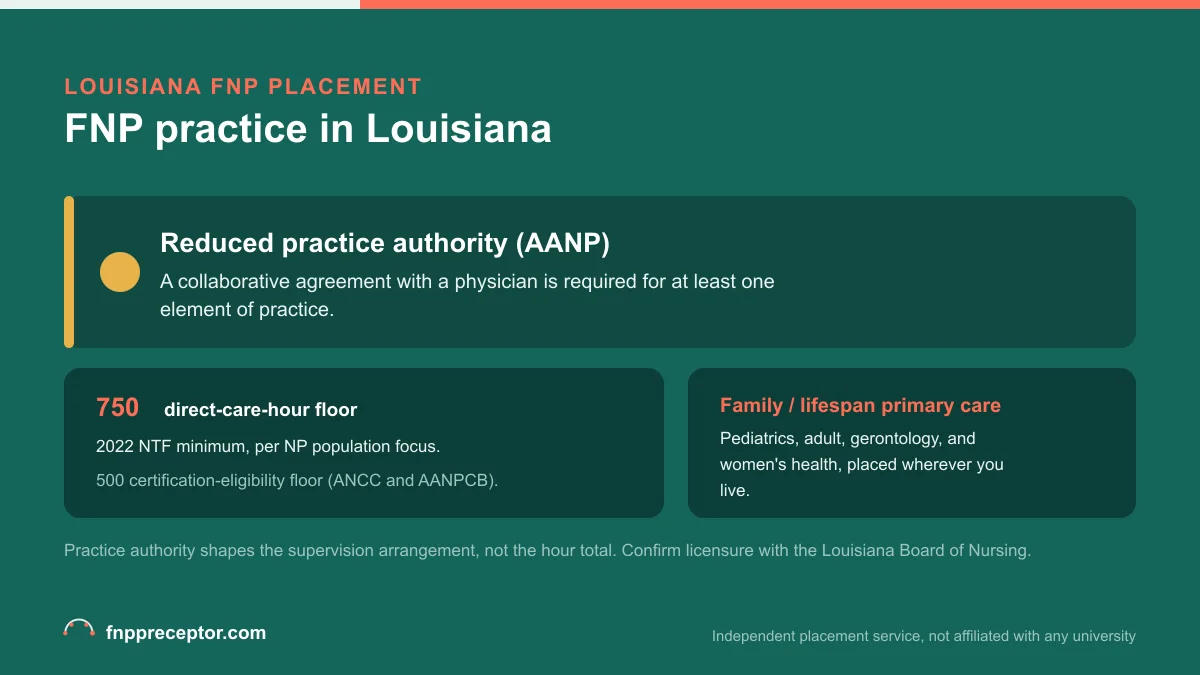
The AANP classifies Louisiana as a reduced practice state, meaning law limits at least one element of NP practice. Here the limit is the collaborative practice agreement: an APRN who diagnoses, manages, or prescribes works under a written agreement with a collaborating physician of comparable scope, filed with and approved by the Louisiana State Board of Nursing before prescriptive authority is used. State rules set out its contents, including accountability, prescribing guidelines, physician availability, and annual review.
For a student that means three things. An experienced NP is still a full preceptor, since the agreement governs prescribing rather than teaching. A physician is usually somewhere in the picture, and some practices want that physician to sign for your placement, so ask early who does. And because agreements are physician and site specific, an NP who recently changed employers may be waiting on approval.
Core qualifications do not shift with practice authority: an active Louisiana license, current practice in the population you are logging, and whatever experience minimum your program sets. Many programs also accept physicians for family and adult hours and midwives for women's health, and our requirements page lists what we verify.
Hours, populations, and paperwork
Know your number before you make a call. The 2022 National Task Force standards recommend a minimum of 750 direct patient care hours per population focus, while certification eligibility through AANP and ANCC starts at 500 faculty supervised hours. Accredited FNP programs publish totals commonly between roughly 540 and 800, and many sit below 750, so confirm your own handbook figure and see how the total breaks apart.
FNP is the across the lifespan track, so hours must span pediatrics, adults, gerontology, and women's health. A broad Louisiana family practice can cover most of it under one roof, which is why those sites get claimed early. Adding a short block elsewhere for a thin population is normal and far easier to arrange in advance than to discover during your final term. Your school and the site also sign an affiliation agreement first, and large systems route students through a central education office with fixed deadlines.
Timing the search, and where we fit
Begin two to three terms out when you can. Send requests in batches, log who you contacted and when, follow up once by phone, and chase pediatrics and women's health first.
If the search has already cost you a semester, that is our job. We are independent and work with students at any university: we identify clinicians inside your reachable radius, confirm the license and patient panel fit the population you need, and stay on the paperwork until it is signed. We assist with placement and never guarantee it, and no service can promise your school will approve a given preceptor. How it works explains the process and pricing is stated plainly. Send your city, term dates, and short populations through the form or contact us.
Good to know
Does my preceptor have to be licensed in Louisiana?
Yes, for hours logged in Louisiana. The preceptor holds an active Louisiana license, APRN or physician, and practices in the population you are logging. If a rotation sits across a state line, the license must match that state and your program must approve the site.
Can a physician precept my FNP hours here?
In many programs, yes. Louisiana's collaborative model already puts physicians and nurse practitioners side by side in primary care, so MD or DO preceptors are common for family, adult, and gerontology hours. Certified nurse midwives are often accepted for women's health.
Does the collaborative practice agreement apply to me as a student?
No. It applies to the APRN you learn from. In practice, a collaborating physician sits in the background of most NP run clinics, that physician may be asked to sign off on hosting you, and a preceptor who recently changed jobs might be waiting on approval of a new agreement.
How many clinical hours will I need?
That comes from your program, not the state. The 2022 NTF standards recommend at least 750 direct patient care hours, certification bodies require a minimum of 500 faculty supervised hours, and accredited FNP programs commonly publish totals around 540 to 800, with many below 750. Confirm your own figure.
Plan the FNP practicum across the lifespan
Tell us your school, city, course, and remaining objectives. We will organize an independent search for possible preceptors and primary care sites, subject to program approval.