Lining up your FNP clinical hours across Maryland
Maryland is a full practice authority state, so an experienced nurse practitioner here can take you on under their own license with no supervising physician written into the arrangement. That widens your pool, but it does not fix what actually stalls students here: pediatric and women's health hours, and a narrow corridor of the state where several programs chase the same offices.
The settings that take FNP students here
Independent primary care offices still exist in real numbers outside the Baltimore and Washington suburbs, and they are the most workable ask because the person you approach is the person who decides. System-owned primary care routes the request through an education office instead, which adds weeks.
Community health centers matter a lot in Maryland. Baltimore Medical System is the state's largest federally qualified health center, and Chesapeake Health Care covers the lower Eastern Shore across Somerset, Wicomico and Worcester counties. One FQHC panel can cover children, adults and older adults in a week, though whether a center takes students varies.
Hours also come from rural health clinics, federally defined sites in designated shortage areas overseen by the Office of Health Care Quality, plus urgent care, campus student health and correctional health.
Read the map before you start asking
Maryland is small enough that a ninety minute drive changes your competitive picture. Most outpatient volume runs along the I-95 and I-270 corridors: Baltimore City and County, Columbia, Annapolis, Frederick, and the Washington suburbs in Montgomery and Prince George's counties. That corridor holds the most practices and the most students chasing them.
The rest of the state runs the other way. Fourteen rural Maryland jurisdictions are designated entirely as primary care health professional shortage areas, and on the Eastern Shore, Caroline, Kent, Somerset and Worcester counties have effectively their whole population in federally designated medically underserved areas. Salisbury, Easton, Cambridge, Hagerstown and Cumberland are places where a preceptor is likelier to say yes.
The tradeoff is travel; Bay Bridge traffic turns a fair commute into a punishing one. Maryland's AHEC network exists because these regions struggle to recruit clinicians, which is why they often have room.
Which of your four populations will fight back
Your track runs across the lifespan, so hours must span pediatrics, adult, gerontology and women's health. Adult and gerontology are the easy end here, with primary care everywhere and a deep long term care and house-call sector supplying complexity.
Pediatrics is the first squeeze. Dedicated pediatric practices cluster in metro Baltimore and the Washington suburbs, exactly where competition is heaviest. Further out, children are more often seen inside family practice offices and community health centers than in standalone pediatric groups. That helps only if your program accepts pediatric hours in a family practice setting under a preceptor whose scope covers children, so get that in writing. See pediatric rotation.
Women's health is harder. Obstetric and gynecologic care concentrates in hospital-affiliated groups and in community health centers running prenatal services, and rural obstetric access has thinned, shrinking the pool of sites that can host a learner. Certified nurse midwives are a legitimate route where your school allows a CNM preceptor. See women's health rotation.
What full practice authority does and does not change
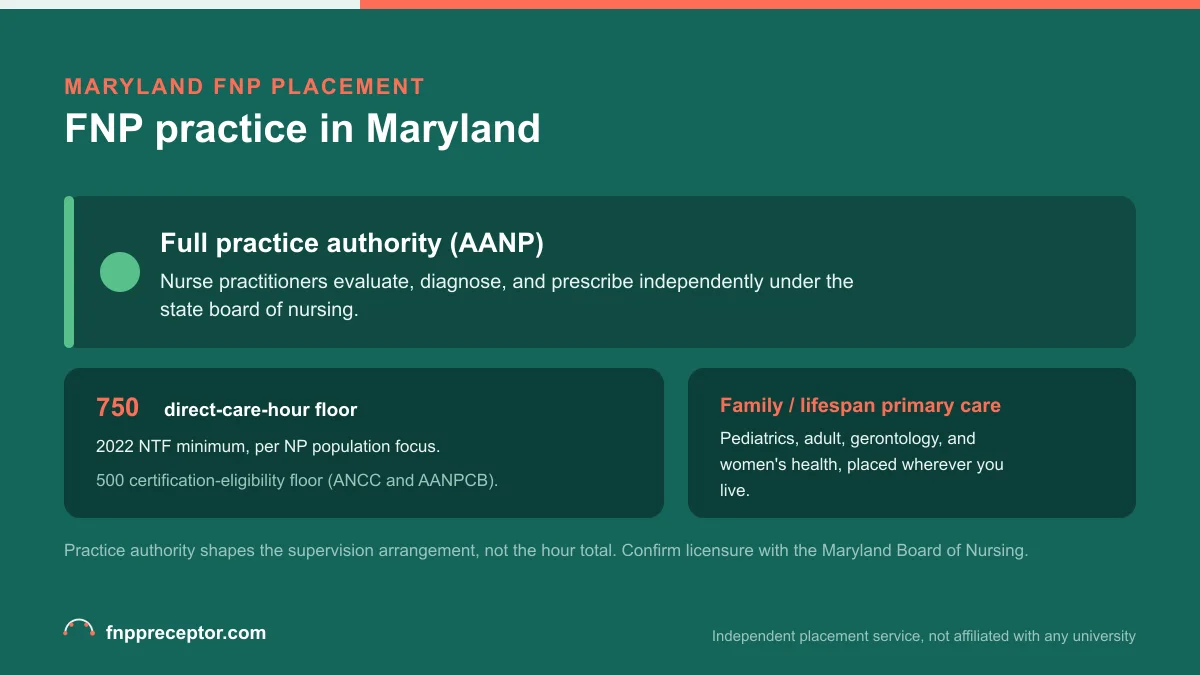
The American Association of Nurse Practitioners lists Maryland as full practice, meaning state law lets nurse practitioners evaluate patients, diagnose, order and interpret tests, and initiate and manage treatment including prescribing, under the exclusive licensure authority of the state board of nursing. Maryland titles the role Certified Registered Nurse Practitioner.
In a reduced or restricted state an NP preceptor often arrives with a collaborating physician attached, and that second signature is one more thing that can fall through. Here an experienced CRNP precepts on their own authority. Maryland applies a limited mentorship step for nurse practitioners entering practice for the first time, so confirm current rules with the Maryland Board of Nursing.
What it does not change is the preceptor's qualifications. They must be licensed where the site sits and practicing in the population you are logging. Nurse practitioners, often physicians holding an MD or DO, and certified nurse midwives for women's health can serve, depending on your school. See preceptor requirements.
Border lines matter more here than almost anywhere
A student in Silver Spring, Bethesda or Hyattsville may cross Maryland, the District of Columbia and Virginia in one week, and that convenience hides a licensing trap. Maryland participates in the Nurse Licensure Compact, so a multistate registered nurse license travels; advanced practice does not. The Maryland Board of Nursing states that advanced practice nurses must obtain certification in each state where they practice, and the APRN Compact is not yet in effect. An NP certified only in Virginia or DC cannot automatically precept you at a Maryland site.
Hours, paperwork, and the number your program actually uses
Do not assume a single hour requirement. The 2022 National Task Force standards recommend a minimum of 750 direct patient care hours per nurse practitioner track, while certification through AANP or ANCC requires at least 500 faculty-supervised hours. Accredited family practice programs commonly publish totals of roughly 540 to 800, and many sit below 750. Only your school's figure governs you. See clinical hours.
- Confirm your program's hour total and the split across the four populations.
- Ask whether pediatric or women's health hours may be logged in a family practice or FQHC setting.
- Verify the preceptor is licensed in the state where the site sits.
- Open the affiliation agreement the moment a site says yes; a large system can take a month to route it.
If you would rather not do this alone
We are an independent placement service for family practice students at any university, and Maryland rewards knowing which regions still have capacity. We source and vet preceptors, confirm licensure and population fit, and hand your school a candidate who can clear its paperwork. We assist with placement; we never guarantee a placement or your school's approval of any preceptor or site. Start at the match form, or read how it works and cost first.
Good to know
Does full practice authority mean I do not need a physician preceptor?
It means an experienced Maryland CRNP can precept you under their own license, with no supervising physician in the arrangement. It does not exclude physicians. An MD or DO can still precept you where your school allows it, which is a program rule rather than a state one.
Can a preceptor licensed in DC or Virginia take me for a Maryland rotation?
Not automatically. Maryland's compact participation covers registered nurse licenses, and the Board of Nursing states that advanced practice nurses must obtain certification in each state where they practice. The APRN Compact is not yet in effect. Confirm credentials for the state where the site sits.
Which FNP population is hardest to place in Maryland?
Women's health, with pediatrics close behind. Obstetric and gynecologic care concentrates in hospital-affiliated groups and community health centers with prenatal services, and rural obstetric access has thinned. Pediatric practices cluster where competition is heaviest. Adult and gerontology hours are far easier to source.
How many clinical hours will my program require?
Confirm it with your own school rather than assuming. The 2022 National Task Force standards recommend a minimum of 750 direct patient care hours per track, and certification through AANP or ANCC requires at least 500 faculty-supervised hours. Accredited programs publish totals of roughly 540 to 800, and many fall below 750.
Do I have to be near Baltimore to get placed?
No, and flexibility helps. The I-95 and I-270 corridors hold the most practices but also the most competing students. Fourteen rural Maryland jurisdictions are designated entirely as primary care shortage areas, and preceptors on the Eastern Shore and in Western Maryland are often more available.
Plan the FNP practicum across the lifespan
Tell us your school, city, course, and remaining objectives. We will organize an independent search for possible preceptors and primary care sites, subject to program approval.