Finding an FNP preceptor in Massachusetts
Massachusetts sits in the full practice category on the AANP State Practice Environment, so an established nurse practitioner here can precept you without a physician written into the arrangement. The law is not the obstacle. The Commonwealth trains an unusual number of health professions students in a small area, so the same practices field requests all year, and students who start early and look past Route 128 do better.
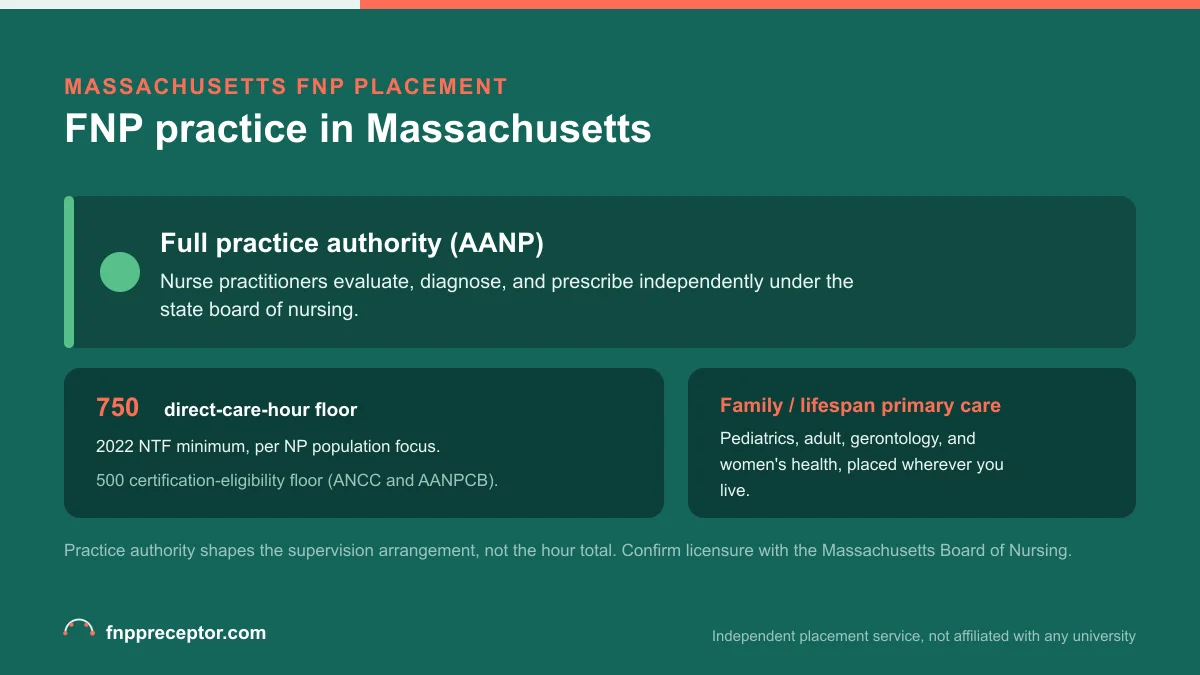
Where FNP students actually train here
The settings that carry FNP rotations in Massachusetts are ordinary primary care, not the academic medical centers the state is famous for. Community health centers do much of the work: members of the Massachusetts League of Community Health Centers serve more than a million residents across 285 or more communities and reach 98 percent of the state's zip codes, and they see the full lifespan under one roof.
Students also place into:
- Family and internal medicine groups, both independent and hospital affiliated
- Urgent and convenient care, good for volume but usually capped as a share of hours
- The state's few rural health clinics in western Massachusetts and on the Cape and Islands
- College student health, plentiful here and mostly young adults
- Correctional health at state and county facilities, adult heavy, clearance arranged early
- Home based primary care for older adults
Be careful with the large academic systems. Boston's teaching hospitals do host students, but access runs through an affiliation agreement with your school, and without that contract an individual clinician often cannot say yes. Independent practices and health centers move faster, because the decision sits with the practice.
Greater Boston versus the rest of the Commonwealth
Most clinical volume sits in Greater Boston: Boston, Cambridge, Somerville, Quincy, Lynn, Framingham, Lowell, Lawrence and Brockton. Those practices are busy, well staffed and asked constantly, because nursing, medical, physician assistant and pharmacy programs all draw from the same pool.
Move outward and the arithmetic changes. Worcester and Springfield anchor central and western Massachusetts with real systems and far less student traffic. Past them, the Berkshires around Pittsfield and North Adams, Franklin County around Greenfield, the North Quabbin towns and the Cape and Islands are where preceptor supply is loosest. Federal primary care shortage designations sit in exactly those places: Dukes and Nantucket counties, the southern Berkshires, North Quabbin, and a stretch of Hampden and Hampshire counties.
The cost out there is distance, not competition. Franklin County is the state's most rural, with one acute care hospital covering roughly 1,121 square miles, and Nantucket County has under 90 direct patient care physicians per 100,000 residents against more than 1,200 in Suffolk County. Price the commute, and on the islands the ferry and summer housing.
The four populations, and which run short here
FNP is the across the lifespan track, so your hours must span pediatrics, adults, gerontology and women's health. Two of the four are the pinch points in this state.
Pediatrics is tightest. Massachusetts separates pediatric primary care from family practice more sharply than many states, so children are seen mainly in dedicated pediatric groups and in the pediatrics departments of health centers. A family practice rotation here can run weeks without a well child visit, and Boston's pediatric subspecialty capacity rarely counts toward a primary care requirement. Start that pediatric rotation search first.
Women's health is second tightest, sitting in obstetrics and gynecology practices, hospital affiliated women's health centers and health center departments. Massachusetts has an active nurse midwifery presence, and where your school and state rules allow it a certified nurse midwife can precept those women's health hours.
Adult and gerontology hours are the least of your worries. Internal medicine, family practice, urgent care and home based primary care all carry them, and the Cape, the Berkshires and the South Coast skew older, so those regions fill gerontology fast.
What full practice authority changes about your preceptor
AANP classifies Massachusetts as a full practice state. A nurse practitioner here evaluates, diagnoses, treats and prescribes under the authority of the Board of Registration in Nursing rather than a permanent physician agreement, so an established NP can take you on under their own signature, with no collaborating physician in the paperwork.
One wrinkle matters. Massachusetts reached full practice through Chapter 260 of the Acts of 2020, and the board's regulations at 244 CMR 4.00 still require a newly certified nurse practitioner to complete supervised practice, generally two years with a qualified health care professional, before practicing independently. Preceptors here therefore skew seasoned.
That does not change what your preceptor must be: actively licensed in Massachusetts, authorized in the population you are logging, and practicing in it now. Physicians precept in many arrangements, and schools differ on which hours they accept. Confirm accepted categories in your handbook and licensure with the board. See preceptor requirements.
Timing a rotation around the Massachusetts calendar
Two seasonal patterns matter here. Cape Cod, Nantucket, Martha's Vineyard and the Berkshires absorb large summer populations, so practices there run hardest from June through August. Summer buys volume and a preceptor with no spare minutes; a shoulder season buys teaching time.
The second is academic. Greater Boston empties out in summer, making college student health a weak July choice and a strong fall or spring one, while health centers hold steady year round. Whatever the season, start earlier than feels necessary: sites here want credentialing, immunization records and a signed affiliation agreement before a preceptor commits.
Hours, paperwork, and where we come in
Know your own number first. The 2022 National Task Force standards recommend a minimum of 750 direct patient care hours per NP track, and certification through AANP or ANCC requires at least 500 faculty supervised hours. Accredited FNP programs publish totals that commonly land between roughly 540 and 800, and a good many sit below 750, so do not assume yours requires more. Confirm your total and population split at FNP clinical hours.
We are an independent placement service for FNP students at any university, independent of any school, covering the whole state from the North Shore to the Berkshires and down to the Cape. We assist with matching; we never guarantee placement, and your school makes the final call on any preceptor or site. Use the form at #match or reach us through contact with your county, term dates and the population you still need. Pricing is on the cost page.
Good to know
Does a physician need to supervise my preceptor in Massachusetts?
No. Massachusetts is a full practice authority state, so an established nurse practitioner practices under the Board of Registration in Nursing and can precept without a collaborating physician in the arrangement. Newly certified NPs are still completing a supervised practice period, so preceptors here tend to be experienced.
Can I complete all my hours at a single site?
Rarely. FNP hours must cross pediatrics, adults, gerontology and women's health, and few Massachusetts practices carry all four in volume, since pediatrics and women's health are usually separate practices here. Community health centers come closest. Most students end up using two or three sites.
Is it easier to find a preceptor outside Greater Boston?
Often yes. Central and western Massachusetts, the North Quabbin area, the Berkshires and the Cape and Islands see far less student traffic and include several federally designated shortage areas, so practices field fewer requests. The trade is travel time, plus ferry and housing costs on the islands.
How many clinical hours will I need?
That depends on your program, not the state. The 2022 NTF standards recommend at least 750 direct patient care hours per track and certification requires a minimum of 500 faculty supervised hours, but published program totals commonly fall between roughly 540 and 800, and many sit below 750. Confirm yours before booking rotations.
Plan the FNP practicum across the lifespan
Tell us your school, city, course, and remaining objectives. We will organize an independent search for possible preceptors and primary care sites, subject to program approval.