Where FNP Students Actually Get Placed in Michigan
Michigan sits in the restricted practice category on the AANP State Practice Environment map, which shapes how a family nurse practitioner rotation is structured but not who may teach you. FNP students place reasonably well in family practice, community health centers, and rural clinics; the pinch points are pediatrics and women's health. This page covers where the sites are and which populations run short.
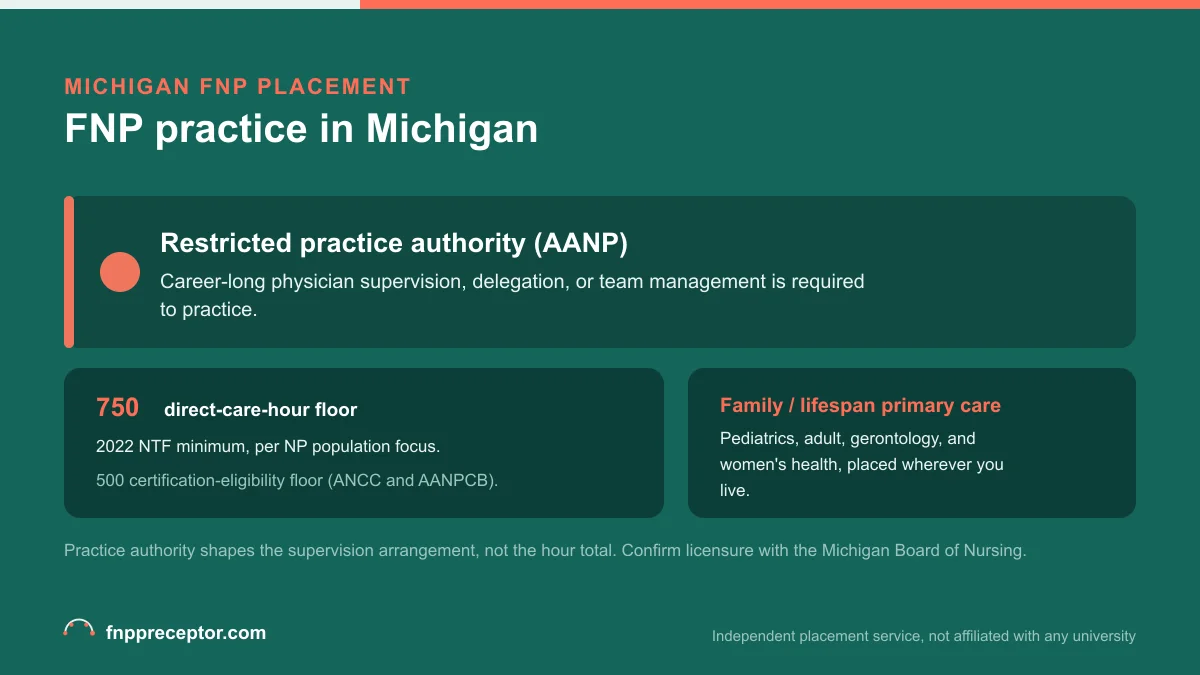
Where Michigan students actually land
Family practice carries most of it. Michigan FNP students log the bulk of their hours in primary care offices, independent or attached to a regional hospital network. The second source is community health centers: the Michigan Primary Care Association counts 50 member health centers running more than 400 locations statewide, serving about one in fourteen residents. They see a wide lifespan mix in one day, which is what an FNP logbook needs.
Past those two, the options thin out:
- Rural health clinics and critical access hospital outpatient departments across northern Michigan and the Upper Peninsula.
- Urgent care and convenient care sites in every metro: good for volume, weak for continuity.
- Student health services in college towns such as Ann Arbor, East Lansing, Kalamazoo, Mount Pleasant, and Marquette.
- Correctional health inside state facilities, adult dominant and gated behind its own clearance.
- Tribal health centers run by federally recognized tribes up north, plus seasonal clinics for agricultural workers along the Lake Michigan fruit belt.
Metro volume versus northern availability
Southeast Michigan holds most of the state's clinical volume and most of its competition. Wayne, Oakland, and Macomb counties, plus Ann Arbor and Ypsilanti, are thick with practices, but nursing, PA, and medical programs draw from the same offices, so a Detroit area request often turns on timing rather than availability. West Michigan around Grand Rapids, Holland, Muskegon, Kalamazoo, and Battle Creek is the second cluster and tends to be less saturated. Mid Michigan (Lansing, Jackson, Flint, Saginaw, Bay City, Midland) sits between them.
North of Clare the arithmetic reverses. Traverse City, Petoskey, Cadillac, Gaylord, Alpena, and the whole Upper Peninsula from Sault Ste. Marie through Marquette to Houghton often have willing preceptors and few students competing for them. The cost is travel: long drives, possibly the Mackinac Bridge, and winters that can make a two hour trip unpredictable from December through March. Price that out before you accept, not in week three.
The two populations that will slow you down here
FNP is a lifespan track, so your hours must span pediatrics, adults, gerontology, and women's health. Adult and gerontology are the easy part here: northern counties skew older, long term care and geriatric practices are plentiful, and almost any family practice gets you there. See adult and gero rotations.
Pediatrics is tighter. In the metros, peds concentrates in dedicated pediatric practices that often prioritize pediatric nurse practitioner students and medical residents. In rural Michigan it usually sits inside family practice, which helps if your program accepts pediatric hours logged in a family setting. Confirm that in writing, because some programs insist on a dedicated peds site. See our pediatric rotation page.
Women's health is the other constraint, and here it is partly a map problem. OB-GYN and midwifery concentrate in larger hospital systems and bigger towns, and obstetric services in many rural counties have consolidated into regional centers, leaving fewer small OB offices to place into. Certified nurse midwives can precept these hours under many programs, which widens the pool. More on women's health rotations.
What restricted practice changes, and what it does not
Nurse practitioners here are certified as a specialty by the Michigan Board of Nursing, inside the Department of Licensing and Regulatory Affairs. AANP places the state in the restricted category because state law keeps a physician involved in parts of NP practice. The clearest example is controlled substances, which an NP prescribes as a delegated act of a physician, with the delegating physician named on the prescription.
The practical effect on your rotation is narrower than students expect. It generally means the practice you join has a physician of record, that site paperwork may reference that relationship, and that an experienced Michigan NP precepts from inside a physician linked practice rather than a solo one. It does not change who is qualified to teach you or what you may do as a student, which your program and clinical agreement define. Confirm current rules with the board, not with any summary including this one.
Hours: use your program's number, not a national one
The 2022 National Task Force standards published through AACN recommend a minimum of 750 direct patient care hours per nurse practitioner population track. Certification eligibility sits lower: AANPCB and ANCC each require at least 500 faculty supervised clinical hours. Accredited FNP programs land across a range, commonly publishing totals between roughly 540 and 800, and a good number sit below 750. Michigan does not set a figure for you.
So the only number worth planning around is your own program's published total, plus any minimum it sets per population. Get it in writing, then work backward: total hours, weeks available, hours per week, and how many separate sites that implies. Our FNP clinical hours page walks through that arithmetic.
What a Michigan preceptor has to have
The baseline is short. Your preceptor must hold a current Michigan license, certification appropriate to their role, and active practice in the population you are logging. A pediatric only preceptor cannot sign off adult hours, and a clinician licensed solely in Ohio or Indiana cannot cover your Michigan site, which comes up in border towns near Toledo and South Bend. NPs precept most FNP students; physicians (MD or DO) precept under many arrangements, and certified nurse midwives are commonly accepted for women's health. Whether your program accepts each is a program decision, not a state one. See preceptor requirements.
If you want help with the Michigan search
We are independent, we serve FNP students at any university, and we work independently of any school. We do not guarantee placement or school approval of a preceptor or site; those calls are your program's. What we do is locate and vet candidate preceptors in the part of Michigan you can reach, confirm they are licensed and practicing in the population you still need, and hand the paperwork to your clinical office. Tell us your city, your gaps, and your start date on the form here (start here) or via contact. Pricing is on the cost page.
Good to know
Is Michigan a full practice authority state for nurse practitioners?
No. AANP classifies Michigan as restricted practice. State law keeps a physician involved in parts of NP practice, including prescribing controlled substances as a delegated act. That affects how a practice is structured, not whether an NP there can precept you.
How many clinical hours will I need for a Michigan FNP rotation?
Your hours come from your program and your certifying body, not the state. The standards recommend at least 750 per track, certification eligibility requires at least 500 faculty supervised hours, and accredited FNP programs commonly publish totals from roughly 540 to 800, with many below 750. Ask your placement office for your number.
Which rotation is hardest to fill in Michigan?
Pediatrics and women's health, the same two that are hardest almost everywhere. The Michigan wrinkle is regional: metro pediatric practices are competitive, and rural obstetric care has consolidated into regional centers, so women's health sites cluster in larger towns.
I live in metro Detroit. Should I take a placement up north?
Only after you have looked at the drive honestly. Northern Michigan and the Upper Peninsula often have availability the metros do not, but winter travel is a real variable and a missed clinical day is expensive. Some students split it, one concentrated block up north and the rest locally.
Plan the FNP practicum across the lifespan
Tell us your school, city, course, and remaining objectives. We will organize an independent search for possible preceptors and primary care sites, subject to program approval.