Clinical placement support for FNP students across Minnesota
Minnesota is a full practice authority state, so an experienced nurse practitioner here can precept you on their own license, with no physician written into the arrangement. What decides whether your Family Nurse Practitioner rotation starts on time is supply: who is taking students this term in the Twin Cities, along the southeast corridor and across greater Minnesota.
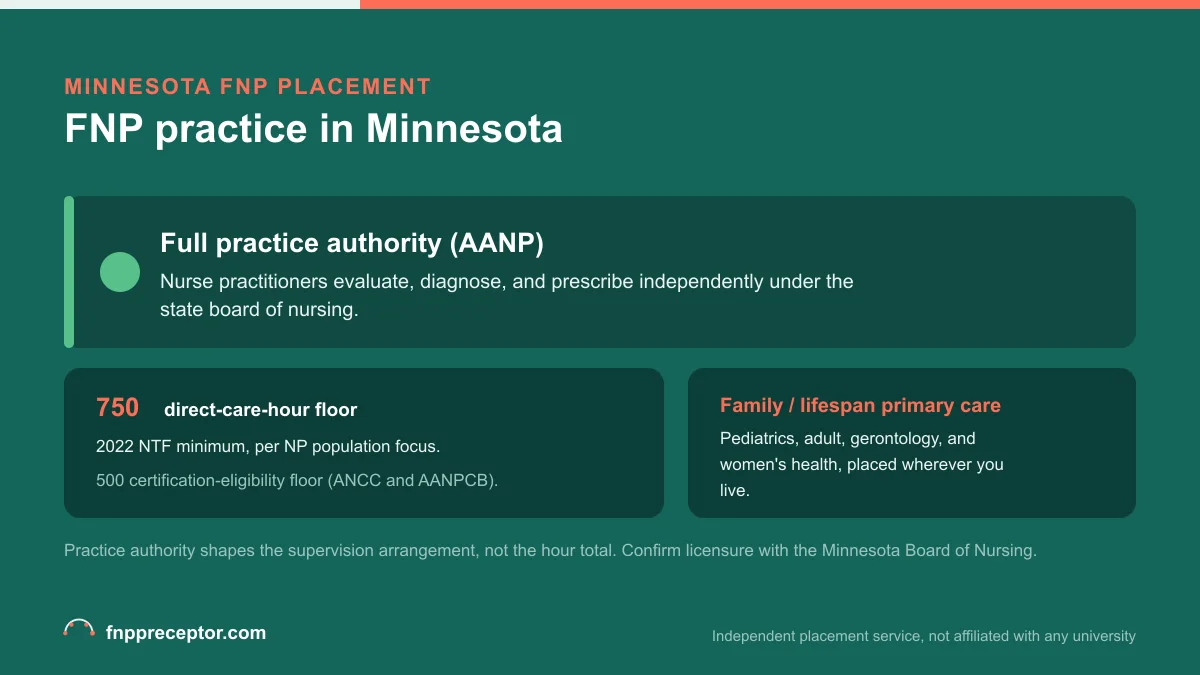
Which Minnesota settings take FNP students
Family medicine anchors an FNP rotation here, and much of it sits inside large integrated systems that route student requests through a central education office rather than the clinic. Slower than emailing a provider, but more likely to end in a signature.
- Community health centers. Minnesota had 16 federal health center program awardees serving more than 160,000 patients in the 2024 reporting year, mostly in Minneapolis and St. Paul but also in Duluth, Mankato and Moorhead.
- Rural health clinics and small family practices across greater Minnesota, where one or two providers cover a whole town.
- Urgent care, good for volume, though many programs cap those hours.
- Correctional health, adult heavy, and often open when clinics are not.
- Tribal and Indian Health Service clinics in the north, serving Ojibwe and Dakota communities, which need a school agreement first.
- Skilled nursing and senior clinics, the usual answer for gerontology hours.
The metro, the southeast corridor, and greater Minnesota
Most of the state's population sits in the Twin Cities metro, and so does the competition. Minneapolis, St. Paul, Bloomington, Maple Grove and Woodbury have deep clinic density, but every nursing and physician assistant program in the region asks the same clinics at once. Southeastern Minnesota differs: Rochester, Winona, Austin and Faribault carry a clinical footprint heavy for their size, and an hour of driving sometimes finds an opening the metro does not have.
Farther out, supply and cost trade places. St. Cloud, Brainerd and Alexandria in the center; Duluth, Bemidji, Hibbing and Thief River Falls in the north; Mankato, Willmar, Marshall and Worthington in the south and west. Preceptors there are often willing, partly because they remember their own search. The trade is travel: 60 to 90 minutes each way is common, and a Minnesota winter makes that a planning item, which is why most students cluster clinical days into two or three long days.
Pediatrics and women's health are where Minnesota students stall
FNP is the across-the-lifespan track, so your hours must span pediatrics, adult, gerontology and women's health. Adult and gerontology are the straightforward half here, since family and internal medicine panels skew older across greater Minnesota. Our adult-gero rotation page covers those settings.
Pediatrics is tighter. Dedicated pediatric practices cluster in the metro and around Rochester, and those slots go early. Elsewhere children are seen inside family medicine, so a busy family clinic in Willmar or Bemidji can produce genuine pediatric encounters without a pediatric sign on the door. Have your faculty confirm in writing that those hours will count. More on our pediatric rotation page.
Women's health is scarce for a different reason: OB-GYN practices concentrate in the metro and regional referral hubs. Certified nurse midwives are a real option where your school allows them, and in smaller towns prenatal care, contraception and well-woman exams happen inside family medicine, often the cleanest way to log the population. See our women's health rotation page.
What full practice authority changes, and what it does not
AANP classifies Minnesota as a Full Practice state, which places nurse practitioners under the licensure authority of the Board of Nursing alone. For your rotation that shapes the arrangement: an experienced Minnesota NP can take you on their own license, with no collaborating or supervising physician added to the paperwork.
It changes nothing about who qualifies. Your preceptor needs an active Minnesota license and must practice in the population you are logging, so an adult-only panel cannot sign off pediatric hours. Physicians (MD or DO) and certified nurse midwives may also precept where your school allows; see preceptor requirements. One local wrinkle: state law has required NPs to complete 2,080 hours within a collaborative agreement before independent practice, and the legislature amended that provision in 2026, so confirm the current rule with the Minnesota Board of Nursing.
Know your hour count, and one Minnesota funding note
Count hours before you count clinics. The 2022 National Task Force standards recommend a minimum of 750 direct patient care hours per NP track, while AANP and ANCC certification eligibility requires at least 500 faculty-supervised hours. Accredited FNP programs commonly publish totals of roughly 540 to 800, and many of them sit below 750. Your own program's number is the only one that governs. Our FNP clinical hours page breaks those totals down.
Minnesota also has something most states lack. The Medical Education and Research Costs program, run by the Minnesota Department of Health since 1996, compensates Minnesota clinical training facilities for part of the cost of training health professions students. Eligibility depends on the profession and the site, so ask a site's education coordinator whether your rotation qualifies. A clinic that recovers some training cost has one less reason to decline.
Timing, and where we come in
Start four to six months ahead. The slow step is rarely the preceptor saying yes. It is the affiliation agreement between your school and the site, which must exist before anyone can schedule you, so ask your placement office which Minnesota sites already have one on file. Then budget two to four weeks for onboarding paperwork and record training.
We are an independent placement service, not part of any university, and we work with FNP students enrolled anywhere, including online programs based elsewhere. If you are short a rotation in Minnesota, send your city, the population you need, your required hours and your term dates, and we will work our Minnesota network. We assist with the search; we do not guarantee a placement, and your school approves the final preceptor and site. Start at request a match or through contact; our cost page is public.
Good to know
Is Minnesota a full practice authority state for nurse practitioners?
Yes. AANP lists Minnesota as Full Practice, so state law allows NPs to evaluate patients, diagnose, order and interpret diagnostic tests, and manage treatment including prescribing, under the exclusive licensure authority of the Board of Nursing. In practice, an experienced Minnesota NP can precept you without a physician written into the agreement, though your school may add conditions.
Can a physician or certified nurse midwife precept my Minnesota rotation?
Often, yes. Many programs accept an MD or DO, and certified nurse midwives are commonly accepted for women's health hours. Minnesota law does not settle this on its own; your school's clinical handbook does. Get the approval in writing before the rotation starts.
How many clinical hours do I need for my FNP program?
Check your own program, because totals vary. The 2022 National Task Force standards recommend a minimum of 750 direct patient care hours per NP track, AANP and ANCC certification eligibility requires at least 500 faculty-supervised hours, and accredited FNP programs commonly publish totals of roughly 540 to 800, with many of them sitting below 750. Your clinical handbook holds the number you have to hit.
I am in the Twin Cities and cannot find a pediatric preceptor. What now?
Widen the radius before you widen the timeline. Family practices in St. Cloud, Mankato, Rochester and Duluth see plenty of children, and a general family panel can often carry your pediatric encounters if your faculty approves it in advance. A 70 minute drive beats losing a term.
My program is online and based in another state. Does my preceptor need a Minnesota license?
If you are completing clinical hours in Minnesota, your preceptor must be licensed and practicing in Minnesota. Online programs place students where the student lives, so the license follows the clinical site rather than the school. Verify your preceptor's license through the Minnesota Board of Nursing before day one.
Plan the FNP practicum across the lifespan
Tell us your school, city, course, and remaining objectives. We will organize an independent search for possible preceptors and primary care sites, subject to program approval.