Finding an FNP preceptor in Mississippi
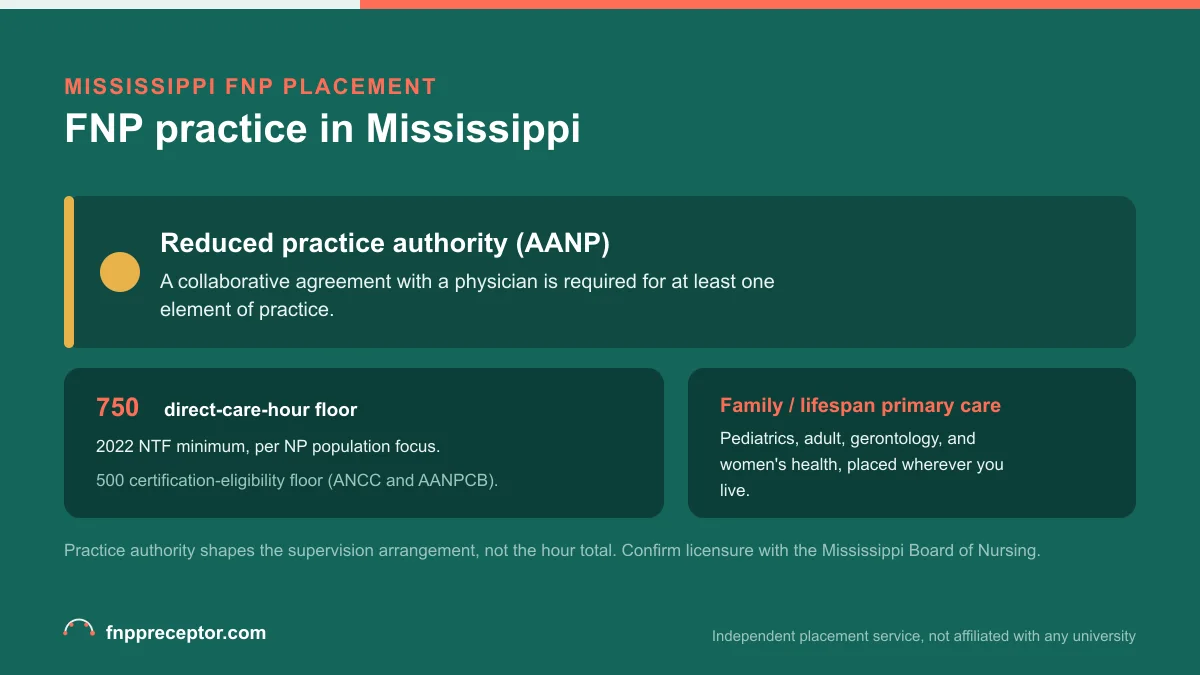
Mississippi is a reduced practice state, so the family nurse practitioner teaching you works under a collaborative agreement with a physician, and that physician often has a say in whether a student is hosted. It rarely changes who may precept you. It changes whose signature you need, which is why students here should start asking early.
Where Mississippi FNP students actually log hours
Primary care here runs on clinics with heavy panels and few clinicians, which helps when you need pediatrics, adults, gerontology, and women's health in one place. The state has 21 federally qualified health centers, each operating several clinic sites in cities and small towns. A single day at a rural health clinic can hold a toddler, a pregnant patient, a diabetic adult, and an 80 year old.
- Family practice and general internal medicine offices
- Federally qualified health centers, plus school based clinics and mobile units
- Rural health clinics, which carry the load outside the metros
- Urgent care around Jackson, the Coast, Hattiesburg, and DeSoto County
- County health department clinics, useful for family planning
- Correctional health, steady adult and gerontology volume
- Tribal health serving the Mississippi Band of Choctaw Indians
- Student health in college towns like Oxford and Starkville
- Pediatric offices, OB GYN practices, and midwifery in larger towns
Whoever you land with must be licensed in Mississippi and practicing in the population you are logging. That is where plans fall apart: a generous family practice preceptor cannot sign off on pediatric hours if children are not on the schedule. Skim preceptor requirements before you start calling.
Where the openings are, and where the competition is
The Jackson metro, Hinds, Madison, and Rankin counties with Ridgeland, Brandon, and Pearl, holds the densest supply of practices and the densest competition for them. The state's academic medical center and most specialty offices sit there, so several programs chase the same calendars.
The rest of the population sits in clusters: the Gulf Coast from Bay St. Louis through Gulfport, Biloxi, and Pascagoula; Hattiesburg and the Pine Belt; Tupelo in the northeast; the Golden Triangle of Columbus, Starkville, and West Point; Meridian; and DeSoto County, where Southaven and Olive Branch act as Memphis suburbs. Each holds enough primary care volume to fill a semester.
About half of Mississippians live outside metro areas, and that half is where preceptors are more available and less concerned with which program you attend. Delta towns such as Greenville, Cleveland, and Greenwood, the southwest around Natchez and Brookhaven, and places like Vicksburg, Laurel, and Corinth all host clinics that take students. The trade is mileage: price a full rotation of driving, and ask about longer days on fewer dates.
The four populations, and which get tight here
Adult and gerontology hours are the least of your worries. Family practice, internal medicine, health center sites, urgent care, and long term care cover them, and patients carrying several chronic conditions at once are the norm. Adult and gero rotations lists what to confirm first.
Pediatrics is harder. Dedicated pediatric offices cluster in the Jackson metro, Hattiesburg, Tupelo, the Gulf Coast, and DeSoto County. Most rural counties have no pediatric practice at all, so children are seen in family practice and at the health centers. That works if you ask up front how many well child and sick child visits land on a typical week's schedule. School based clinics are another source. See pediatric rotations.
Women's health is the tightest of the four. Obstetric care concentrates in the larger towns, so across much of rural Mississippi prenatal visits, family planning, and gynecology run through community health centers and county health department clinics rather than a private OB GYN office. Many programs accept certified nurse midwives for women's health, which widens your options. Get that in writing, and read women's health rotations.
What reduced practice actually changes for you
The American Association of Nurse Practitioners classifies Mississippi as reduced practice. Concretely, the Board of Nursing requires an APRN to hold at least one collaborative physician for each practice site, a protocol signed by both, and a quality assurance program kept on site for board inspection. An APRN can be licensed here without a practice site, but cannot begin working until the site, the physician, and the agreement are approved.
None of that disqualifies an NP from teaching you. What it changes is the approval chain: the collaborating physician and the practice owner usually have a say, your school's affiliation agreement may need the practice's signature rather than your preceptor's alone, and in a physician led office the physician may prefer to precept you directly.
The physician side sits with the Mississippi State Board of Medical Licensure, and those rules have been revised more than once, including the old distance limit. Confirm current requirements with both boards.
Hours, agreements, and your calendar
The 2022 National Task Force standards recommend a minimum of 750 direct patient care hours per NP track, while certification through AANP or ANCC requires at least 500 faculty supervised hours. Accredited FNP programs commonly publish totals of roughly 540 to 800, and many sit below 750. Open your own handbook and note the total and any per population minimums. FNP clinical hours covers how totals get split.
Start four to six months ahead. You are often dealing with independent practices and small health center administrations where no legal office is waiting to review an affiliation agreement, and that review, not the preceptor's willingness, is the slow step. Keep your school's template and your records ready to send the day someone says yes.
If you would rather not cold call every clinic in the state
We are an independent placement service for FNP students at any university. Tell us the part of Mississippi you can reach, the populations still open, and your term dates. We contact practices, check licensure and population fit, and hand back a preceptor who has already agreed. We do not promise placement, and your school still approves the site. Pricing sits at cost, the steps at how it works, and you can start at the match form or contact.
Good to know
Is Mississippi a full practice state for nurse practitioners?
No. AANP lists it as reduced practice, and the Board of Nursing requires a collaborative physician for each practice site, a signed protocol, and a quality assurance program kept on site. That shapes the practice, not whether an NP there can precept you.
Can a physician precept my FNP clinical hours in Mississippi?
In many arrangements, yes. MD and DO preceptors are commonly accepted, and certified nurse midwives are often accepted for women's health. The preceptor must be licensed in Mississippi and practicing in the population you log, and your program decides who counts.
My program is out of state and I live in Mississippi. Does that work?
Usually. What matters is that the preceptor is licensed where the hours happen, and that your school approves the site and signs an affiliation agreement with it. Some programs hold agreements only in certain states, so ask your clinical office first.
How many clinical hours will I actually need?
Check your own handbook. The 2022 NTF standards recommend at least 750 direct patient care hours per track and certification requires a minimum of 500, but accredited FNP programs publish totals across roughly 540 to 800 and many fall under 750.
Which Mississippi rotations are hardest to fill?
Pediatrics and women's health, as in most states. Both concentrate in the Jackson metro, Hattiesburg, Tupelo, the Gulf Coast, and DeSoto County. Elsewhere, look to health centers, school based clinics, and county health departments, where those visits appear on a general schedule.
Plan the FNP practicum across the lifespan
Tell us your school, city, course, and remaining objectives. We will organize an independent search for possible preceptors and primary care sites, subject to program approval.