Finding an FNP preceptor in Missouri
Missouri is a workable state for family nurse practitioner students, but the search runs very differently in St. Louis than it does in the Bootheel, and the population you still need matters more than the town you live in. Missouri is a restricted practice state, so a collaborating physician is nearly always part of the arrangement at the site you join. That shapes who signs off, not what you learn.
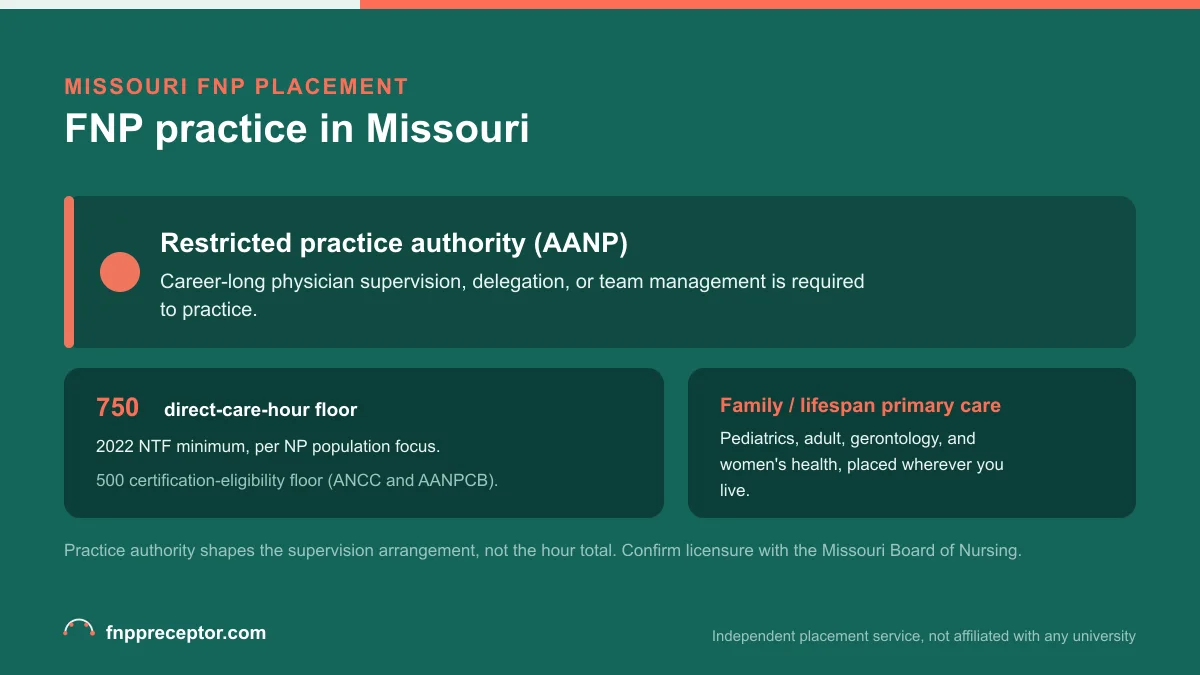
Where Missouri practices actually take FNP students
Family practice is the workhorse here. A general panel in a mid-size Missouri town sees infants, school-age kids, adults with diabetes and hypertension, pregnant patients co-managed with an obstetric group, and nursing home residents, often in one week. A single strong family site can cover much of your lifespan requirement.
Safety-net primary care is the second pillar and unusually deep here. The Rural Health Information Hub counts 319 rural health clinics and 209 federally qualified health center sites statewide, serving urban neighborhoods and thinly populated counties alike. They run broad panels by design and stay busy, so approach them early. Other settings:
- Urgent care and retail convenient care: strong for acute complaints, thin on continuity
- Student health at the larger campuses, skewing heavily toward young adults
- County health department clinics, often carrying family planning, immunizations and prenatal intake
- Correctional health, adult-heavy and rarely useful for pediatrics or women's health
- University-affiliated primary care in Columbia, St. Louis and Kansas City: strong teaching, heavy competition
Confirm how your program counts a setting, since urgent care and correctional hours get capped by some schools. See preceptor requirements.
Two big metros, several regional hubs, and a lot of open country
St. Louis and Kansas City hold the most clinics and the heaviest competition. Both host multiple nursing programs plus medical, PA and pharmacy students, so good calendars fill months ahead. Widen your radius early: St. Charles, Jefferson County, Independence, Lee's Summit, the Northland.
The regional hubs are often the better bet. Springfield, Columbia, Joplin, St. Joseph, Cape Girardeau and Jefferson City each anchor a referral region with clinic volume but a lighter student load. Driving an hour into one usually beats waiting for a site ten minutes away.
Then there is the rest of the state, which is most of its map. About a quarter of Missourians live in nonmetro areas across the Ozarks, the southeastern Bootheel and the northern farm country. Rural Missouri inverts the metro problem: willingness is there, but the nearest qualifying site may be forty-five minutes out with one or two clinicians. Mileage and winter roads become the constraint.
The four populations, and the two that get tight
The FNP track spans the lifespan, so your hours must cover pediatrics, adult, gerontology and women's health. Nearly everywhere, the first and last of those cause the trouble, and Missouri's geography changes how each behaves.
Pediatrics is usually the hardest block, and the pattern inverts by region. In St. Louis, Kansas City, Springfield and Columbia, children's care sits in dedicated pediatric practices that local programs claim first. In rural counties no separate peds office exists, so family practices carry their own pediatric panels, making a rural clinic an easier route than a metro pediatric group. See our pediatric rotation guidance.
Women's health is tight for a different reason. Obstetric and gynecologic care concentrates in the metros and regional hospital systems, and a number of rural counties have limited or no local obstetric services, leaving fewer rural sites able to offer the population. Certified nurse midwives and women's health NPs can precept it in many arrangements, and health department clinics running family planning and prenatal intake are worth calling. Check which credentials your school accepts, then see women's health rotation.
Adult and gerontology hours are the least of your worries. Between family practice, community health centers, long-term care and the retiree population around Branson and the Ozarks, volume is easy. Front-load the scarce populations and let adult and gero fill in around them.
What restricted practice changes about your rotation
The American Association of Nurse Practitioners classifies Missouri as a restricted practice state. NPs here do not practice independently; they work under a collaborative practice arrangement with a physician, governed by section 334.104 RSMo and rules at 20 CSR 2200-4.200 and 20 CSR 2150-5.100.
A few conditions decide whether a site can say yes. The collaborating physician must generally be within seventy-five miles by road, with a telehealth exception. A new arrangement starts with one month at the same location, physician continuously present. The physician reviews a set share of the NP's charts and controlled substance cases every fourteen days. And no physician may collaborate with more than six full-time-equivalent APRNs or physician assistants combined.
That cap is what students hit without knowing why: a practice already at six has no room, and a physician with a full review roster may decline on workload alone. Ask directly. The upside is that physicians commonly precept FNP students here, so your pool includes MDs and DOs. Either way your preceptor must be licensed in Missouri, in good standing, and practicing in the population you log. Verify current rules with the Missouri State Board of Nursing.
Your hours number is your program's number
The 2022 National Task Force standards recommend a minimum of 750 direct patient care hours per NP population track, and certification through AANP or ANCC requires at least 500 faculty-supervised hours. In practice, accredited FNP programs publish totals commonly landing between roughly 540 and 800, and a meaningful number sit below 750. Do not assume yours is either figure. Work from your clinical handbook and its per-population minimums, which drive the pediatrics and women's health scramble. Our FNP clinical hours page covers planning backward from graduation.
How we help with a Missouri search
We are an independent placement service, separate from any university, working with students from any FNP program. We work the phones and professional networks across Missouri and target the population you are short on.
We do not promise placement, and we do not promise your school will approve a given preceptor or site; your program has the final say. What we do is take the cold calling off your plate. Read how it works and our pricing, then send your county, term dates and remaining population through #match or contact.
Good to know
Can a physician precept me for FNP hours in Missouri?
In many program arrangements, yes. Because Missouri NPs work under collaborative arrangements with physicians, MDs and DOs are frequently approved as preceptors. Certified nurse midwives are also commonly accepted for women's health. Your school sets the final rule.
Why do Missouri clinics turn students down when the NP is willing?
The constraint often sits on the physician side. Missouri limits a collaborating physician to six full-time-equivalent APRNs or physician assistants and requires chart and controlled substance review every fourteen days. A practice at that cap may simply have no room.
Where are pediatric hours easiest to find in Missouri?
Frequently in rural and small-town family practices rather than metro pediatric offices. Dedicated pediatric groups in the larger cities get booked early by local programs, while a small-county clinic carries its own pediatric panel. Rural placement costs drive time instead of wait time.
How many clinical hours will my FNP program require?
That depends on your program, not the state. NTF standards recommend at least 750 direct patient care hours per track and certification requires a minimum of 500 faculty-supervised hours, but accredited programs publish totals roughly between 540 and 800, and many fall below 750.
Does my preceptor have to be licensed in Missouri?
Your preceptor needs a current, unencumbered license in the state where you complete the hours, and must be practicing in the population you are logging. If you live near the Kansas or Illinois line, clear any crossing with your program first.
Plan the FNP practicum across the lifespan
Tell us your school, city, course, and remaining objectives. We will organize an independent search for possible preceptors and primary care sites, subject to program approval.