Lining up FNP clinical placement across Montana
Montana is a full practice authority state, so an experienced nurse practitioner licensed here can precept you under their own license with no physician written into the arrangement. What actually decides a Montana rotation is the odometer. Close to 45 percent of residents live outside a metro area, and the clinic willing to take you is often a long drive from where you sleep, so the search starts with a map.
Family practice carries most of the load here
In a state of just over 1.1 million people there is no deep bench of specialty clinics absorbing routine care. Primary care in Montana is mostly family medicine, and family medicine sees the whole lifespan in one panel, which is the shape an FNP log needs. A morning in a Glendive or Lewistown clinic can produce a well child check, a prenatal visit and two Medicare follow ups.
- Federally qualified health centers. Member centers of the Montana Primary Care Association reach Missoula, Helena, Billings, Great Falls, Kalispell, Butte, Bozeman, Hamilton, Havre, Libby, Cut Bank, Miles City, Glendive, Hardin and Lewistown.
- Rural health clinics. Montana has 62, most attached to a small hospital and often the only primary care in a county.
- Critical access hospitals. Roughly 49 statewide, with outpatient clinics and swing beds that suit a student willing to work off the interstate.
- Hospital employed primary care. Concentrated in Billings, Missoula, Great Falls, Bozeman, Kalispell, Helena and Butte, with satellite clinics out in the valleys.
- Smaller pools. Urgent and convenient care in the cities and resort corridors, campus student health, correctional health, and long term care for gerontology hours.
Full practice authority, and the one thing it does not decide
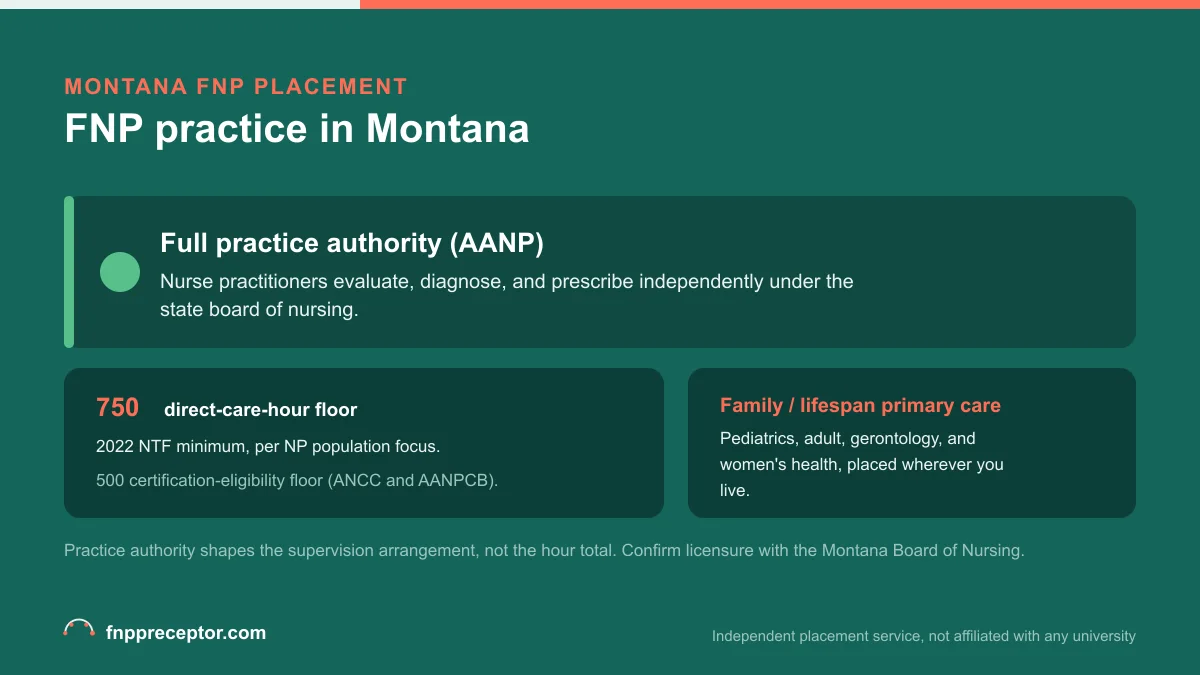
AANP places Montana in the full practice category. Nurse practitioners here evaluate, diagnose, order and interpret testing, and prescribe under the exclusive licensure authority of the Montana Board of Nursing, which also licenses nurse midwives and clinical nurse specialists.
For your rotation the effect is structural: an NP can take you on their own signature, with no collaborating physician built into the arrangement the way reduced and restricted states require. What does not change is who qualifies. Your preceptor needs a current Montana license and must be practicing in the population you are logging. Physicians precept in many arrangements and certified nurse midwives are widely accepted for women's health, but that list belongs to your school rather than the state. See preceptor requirements, and confirm licensure details with the board.
Distance is the constraint that shapes the term
Montana runs about 147,000 square miles and clinical density follows the highways: the I-90 and I-94 corridor through Missoula, Butte, Bozeman, Billings and Miles City, US 2 across the Hi-Line at Cut Bank, Havre, Glasgow and Wolf Point, and US 93 up the western valleys from Hamilton through Polson to Kalispell.
The trade is consistent. Billings, Missoula, Bozeman, Great Falls and Kalispell hold the volume and the heaviest competition from nursing, medical and physician assistant students. Smaller towns often have willing preceptors and nobody asking, and you pay in fuel, lodging and winter driving. Two moves help: ask for block scheduling, three or four long days rather than five short ones, and ask early whether the site has student housing.
Pediatrics and women's health are the two that go last
FNP is the across the lifespan track, so your hours must span pediatrics, adult, gerontology and women's health. Adult and gerontology are the easy ones here: long term care, swing beds and the older populations of the eastern counties fill them without much searching. See adult-gero rotations.
Pediatrics splits the state in two. Dedicated pediatric practices cluster in Billings, Missoula, Bozeman, Great Falls and Kalispell, and every health professions student in Montana knocks on those doors first. Everywhere else children belong to family medicine, which works if your program counts peds encounters inside a family practice rotation. If it wants a pediatrics only preceptor, you are running a hub city search and should start months ahead. See pediatric rotations.
Women's health is thinner. Obstetric coverage outside the hubs has been contracting for years, so across much of rural Montana prenatal and gynecologic care runs through family practice, health centers, public health and family planning services, and certified nurse midwives at regional hospitals. The hours usually come from a mixed schedule rather than a dedicated OB-GYN desk. If your program accepts a nurse midwife, say so early; it widens the pool noticeably. See women's health rotations.
Tribal and reservation settings need a longer runway
Montana has seven reservations, and care there runs through Indian Health Service facilities, tribally operated health programs and health centers in and around towns such as Browning, Poplar, Lame Deer, Hardin, Harlem, Box Elder and Polson. Urban Indian health programs serve Billings, Missoula, Great Falls, Helena and Butte, several of them federally qualified health centers in their own right.
Clinically these are strong FNP rotations: broad panels, real chronic disease management, the full lifespan rather than a filtered slice of it. Administratively they are the slowest sites in the state to enter, so ask up front about background checks, immunization records, and whether your school already holds an agreement with that site.
Hours, lead time, and handing the search off
The 2022 NTF Standards recommend a minimum of 750 direct patient care hours per nurse practitioner track, and AANP and ANCC certification eligibility requires at least 500 faculty supervised hours. Accredited FNP programs commonly publish totals of roughly 540 to 800, and a real share of them sit below 750, so do not assume yours. Find the figure in your handbook, then divide it across the four populations before you contact anyone; FNP clinical hours explains the usual split.
Give yourself four to six months, longer for tribal sites or a large hospital system, since affiliation agreements can take a full term. Small clinics are also interruptible: when one of two providers is out, your schedule closes for a week. Build in buffer and log hours as you go.
That is where we come in. We are independent, we work with FNP students at any university, and we run the outreach and paperwork so you are not cold calling clinics between shifts. We do not guarantee placement or your school's approval of any preceptor or site. Use the form at #match or reach us through contact; how it works and cost cover the rest.
Good to know
Does a physician have to supervise my preceptor in Montana?
No. Montana sits in the AANP full practice category, so a qualified nurse practitioner can practice and precept under their own license without a collaborating or supervising physician required by the state. Your school can still add its own conditions, so confirm the preceptor's license and population match before you commit.
Is it worth taking a rural Montana placement?
Often yes, if you plan the travel honestly. Rural health clinics and critical access hospitals regularly have preceptors with capacity and no competing students, and their panels cover the full lifespan. Ask about block scheduling and student housing before you accept, and picture the drive in January.
Where do Montana students find pediatric hours?
Dedicated pediatric practices are concentrated in Billings, Missoula, Bozeman, Great Falls and Kalispell, and they book out early. Outside those cities children are seen in family practice and community health centers, which works if your program allows peds encounters inside a family practice rotation. Confirm that rule with your placement office first.
How many clinical hours will I need?
It depends on your program. National guidance recommends a minimum of 750 direct patient care hours, certification bodies require at least 500 faculty supervised hours, and published program totals commonly land between about 540 and 800. Your own handbook is the only authority on your number.
Plan the FNP practicum across the lifespan
Tell us your school, city, course, and remaining objectives. We will organize an independent search for possible preceptors and primary care sites, subject to program approval.