Preceptor placement for FNP students across Nebraska
Nebraska sits in the full practice category, so an established nurse practitioner here can precept you with no physician attached to the arrangement. That widens the pool, but it does not touch what actually delays students here: pediatric and women's health hours, and the distance between willing preceptors and where students live.
Where FNP students actually land in Nebraska
Most FNP clinical time here happens in ordinary outpatient family practice: independent clinics, physician group offices, and system owned primary care in Omaha, Lincoln, Grand Island, Kearney, Norfolk, Columbus, Hastings, North Platte and Scottsbluff. Family practice is the best structural fit for a lifespan student, because one panel can feed several populations in the same week.
- Community health centers. The Health Center Association of Nebraska lists nine organizations running roughly 91 sites across Omaha, Lincoln, Grand Island, Norfolk, Columbus, Gering and South Sioux City. FQHC panels skew toward the mixed, underserved primary care you should be seeing.
- Rural health clinics and critical access hospitals. About 126 certified rural health clinics and 61 critical access hospitals, most with attached outpatient primary care.
- Urgent and convenient care in the metros: good for volume, thin on continuity, often capped by schools.
- Campus student health in Lincoln, Omaha and Kearney, heavy on young adults and routine screening.
- Correctional health, dense in adult and gerontology, usually short on people willing to teach.
- Tribal health in the northeast. Four federally recognized tribes are headquartered here, with facilities around Winnebago, Macy, Norfolk and Omaha under the IHS Great Plains Area. Access runs through each tribe's own approval process.
The I-80 corridor, and everything north and west of it
Roughly 677,000 Nebraskans, about a third of the state, live outside metro counties, and that figure explains most of what happens to students. The eastern corner holding Omaha, Bellevue and Lincoln has the clinic volume and also the competition: nurse practitioner, physician assistant and medical students pull from the same offices, and a preceptor who takes three learners a year is booked months ahead.
Move west and the ratio inverts. Grand Island, Kearney, North Platte, and the Scottsbluff and Gering area serve large catchments with fewer people asking, so clinicians are often more open to teaching. The cost is mileage, and Panhandle sites can mean staying over. Set your limit early, because a confirmed preceptor 150 miles out beats a maybe ten minutes away. The Sandhills and far west have real family practice supply but few specialty offices, so plan general hours there and narrower populations nearer a hub.
Pediatrics and women's health are where Nebraska students stall
FNP is the across the lifespan track, so your hours must span pediatrics, adult, gerontology and women's health, and most programs audit that spread, not only the total. Adult and gerontology are the easy part here: a typical family panel fills them, and long term care adds depth if your log runs light.
Pediatrics is the harder ask. Dedicated pediatric practices cluster in Omaha and Lincoln, and those offices field requests from several programs at once. West of Lincoln, children are largely seen inside family practice, so the realistic play is a family clinic with a young panel, a community health center pediatric schedule, or a public health or school based clinic. That counts for many programs, but confirm how your faculty want a mixed panel day documented. See our pediatric rotation page.
Women's health is the other pinch point. OB-GYN and midwifery concentrate around Omaha, Lincoln and the regional hubs, and obstetric services in rural Nebraska have thinned, pushing prenatal and gynecologic care back into family practice and community health centers. For a student that is often the better classroom, since a clinician doing prenatal visits inside a family panel shows more range than a narrow subspecialty office. Midwives are approved for these hours under many school policies. See women's health and adult gero.
Full practice authority, and the wrinkle Nebraska adds
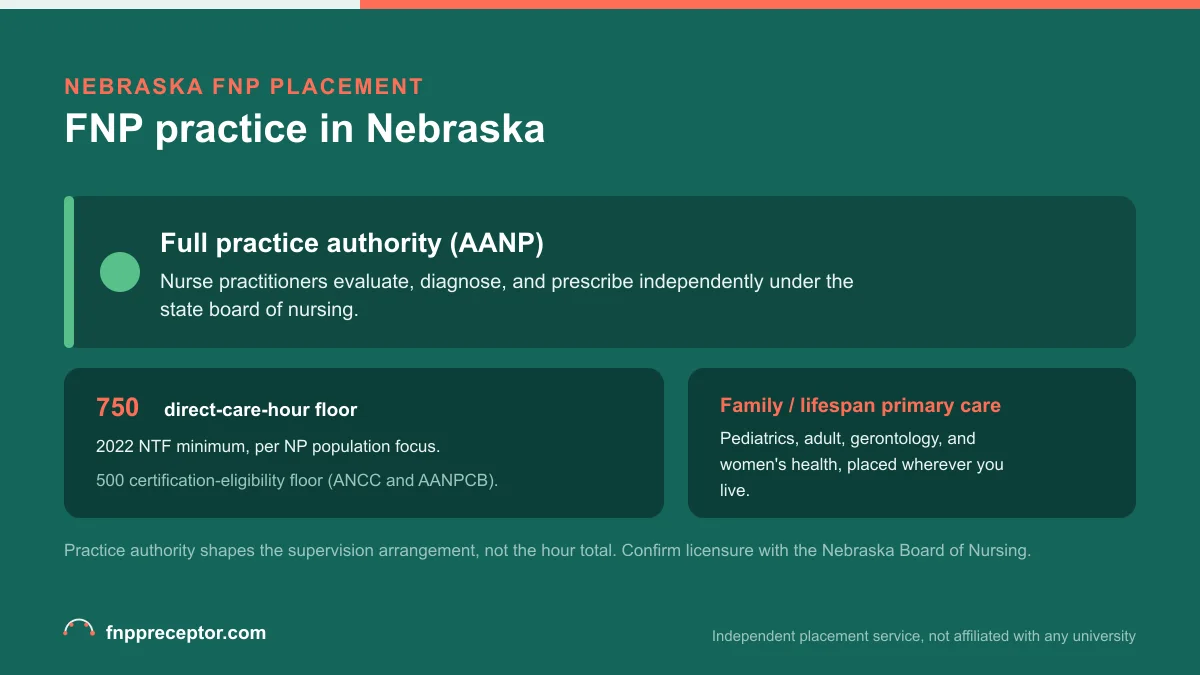
AANP places Nebraska in the full practice category. Since LB 107 took effect in 2015 the state no longer requires an ongoing integrated practice agreement with a physician, so an established Nebraska NP can evaluate, diagnose, order tests and prescribe under state licensure authority, and can precept you with no physician signature on the practice side.
The wrinkle is the transition to practice period. A newly licensed Nebraska NP works under a transition to practice agreement for the first 2,000 hours, supervised by a physician or an NP with at least 10,000 practice hours. So a clinician still inside their own first 2,000 hours may not be an appropriate teacher for you, and some schools will not approve one. Asking how long someone has practiced as an NP here is an ordinary question. Confirm current rules with the Nebraska Department of Health and Human Services Division of Public Health Licensure Unit.
Hours, and what your preceptor has to have on paper
Be skeptical of a single national hour count. The 2022 NTF Standards recommend a minimum of 750 direct patient care hours per NP track, while certification is a separate, lower bar: AANPCB and ANCC each require at least 500 faculty supervised hours. Accredited FNP programs publish totals across roughly 540 to 800, and plenty sit below 750. The only number governing you is the one in your handbook, so pull it along with the per population minimums and any cap on hours at one site, since those caps force a second preceptor. Our clinical hours page works the arithmetic.
Two preceptor requirements are near universal: an active, unencumbered Nebraska license, and current practice in the population you are logging. A cardiology NP cannot sign pediatric hours. Nurse practitioners are the default, physicians in family medicine and pediatrics are accepted by most programs, midwives are commonly approved for women's health, and physician assistant acceptance varies by school.
Your school then adds a CV, license verification, sometimes malpractice detail, and an affiliation agreement with the clinic. That agreement quietly kills more placements than anything else, because a clinic that says yes out loud may still decline to sign a contract. Start it the day you get a verbal yes. Preceptor requirements lists what we need.
Working with us
We are an independent service working with FNP students from every program, which is why we can tell you what different schools will and will not approve. We do the outreach, screen for license and population fit, and hand you a preceptor who has agreed to teach and to sign your paperwork.
We assist. We do not guarantee placement, and your faculty still rule on any preceptor or site. What we can do is keep you from cold emailing sixty Nebraska clinics between shifts. Send your city, outstanding populations, term dates and driving limit through #match or contact.
Good to know
Does full practice authority mean any Nebraska NP can precept me?
An experienced Nebraska NP can precept independently, with no physician on the practice side. A newly licensed one is different: for the first 2,000 hours they work under a transition to practice agreement, and many programs will not approve a preceptor that early on. Your school's own minimum, often one to two years in the population, is usually the tighter limit.
Can a physician or a nurse midwife precept my FNP hours here?
Usually yes for physicians. MDs and DOs in family medicine and pediatrics are accepted by most FNP programs, and certified nurse midwives are commonly approved for the women's health portion specifically. Physician assistant acceptance varies. Nebraska law does not decide this; your program's clinical handbook does.
Where are pediatric hours easiest to find in Nebraska?
Omaha and Lincoln hold the dedicated pediatric practices, and the heaviest competition for them. Elsewhere, plan on family practice with a young panel, a community health center pediatric schedule, or public health and school based clinics. Ask in advance how your faculty want mixed panel days recorded.
Do I actually need 750 clinical hours?
Only if your program says so. The 2022 NTF Standards recommend 750 per track, certification bodies require at least 500 faculty supervised hours, and published FNP program totals commonly land anywhere from about 540 to 800. Build to the number in your own handbook, not one from a forum.
Plan the FNP practicum across the lifespan
Tell us your school, city, course, and remaining objectives. We will organize an independent search for possible preceptors and primary care sites, subject to program approval.