Clinical Placement for FNP Students Across New Jersey
New Jersey is an AANP reduced practice state, so the nurse practitioner precepting you may still work under a formal arrangement with a physician, and that often decides how fast a practice can take a student. The advantage here is geography: a preceptor forty minutes away is ordinary. The difficulty is that every nursing program in the region calls the same offices.
Where FNP hours actually get logged here
Nearly all of your family nurse practitioner hours will be outpatient, and New Jersey packs a lot of outpatient primary care into a small footprint. Independent family practice groups remain the most common student setting, followed by primary care offices owned by the large hospital systems. System offices have formal student agreements and slower approvals; an independent group can decide in a week.
Other settings that regularly host FNP students here:
- Community health centers. The New Jersey Primary Care Association represents 23 federally qualified health center organizations plus one look-alike, running roughly 130 sites across all 21 counties. Their unscreened patient mix suits a lifespan log.
- Urgent and convenient care, dense along the commuter corridors and shore counties, though visits skew episodic.
- College student health, steady young adult and women's health encounters.
- Correctional and county jail health, consistent adult and behavioral exposure and far less contested.
- Home based primary care and long term care, which fills gerontology fastest.
Most FNP programs count only limited inpatient or subspecialty time toward a primary care track, so confirm what yours accepts before committing a semester.
North, central, and south are three different markets
North Jersey, meaning Newark, Jersey City, Paterson, Elizabeth, and the Bergen and Essex suburbs, holds the most clinicians and the most students competing for them. Practices there field requests constantly and many have stopped accepting. Volume is never the problem in the north; access is.
The central belt around New Brunswick, Edison, Princeton, and Trenton is the most contested ground, because it also draws students from New York and Pennsylvania programs. Widening your radius by twenty minutes helps more there than anything else.
South Jersey changes the math. Camden and Cherry Hill compete with Philadelphia's student pipeline, but once you reach Cumberland, Salem, and Cape May counties and the farm areas around Vineland, Bridgeton, and Millville, supply relative to demand improves. The same holds in Sussex, Warren, and Hunterdon. Those areas carry federally designated primary care shortage populations, so clinicians are busy but far less picked over, and the extra drive is usually under an hour.
Two of the four populations are the whole difficulty
The FNP track runs across the lifespan, so your hours must reach pediatrics, adults, gerontology, and women's health. Adult and gero take care of themselves here: internal medicine, family practice, urgent care, long term care, and home based primary care all produce that population in quantity. See adult and gero rotations.
Pediatrics is the first bottleneck. Most well child and sick child care in New Jersey happens inside dedicated pediatric practices rather than mixed family offices, and those are the same practices pediatric nurse practitioner students are chasing. A family practice that truly sees children across the age range is worth more than a large adult panel. See pediatric rotations.
Women's health is the second. Routine gynecologic and prenatal care sits mostly in OB-GYN group practices and hospital women's health service lines, not general family medicine. Certified nurse midwives practice widely here and, depending on your school's rules, a CNM can often precept women's health hours. That opens more doors than most students realize. See women's health rotations. Start those two searches first and let adult and gerontology fill in around them.
What reduced practice means for the person teaching you
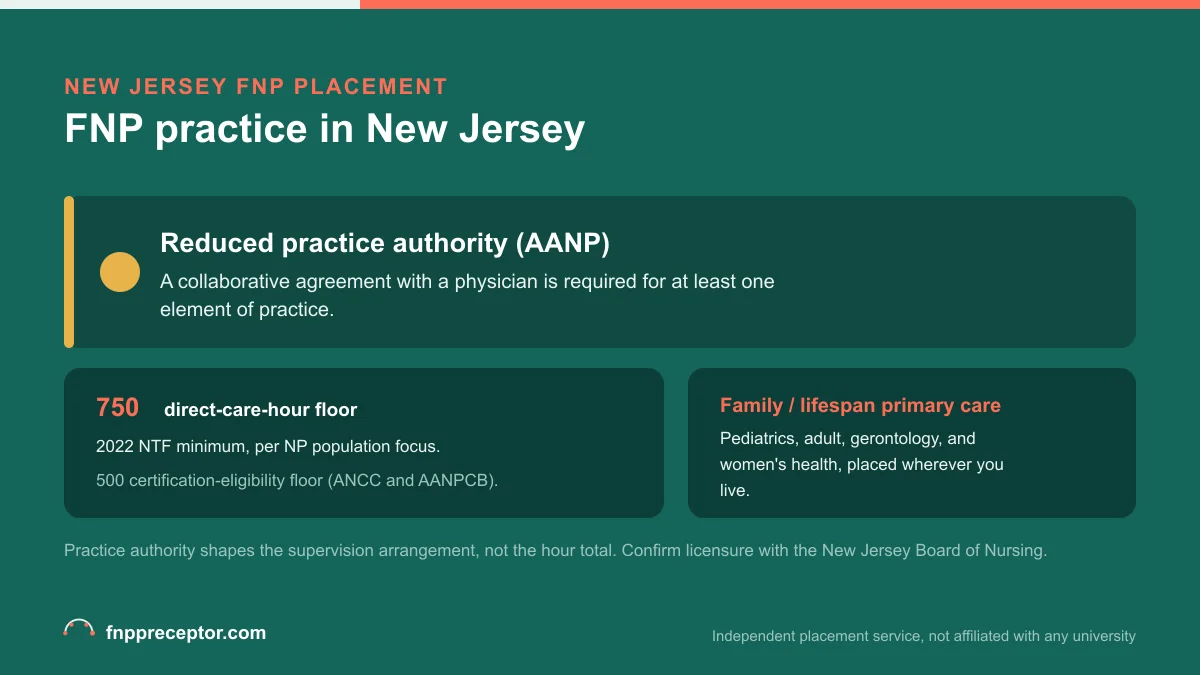
AANP classifies New Jersey as reduced practice, meaning state law limits at least one element of independent nurse practitioner practice. Here that element was prescribing: under Board of Nursing rules, an advanced practice nurse needed a joint protocol with a New Jersey licensed collaborating physician before prescribing medication or devices.
That changed in 2026. New Jersey enacted S2996 and A4052 on March 30, 2026, dropping the joint protocol requirement for qualifying advanced practice nurses who deliver primary or behavioral health care. As passed it reaches APNs with more than 5,000 hours of active advanced practice and excludes elective aesthetic services. AANP still lists the state as reduced, so confirm current rules with the board.
For a student the effect is narrower than it sounds. It changes the arrangement around your preceptor, not what makes a preceptor acceptable to your school. An experienced NP may now precept with no physician attached while a newer one in the same office still has one. Either way your preceptor needs an active New Jersey license and must practice in the population you log. See preceptor requirements.
Get your own hour requirement in writing first
There is no single national number, and this trips up more students than any legal question. The 2022 National Task Force Standards published through AACN recommend a minimum of 750 direct patient care hours per nurse practitioner track, while AANP and ANCC certification eligibility requires at least 500 faculty supervised hours. Accredited FNP programs publish totals from roughly 540 to 800, and many sit below 750.
So do not assume yours. Find your exact total, the hours expected per population, and whether your school caps hours per site or per preceptor. Those answers decide how many separate placements you need, the only figure that matters once you start asking practices. See FNP clinical hours.
Confirm the paperwork early too. New Jersey sites usually want an affiliation agreement with your school, which can take longer to execute than the search itself did.
Where we come in
We are an independent placement service, separate from any university, and we work with FNP students wherever they are enrolled. We do the outreach: finding New Jersey clinicians in the population you still need, confirming licensure and willingness, and handing you someone who has already agreed. We do not claim placement is guaranteed, and your school still holds approval of any preceptor or site.
To start, use the form at #match with your county, the populations you still need, and your term start date. Our process is on how it works, pricing on cost, and other states at our state index.
Good to know
Can a physician precept my FNP hours in New Jersey?
In many arrangements, yes. MDs and DOs practicing in the population you log are accepted by a large share of FNP programs, and certified nurse midwives are commonly accepted for women's health. The limit is rarely state law; it is your school's preceptor policy, so get that in writing.
Did the 2026 law change who is allowed to precept me?
Not directly. It changed whether qualifying advanced practice nurses need a joint protocol to practice and prescribe. Preceptor eligibility is set by your program and by accreditation standards. You may find some nurse practitioner owned practices easier to arrange with, since there is one fewer party to the agreement.
How far should I expect to drive for a placement here?
Less than students in most states. In the northern and central counties, plan on twenty to fifty minutes and be willing to cross a county line, since the search radius matters more than the mileage. Multi hour commutes are rare in New Jersey.
Why are pediatrics and women's health the hardest to fill?
Because in New Jersey both sit in dedicated practices rather than spread through general family medicine. Pediatric offices are also targeted by pediatric nurse practitioner students, and OB-GYN practices field requests from midwifery students. You are competing inside a smaller pool of sites.
Does my preceptor have to be licensed in New Jersey?
Your preceptor must be licensed in the state where you physically complete the hours and must practice in the population you are logging. If you live near the New York or Pennsylvania line and plan to cross it, that changes which license applies and which paperwork your school needs. Settle it with your clinical coordinator first.
Plan the FNP practicum across the lifespan
Tell us your school, city, course, and remaining objectives. We will organize an independent search for possible preceptors and primary care sites, subject to program approval.