Preceptor matching for FNP students in New York State
New York is a full practice authority state, so an experienced nurse practitioner here can precept you without a physician written into the arrangement. That removes a legal obstacle; it does not create clinical seats. The real work is finding a family practice, health center or specialty office with room for one more learner, in a state where downstate sites are committed months ahead while upstate offices often have never had a student walk in.
Your four populations, and how New York splits them up
FNP is the across the lifespan track, so your hours have to reach pediatrics, adult, gerontology and women's health. New York divides those four differently depending on where you stand. In the five boroughs and the Nassau, Suffolk and Westchester suburbs, children are largely seen in dedicated pediatric practices and obstetrics sits inside hospital affiliated groups, which turns peds and women's health into separate placements with separate approvals. Upstate the pattern reverses: a family practice in Utica, Elmira or Watertown often keeps toddlers, pregnant patients and 85 year olds on one panel, so a single site can carry three populations.
Two lighter doors are specific to this state. School based health centers sit inside New York public schools and are a real source of pediatric contact that students overlook. And New York licenses midwifery as its own profession through the State Education Department, so a licensed midwife can be a strong women's health preceptor where your program accepts one. See pediatric rotations and women's health rotations. Adult and geriatric hours are the least contested part of a New York calendar; lock them early anyway, because they anchor everything else. See adult and gero rotations.
Full practice authority here comes with an hour count
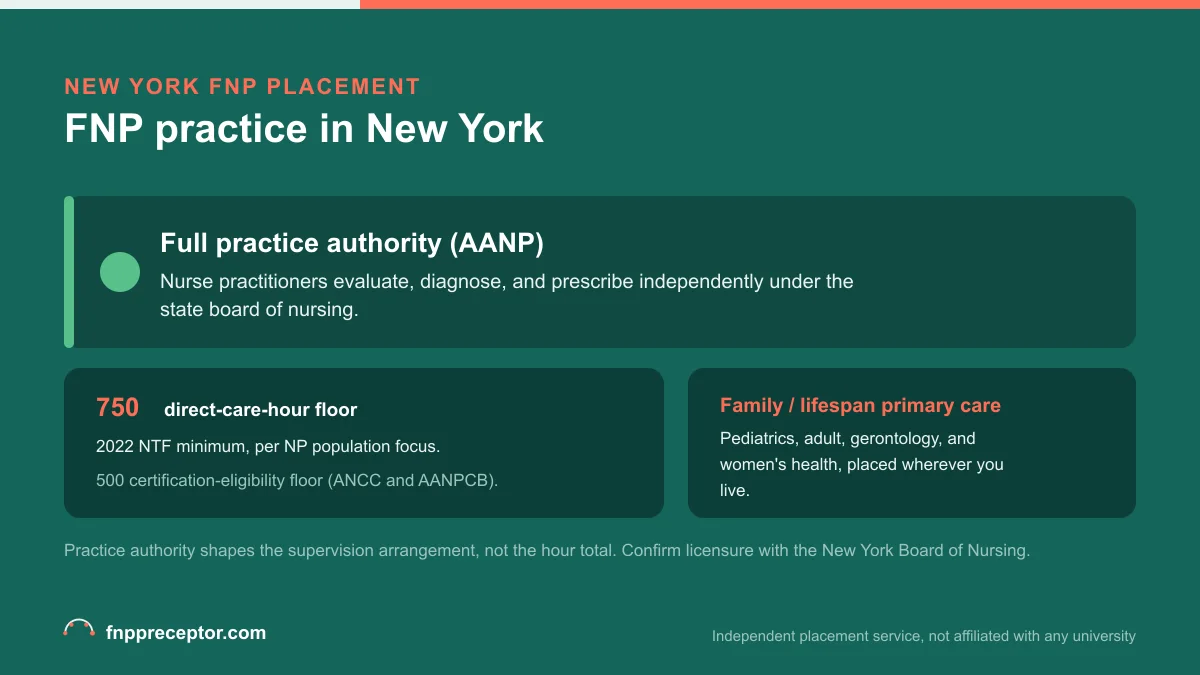
AANP classifies New York as a full practice state, but the New York version has a threshold inside it. Under State Education Department rules, a nurse practitioner who has completed 3,600 hours of qualifying practice experience may work without a written practice agreement and protocols with a collaborating physician. One below 3,600 hours still practices under that agreement, with a physician qualified in the same specialty area. The Legislature extended the current independent practice provisions to July 1, 2030, so confirm the rule in force with the board.
That changes the shape of the arrangement, not your preceptor's core qualifications. An experienced nurse practitioner past the threshold can precept you with nobody else on the paperwork. A newer one may be excellent clinically and still have a collaborating physician in the background, which some site approval forms ask about. Physicians can precept FNP students where your program permits it, and physician led practices are common in rural counties.
One New York detail catches students out late. The State Education Department certifies nurse practitioners into named specialty areas, among them Family Health, Pediatrics, Obstetrics and Gynecology, Women's Health and College Health, and prescribing authority is tied to the certified area. Match the population you are logging to your preceptor's certified area, not to the sign on the door. See preceptor requirements.
The clinic types that host FNP students in New York
New York primary care is not one market. These site types host FNP students most often here:
- Family and internal medicine practices, from two provider offices to multi site groups.
- Federally qualified health centers, dense in the South Bronx, central Brooklyn, northern Manhattan, Buffalo, Rochester, Syracuse and Utica.
- Rural health clinics and hospital owned primary care sites in the North Country, the Southern Tier and the western counties.
- Urgent care, heaviest on Long Island and in the metro suburbs.
- School based health centers, and campus student health, which New York recognizes as its own specialty area.
- Correctional health, in the New York City jail system and at state facilities upstate.
- Tribal health serving the Akwesasne Mohawk community and Seneca Nation communities in western New York.
- Migrant and seasonal farmworker health across the Finger Lakes, the Hudson Valley and eastern Suffolk County.
Community health centers deserve their own mention. They sit where primary care is thinnest and tend to be teaching minded; the state primary care association reports its member centers serve more than 2.5 million New Yorkers across close to 900 sites. The tradeoff is administrative, since student requests route through a central education office rather than the clinician who said yes in the hallway.
Downstate is crowded, upstate has room
New York City, Long Island and the lower Hudson Valley hold most of the state's clinical volume. They also hold most of its nursing programs, and that is the problem. In Brooklyn, Queens, the Bronx and Yonkers, a strong preceptor is often already committed to a medical student, a physician assistant student, or a nurse practitioner student from another program.
Head north or west and the arithmetic flips. Practices around Albany, Utica, Syracuse, Rochester, Buffalo, Binghamton, Watertown and Plattsburgh see real complexity and rarely turn students away for lack of room. The cost is distance, since a rotation in the Adirondack region or the far western counties can add serious driving to both ends of a clinic day. Poughkeepsie, Newburgh and Kingston are the middle ground, reachable without relocating.
Hour totals: the only number that matters is your program's
Bad numbers circulate, so be precise. The 2022 National Task Force standards published through AACN recommend a minimum of 750 direct patient care hours per nurse practitioner population track, while AANP and ANCC certification eligibility starts at 500 faculty supervised hours. Accredited FNP programs publish totals commonly between roughly 540 and 800, and many of them sit below 750. New York does not set your total; your program does. Read your own handbook, and see FNP clinical hours for how the counting works.
Paperwork, lead time, and the part we handle
Two things decide whether a New York placement happens: how early you start, and who can sign. Health systems and health center networks route student requests through a central education or compliance office, and an affiliation agreement with your school can take weeks; a small practice can agree in one conversation. Start two to three semesters ahead downstate and one semester ahead elsewhere, with immunizations, background check, malpractice coverage and compliance modules ready.
That outreach is what we do. Tell us your county, populations and dates using the match form, and we work our New York contacts to find a preceptor licensed and certified here, practicing in the population you need and willing to sign your school's forms. We are independent and work with students at any university. We do not guarantee placement or your school's approval of any preceptor or site; fees are on the cost page, or contact us.
Good to know
Does New York full practice authority mean my preceptor has no physician involved?
It depends on their experience. A nurse practitioner past 3,600 hours of qualifying practice may work without a written practice agreement with a collaborating physician; one below that threshold still has an agreement. Neither disqualifies them, but your school's form may ask.
Can a physician precept my FNP clinical hours in New York?
In many arrangements yes, and it is common in rural New York where the practice is physician led. Whether it counts is your program's call, not the state's. Most schools accept MD and DO preceptors for part of the hours and want the balance with a nurse practitioner. Get the split in writing.
Is it easier to find a preceptor upstate than in New York City?
Generally yes on availability, no on convenience. Practices in the Southern Tier, the North Country and the Mohawk Valley are far less saturated with students than Brooklyn, Queens or Nassau County. You trade competition for a commute.
Do I need a separate preceptor for pediatric hours in New York?
Downstate, usually, because children in the metro area are mostly seen in dedicated pediatric practices. Upstate, family practices more often keep children on the panel, so one site can cover pediatric and adult hours. Ask a prospective site what share of its panel is under 18.
Does my preceptor's New York specialty certification matter?
Yes, more than in most states. The State Education Department certifies nurse practitioners into named specialty areas such as Family Health, Pediatrics or Obstetrics and Gynecology, and prescribing authority is tied to that area. Match your logged population to it.
Plan the FNP practicum across the lifespan
Tell us your school, city, course, and remaining objectives. We will organize an independent search for possible preceptors and primary care sites, subject to program approval.