Finding an FNP clinical preceptor across North Carolina
North Carolina has a deep primary care bench and a crowded student pool competing for it. The practices that host family nurse practitioner students cluster in a few metro corridors, then thin out fast across the coastal plain and the western mountains. This page covers where FNP rotations actually happen in the state, which lifespan populations are hardest to cover, and how North Carolina's supervision rules shape the paperwork behind a placement.
Where FNP students actually rotate here
Family practice carries most FNP placement in North Carolina. Independent and small-group family medicine offices still exist in real numbers in the smaller towns along the I-85 and I-40 corridors. The large health systems in Charlotte, the Triangle, the Triad, and the east run employed primary care networks, and those tend to have formal student agreements your school must sign before any individual clinician can say yes to you.
Federally qualified health centers matter enormously here. The state's community health center association represents dozens of organizations serving close to half a million patients, and their panels run infants through elders in the same half-day. The Office of Rural Health also supports state-designated rural health centers in underserved communities. Past that core, students log hours in urgent care, student health, occupational health, correctional health, and county health department clinics, though those settings rarely cover every population on their own.
Metros, the coastal plain, and the mountains
The state splits into a few placement markets. Charlotte and Mecklenburg County, the Raleigh and Durham and Chapel Hill Triangle, and the Greensboro and Winston-Salem Triad hold the most clinics and also the most nursing students. Wilmington, Asheville, Fayetteville, and Greenville each anchor a smaller market mixing system clinics and independents.
Then there is everything else. Counties like Robeson, Halifax, Bertie, and Duplin in the east, and the mountain counties beyond Buncombe, have fewer providers per resident. Provider distribution in North Carolina has historically skewed toward cities and larger towns, which is why the state funds rural health infrastructure at all. For a student that cuts both ways: a rural clinic often says yes because nobody else asked this semester, but you may be driving forty to ninety minutes each way for a full term. Widening your radius by an hour is usually the highest-yield move when a metro search stalls.
Which populations are hardest to cover here
FNP is an across-the-lifespan track, so your hours have to reach pediatrics, adults, gerontology, and women's health. Adult and geriatric hours are the easy part in North Carolina. Between family practice, internal medicine, urgent care, and large retiree populations in the Triangle, on the coast, and in the mountains, most students fill those without much trouble.
Pediatrics is the first pinch point, because much of the state's peds volume sits in dedicated pediatric practices that field requests from FNP, PNP, PA, and medical students at once. Community health centers and health department child health clinics are usually the better path. Women's health is tighter still: OB-GYN practice concentrates in hospital-affiliated groups, and obstetric coverage has thinned in some rural counties, so certified nurse midwives and family planning services inside FQHCs and health departments carry much of the load. Start that search first. Our women's health rotation and pediatric rotation pages cover what each one needs documented.
North Carolina supervision rules, in plain terms
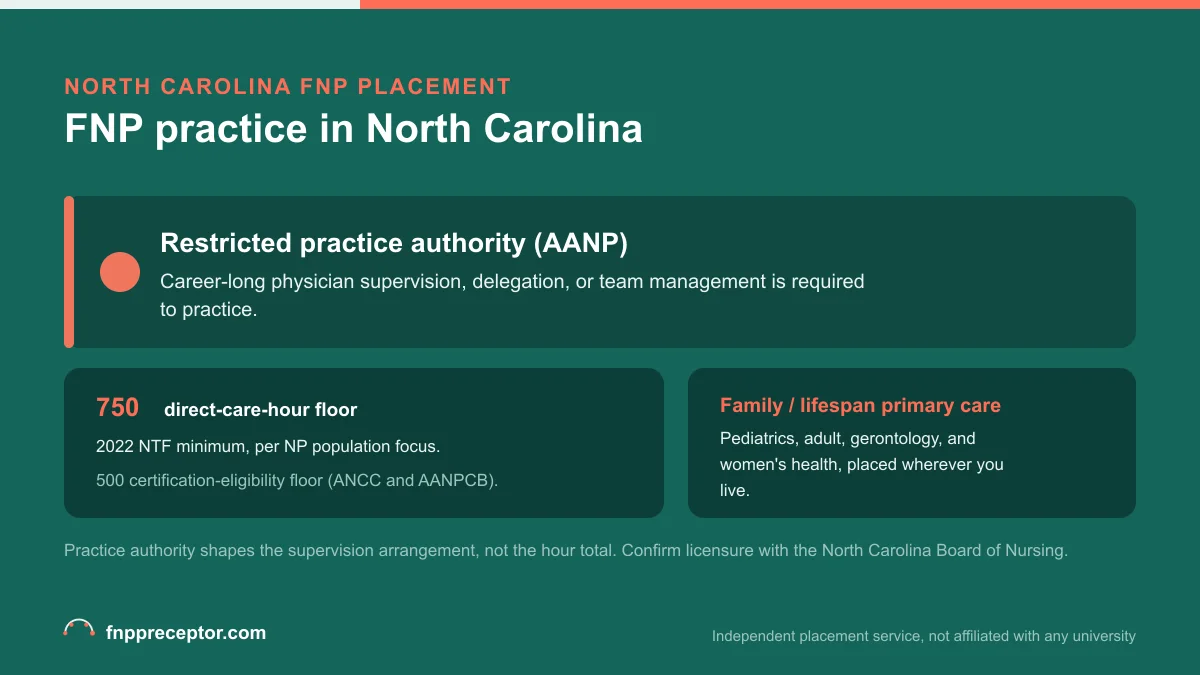
The AANP State Practice Environment lists North Carolina as a restricted practice state. Nurse practitioners here are jointly regulated by the North Carolina Board of Nursing and the North Carolina Medical Board, and practice requires a written collaborative practice agreement with a physician available for consultation, collaboration, referral, and evaluation of the care given. The approval rules sit in the Medical Board's Subchapter 32M and in the Board of Nursing's matching rules.
For a student, the effect is narrower than it sounds. It does not change what makes a good preceptor: a licensed clinician practicing in your population, willing to teach, with enough volume to keep you busy. It changes the arrangement around that clinician. In a full practice state an experienced NP can often precept on her own signature. Here the NP preceptor already works under a collaborative agreement, so a physician is usually part of the site's structure and your request may route through that physician or a system education office. Expect one extra approval layer, and confirm licensure details with the Board of Nursing rather than any summary, including this one.
Hours: check your own program's number
There is a persistent myth that every accredited FNP program requires 750 clinical hours. It is not true. The 2022 NTF Standards recommend a minimum of 750 direct patient care hours per NP population focus, and ANCC certification eligibility requires at least 500 faculty-supervised hours. Accredited programs publish totals commonly ranging from about 540 to 800, and plenty of them sit below 750. The only number that governs your planning is the one in your own handbook, plus any per-population minimum and any cap on hours from one site. Pull it before you contact a clinic. See FNP clinical hours and preceptor requirements.
What works when you reach out
- Ask early. Spring and fall terms in the Triangle and Charlotte get spoken for months ahead.
- Send the paperwork with the first message: program type, term dates, hour total, population needed, and the fact that your school has an affiliation agreement ready to sign.
- Go where the panels are mixed. FQHCs, health departments, and rural health centers see the whole lifespan in one clinic.
- Do not limit yourself to physicians. NPs licensed and practicing in North Carolina, and CNMs for women's health, precept regularly, subject to your school's rules.
- Keep written records of every yes: names, dates, license numbers, site addresses.
- Do not assume last year's answer still holds. Practices change owners and student policies constantly here.
If you are inside eight weeks of a term start with nothing confirmed, that is the moment to ask for help. We work with FNP students at any university, independent of any school, and we do not guarantee placement or that your school will approve a given preceptor or site. Send your county, term dates, remaining hours, and open populations through the form at #match or via contact. Pricing is on the cost page.
Good to know
Can a nurse practitioner precept me in North Carolina, or does it have to be a physician?
NPs precept FNP students here routinely. The restricted classification governs how NPs practice, not who may teach a student. Your preceptor needs a North Carolina license and active practice in the population you are logging. Physicians and, for women's health, certified nurse midwives also precept in many arrangements. Your school's rule is usually the binding constraint.
Why does a placement here take longer to confirm than in some other states?
Two reasons. North Carolina practices operate under collaborative practice agreements, so the NP who wants to teach you may need a physician or practice manager to sign off. And most large systems route student requests through a central education office with its own queue.
Do I need 750 clinical hours for an FNP program in North Carolina?
Not necessarily. The 2022 NTF Standards recommend a minimum of 750 direct patient care hours per population focus, and ANCC requires at least 500 faculty-supervised hours for FNP certification eligibility. Accredited programs publish totals commonly ranging from about 540 to 800, and many sit below 750. Your handbook settles it.
Is it worth looking outside my city?
Usually yes. Rural counties east and west often have willing preceptors and far fewer students asking, while metro clinics have volume but heavy competition. The trade is drive time. Work out what you can sustain across a whole term, including winter weather in the mountain counties, before you commit.
Related
Plan the FNP practicum across the lifespan
Tell us your school, city, course, and remaining objectives. We will organize an independent search for possible preceptors and primary care sites, subject to program approval.