Finding an FNP preceptor across North Dakota clinics and small towns
North Dakota is a full practice authority state, so an experienced nurse practitioner here can precept you without a physician attached to the arrangement. The harder problem is geography: four small metros hold most of the clinical volume, and everything else is spread thin. Here is where FNP students actually log hours in this state, which populations run short, and what to confirm before you commit to a site.
The shape of the state, and what it does to your search
About 39 percent of North Dakotans live outside a metro area, and the clinical map follows. Fargo, Bismarck, Grand Forks, and Minot hold most of the volume and most of the competition, since every program placing students here aims at the same short list of clinics. Williston and Dickinson anchor the west, and towns like Jamestown and Devils Lake still keep a family practice provider.
That rural weight is an asset for an FNP student. The state counts 37 critical access hospitals, 56 rural health clinics, and 15 federally qualified health centers. In a small town clinic, one day can hold a newborn check, a sports physical, several adults with diabetes, and a nursing home round, so hours that would take four metro placements can come from one site.
The cost is travel: a long drive each clinical day or a rented room for the block, plus days winter cancels outright. Ask whether a site can shift days when roads close.
Where the hours actually come from
The settings that host FNP students here are wider than most students assume:
- Family medicine clinics attached to critical access hospitals
- Rural health clinics, which exist to hold primary care in underserved counties
- Community health centers, mixing payers, ages, and languages in one building
- Urgent and convenient care in the metros, though many programs cap episodic care
- Student health at the campuses in Fargo, Grand Forks, Bismarck, and Minot
- Correctional health, a small but real adult primary care setting
- Indian Health Service and tribally operated clinics serving Turtle Mountain, Spirit Lake, Standing Rock, and Fort Berthold
- Long term care rounds for gerontology
Federal and tribal sites run their own onboarding and credentialing on their own schedule. If one interests you, start months ahead and keep a second option alive.
Peds and women's health are what will slow you down
FNP is the across the lifespan track, so your hours have to span pediatrics, adult, gerontology, and women's health. Adult and gero fill themselves here. The other two are where students stall.
Dedicated pediatric practices cluster in the four metros. Everywhere else, children are seen inside family medicine by the provider who saw their grandmother that morning. That helps if your program lets pediatric volume be logged in a family practice setting, and it hurts if it wants a dedicated peds site, because then you are queued behind everyone else. Ask which rule applies before you sign anything, and read how peds rotations are structured if you are unsure.
Women's health thinned outside the metros as rural obstetric services consolidated, so prenatal and gyn visits concentrate in metro systems and the community health centers that kept those services. Certified nurse midwives are a legitimate route here where your school allows it. Book women's health and peds first, then fill adult and gero around them.
Full practice authority, in plain terms
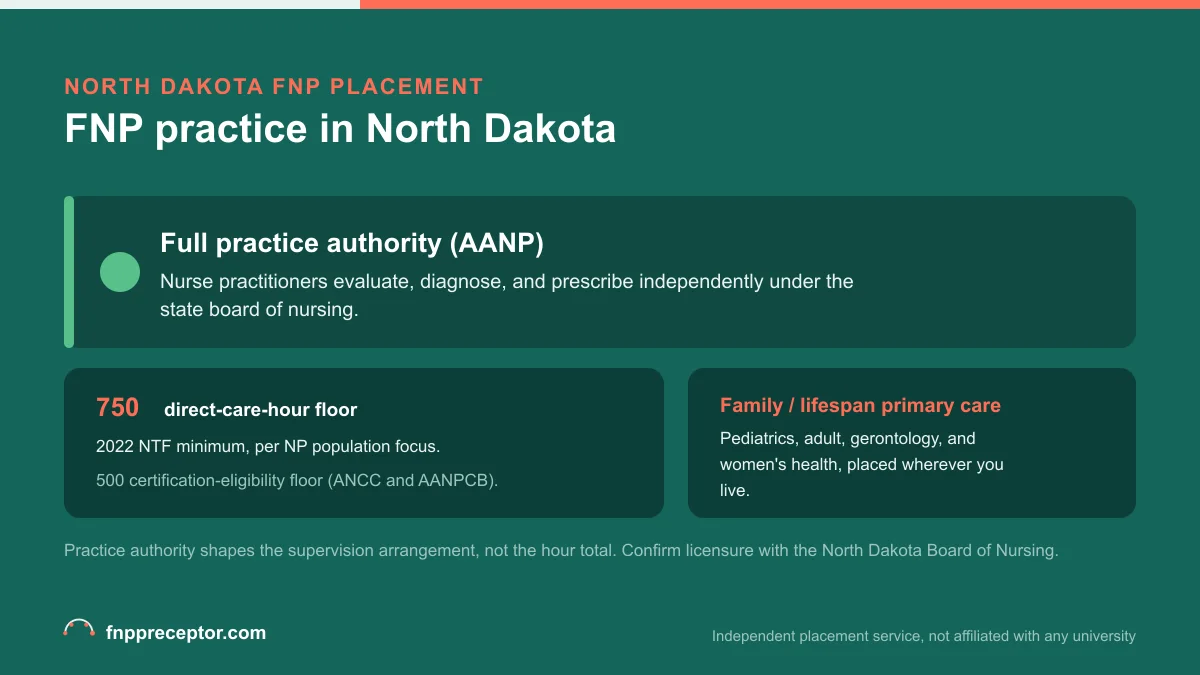
The AANP State Practice Environment lists North Dakota as full practice. Nurse practitioners are licensed by the North Dakota Board of Nursing, and state law does not require a collaborating or supervising physician for an NP to practice and prescribe. That changes the supervision arrangement, not your preceptor's qualifications: an experienced ND licensed NP can take you on alone.
Check one local catch first. APRN licenses here are single state and sit outside the Nurse Licensure Compact, even though North Dakota recognizes compact RN licenses. An NP holding a multistate RN license from another state is not automatically licensed as an APRN here. If your candidate recently moved or works near a border, confirm the ND APRN license before you log an hour.
Your school layers its own rules on top of state law, and those are usually stricter. When the two disagree the school wins.
Who is allowed to sign for you
A preceptor must be licensed in the state where care is delivered and practicing in the population you are logging. In North Dakota that usually means an NP with a current ND APRN license, or in many arrangements a physician, MD or DO, in the same primary care setting. Certified nurse midwives commonly cover women's health when a program permits it.
Most programs also want a year or more in the role, current population certification, and a site willing to sign an affiliation agreement. That agreement is the step students forget and often the slowest one. Our preceptor requirements page has the checklist for screening a candidate in one call.
Confirm your own hour total first
The 2022 NTF Standards recommend a minimum of 750 direct patient care hours per nurse practitioner track, while certification eligibility through AANP or ANCC starts at a minimum of 500 faculty supervised hours. Accredited FNP programs publish totals of roughly 540 to 800, and many sit below 750, so do not take your number from a forum post. Pull it from your clinical handbook and split it across the four populations before you call anyone; our clinical hours guide covers the usual splits.
One local wrinkle works in your favor. Because a rural family clinic can cover most of the lifespan, students here often finish with fewer separate sites than classmates in denser states. That is fine as long as each population minimum is satisfied on its own, so get it confirmed in writing by your clinical coordinator early.
If you would rather not cold call the whole state
We are an independent placement service for FNP students at any university, independent of any school. We work the phones, confirm licensure and population fit, and hand you a preceptor who has agreed to take a student. We do not guarantee a placement or your school's approval of any preceptor or site.
Tell us your target region, the populations you still need, and your start date at #match or through contact. Pricing is on the cost page and the steps are on how it works.
Good to know
Does full practice authority mean no physician has to be involved?
As far as state law goes, yes. An ND licensed nurse practitioner needs no supervising physician, so one can precept you alone. Your school can still add conditions, and a clinic can have internal rules about who signs student paperwork. A physician preceptor stays acceptable in most FNP programs, so full practice authority widens your options rather than narrowing them.
My preceptor has a multistate compact license. Is that enough here?
Not for the advanced practice part. North Dakota recognizes compact RN licenses, but APRN licensure is single state and sits outside the compact. Your preceptor needs an actual North Dakota APRN license to precept advanced practice hours. Verify it with the Board of Nursing rather than taking a verbal answer.
I live in Fargo or Grand Forks. Can I log hours in Minnesota?
Sometimes, and two things have to line up. The preceptor must be licensed where the care happens, and your school needs an affiliation agreement covering that site and state. Border students assume the drive is the obstacle when the paperwork usually is. Ask your placement office before approaching a clinic across the line.
Are rural North Dakota placements worth the driving?
For many students, yes. Competition is lighter than in the metros, and one rural family practice can supply pediatric, adult, gerontology, and some women's health exposure in a single week. Price the real cost first, including fuel, lodging, and work hours you give up, then ask how the site handles days lost to weather.
How far ahead should I start looking?
Two to three semesters, and earlier for pediatrics and women's health. Metro sites commit to students well before a term starts, and tribal or federal facilities need extra lead time for credentialing. Starting late is the most common reason a student pushes a course to the next term.
Plan the FNP practicum across the lifespan
Tell us your school, city, course, and remaining objectives. We will organize an independent search for possible preceptors and primary care sites, subject to program approval.