Where Ohio FNP Students Actually Log Their Clinical Hours
Ohio is a reduced practice state, so the nurse practitioner who precepts you here is almost certainly working under a written standard care arrangement with a collaborating physician. That shapes the paperwork around your rotation more than it shapes who can teach you. The harder question is geographic: whether you can reach a practice with room for a learner across pediatrics, adults, older adults, and women's health.
The settings that actually take FNP students in Ohio
The workhorse of an Ohio rotation is the ordinary family medicine office. Some are independent practices in small towns and older suburbs; many more belong to a large regional system. Both host students, but the system-owned office routes your request through an education department and moves slowly, while an independent practice can say yes in a week.
- Federally qualified health centers, in both the big cities and shortage-designated rural counties
- Rural health clinics in counties certified as shortage areas
- Urgent care and retail or convenient care, dense across every Ohio metro
- Student health at Ohio's unusually large number of college campuses
- Correctional health, with real volume in a state that runs a large prison system
- Occupational clinics tied to manufacturing and logistics employers
Each carries a trade. Health centers give the widest patient mix fastest and are the first door every other student knocks on, while urgent care schedules easily but is often capped by programs.
Reading the Ohio map before you send a single email
Ohio is not one placement market. Central Ohio around Columbus, the northeast around Cleveland, Akron and Youngstown, and the southwest around Cincinnati and Dayton hold most of the clinical volume and nearly all of the competition. Those metros also host medical schools, PA programs and several nursing programs at once, so a known family practice in Dublin, Beachwood or Mason may be booked two terms out.
The mid-size cities are the underrated middle: Toledo, Springfield, Lima, Mansfield, Newark, Elyria, Hamilton and Findlay have real primary care infrastructure and far fewer students chasing it. Appalachian Ohio in the southeast, around Athens, Marietta, Chillicothe, Zanesville and Portsmouth, often has willing preceptors and severe shortages at once, since much of the state carries federal shortage designations and those counties are heavily represented. The cost there is distance. One local detail: lake effect snow in the northeast snowbelt eats clinical days in January.
Which of the four populations run tight here
FNP is a lifespan track, so your hours have to span pediatrics, adults, gerontology and women's health. Adults and older adults are the easy part in Ohio. Family and internal medicine offices are everywhere, and the aging populations of the industrial northeast and the Appalachian southeast hand you geriatric complexity without your asking. See adult and gerontology rotations.
Pediatrics is tighter, for a specifically Ohio reason. The state has a heavy concentration of large freestanding children's hospitals anchored in Columbus, Cincinnati, Cleveland, Akron, Dayton and Toledo, and their primary care networks absorb much of the metro pediatric volume while rotating learners of every kind. Metro peds also tends to sit in dedicated practices that see no adults, so you may need a separate site just for kids. The common workaround is a small town family practice whose panel includes toddlers, their parents and their grandparents. Our pediatric rotation page covers what to ask for.
Women's health is usually the last block to fall into place. Obstetrics and gynecology clusters in hospital-affiliated groups in the larger cities, and several rural counties have thinner obstetric coverage than they once did. Two openings help: health centers often run prenatal, contraception and well woman care alongside family practice, and Ohio licenses certified nurse midwives as advanced practice nurses under the same chapter as NPs, so a CNM can precept when your school allows it. Start with the women's health guide.
What the standard care arrangement changes for you
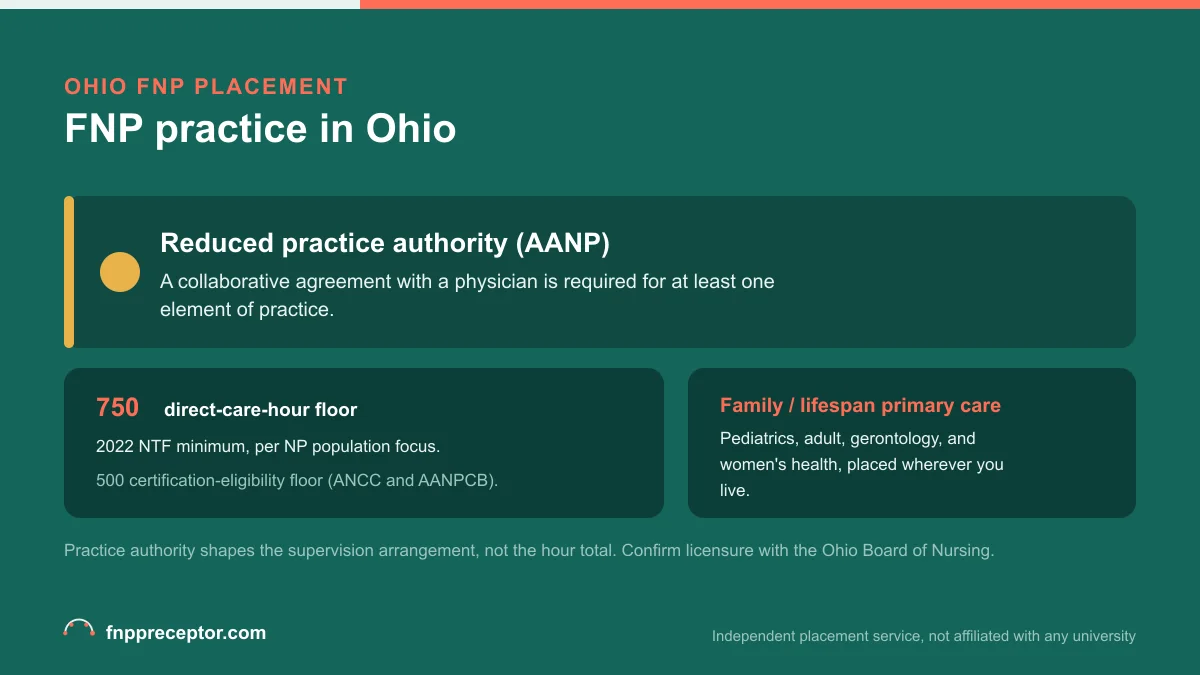
The compact version: under Ohio Revised Code 4723.431, a certified nurse practitioner, nurse midwife or clinical nurse specialist practices in accordance with a written standard care arrangement entered into with each physician or podiatrist they collaborate with. That physician need not be in the building but must be licensed in Ohio and available for consultation, and the Board of Nursing does not pre-approve the arrangement, though it may review one. That requirement is why AANP places Ohio in the reduced practice category.
What the category does not change is what makes a preceptor acceptable. You still need an active Ohio license, current practice in the population you are logging, and your program's approval. The difference is that your preceptor teaches you from inside their own collaborative arrangement, and some sites want the collaborating physician countersigned on your affiliation agreement. Physicians precept FNP students here directly all the time. Verify any license through the state's online lookup, and confirm specifics with the board. Our preceptor requirements page lists what schools ask for.
Hours, and why your program's number is the only one that counts
Three numbers get mixed up constantly. The 2022 National Task Force standards recommend a minimum of 750 direct patient care hours per population focus. Certification through AANP or ANCC requires at least 500 faculty-supervised hours. Accredited FNP programs publish totals in the neighborhood of 540 to 800, and a fair number sit below 750. Pull your own clinical handbook and work from that figure, then see our clinical hours page.
Split the total before you recruit. Most Ohio students land an anchor site carrying adults, older adults and some pediatrics, plus a shorter dedicated block for women's health. Booking that second site early is the best predictor of finishing on time.
Getting a yes in a crowded market
Start four to six months ahead, earlier for a metro site. Have the packet ready before the first email: program and term dates, exact hour count, your school's affiliation agreement, immunizations, background check, malpractice coverage, and a paragraph on what you can already do in a room. Ohio preceptors decline for vagueness and short notice far more often than for anything about the student.
If that hunt has already cost you a semester, this is the part we handle. We work with FNP students at any university, are affiliated with no school, and place across Ohio. We assist with finding and arranging a preceptor; we never guarantee placement or your school's approval, since that call is your program's. Send your city, term dates and the missing population through #match or contact, or read how it works first.
Good to know
Is Ohio a full practice authority state for nurse practitioners?
No. AANP classifies Ohio as reduced practice because nurse practitioners must maintain a written standard care arrangement with a collaborating physician or podiatrist. The physician need not be on site, but the arrangement must exist. For a student, that shows up in site paperwork, not in your preceptor's ability to teach.
Can a physician precept my FNP clinicals in Ohio?
Usually yes. MDs and DOs precept FNP students throughout Ohio. Certified nurse midwives are licensed as advanced practice nurses here too and make strong women's health preceptors. The real limit is your school's policy, so check your clinical handbook before committing to a site.
Which rotation is hardest to fill in Ohio?
Women's health, then pediatrics. Obstetrics and gynecology clusters in hospital-affiliated groups in the larger cities, and metro pediatric primary care often sits in dedicated practices or children's hospital networks already carrying many learners. Health centers and small town family practices are the most reliable ways around both.
Do I have to find my own preceptor as an Ohio FNP student?
It depends on your program. Some schools place you, some place you only in certain regions, and many require you to source your own preceptor and simply approve what you bring. Confirm which model applies in writing early, because learning it in your final year turns a routine search into an emergency.
How many clinical hours will my Ohio FNP program require?
Check your own program, since totals vary. AANP and ANCC certification requires at least 500 faculty-supervised hours, the 2022 National Task Force standards recommend a minimum of 750 direct patient care hours per population focus, and published program totals commonly run from about 540 to 800.
Plan the FNP practicum across the lifespan
Tell us your school, city, course, and remaining objectives. We will organize an independent search for possible preceptors and primary care sites, subject to program approval.