Finding an FNP preceptor across Oklahoma
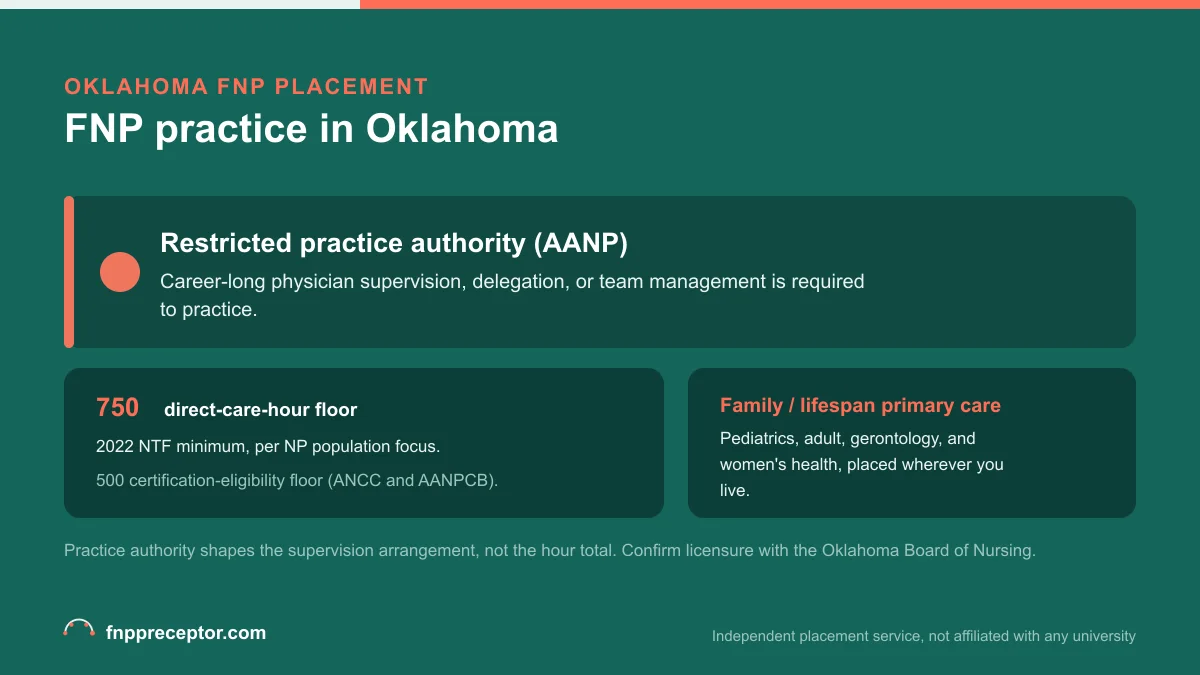
Oklahoma is workable for FNP clinicals, but the supply is lopsided. Oklahoma City and Tulsa hold most of the patient volume and most of the competition, while rural counties often have preceptors who will say yes and a long drive attached. The state sits in the restricted category of the AANP State Practice Environment, which shapes your rotation paperwork more than who can teach you.
Where FNP students actually land here
Hours in Oklahoma rarely come from one channel. Students assemble them from independent family medicine offices, health system clinics, and safety net sites. Patient mix matters more than setting, because your log has to span the lifespan.
- Small group family practice, the backbone of care in mid sized towns.
- Community health centers, whose state association counts over a hundred member service sites serving more than 350,000 Oklahomans in 2025.
- Rural health clinics, a designation Oklahoma leans on in low population counties.
- Urgent care, heavy acute volume, thin on continuity and young pediatrics.
- Campus student health, young adult heavy with almost no geriatrics.
- Correctional and occupational health, stronger for chronic disease hours than students expect.
- Tribal and Indian Health Service clinics, below.
Our adult and gerontology rotation page covers where those hours come easily.
The metro and rural split
Oklahoma has 77 counties and two real metros. Oklahoma City with Edmond, Norman and Moore, plus Tulsa with Broken Arrow, Owasso and Jenks, hold most of the clinics and most of the demand. Nursing, physician assistant and medical students chase the same offices, and a practice already hosting two learners will decline a third quickly.
Outside those hubs it flips. Lawton, Enid, Ardmore, Muskogee, Stillwater, Durant, McAlester, Bartlesville, Tahlequah and Claremore have fewer competing students per preceptor. The trade is distance, and Woodward, Guymon, Elk City and Altus sit hours off the main corridors. Metro students should start asking early and expect an hour's drive along I 35, I 40 or I 44 for a harder rotation. Rural students have the opposite problem: family practice is easy, the specialty populations are not.
Practice authority here, and what it actually changes
The AANP State Practice Environment lists Oklahoma as restricted: state law requires career long supervision, delegation or team management by another provider for at least one element of nurse practitioner practice. Here that element has been prescribing. The Oklahoma Board of Nursing licenses four advanced practice roles, including the certified nurse practitioner.
That shifted partly. House Bill 2298 took effect November 1, 2025 and lets eligible advanced practice nurses apply for independent prescriptive authority after 6,240 hours of physician supervised practice with prescriptive authority, plus malpractice coverage. The board is clear it did not change scope of practice, and that an applicant keeps a supervising physician until independent authority is granted.
For a student this is paperwork, not teaching quality. Many Oklahoma nurse practitioners have a physician formally attached to their practice, so your affiliation agreement may need that physician named or countersigned. Ask the clinic who signs, early.
Pediatrics and women's health are the pinch points
FNP is the across the lifespan track, so supervised hours must span pediatrics, adult, gerontology and women's health. Adult and geriatric hours are the easy part here, between family practice, long term care and an older rural population.
Pediatrics splits on the same line. Dedicated pediatric practices cluster in the two metros and are heavily requested. Smaller towns often have no separate pediatric office, which helps: the family practice there sees infants, toddlers and teens on one schedule. Confirm the age mix, since some clinics are family practice in name only. The pediatric rotation page lists what to ask.
Women's health is tightest. Obstetric and gynecologic care concentrates in hospital affiliated groups in the metros and regional hubs, and several rural counties have no local obstetric coverage, so a purely rural placement leaves that column thin. Certified nurse midwives can precept these hours under many arrangements, and family practices still doing contraception and prenatal visits widen the pool. See the women's health page.
Tribal and federal clinics are part of the picture
Oklahoma has one of the largest tribal health infrastructures in the country. The Indian Health Service Oklahoma City Area covers Oklahoma, Kansas and part of Texas, and dozens of tribes run their own health programs. Cherokee Nation Health Services is the largest tribally operated system in the United States, and the Chickasaw Nation runs a medical center plus clinics in Ardmore, Purcell and Tishomingo.
These sites deliver the lifespan primary care an FNP student needs, and in northeastern and south central Oklahoma they are geographically obvious. They also carry the most process, setting their own student agreements, background and immunization requirements and onboarding calendars, separate from anything your university has signed.
Hours, licensure and what your program checks
Two numbers get repeated wrongly online. The 2022 National Task Force standards published through AACN recommend a minimum of 750 direct patient care hours per nurse practitioner track, while AANP and ANCC certification eligibility calls for at least 500 faculty supervised hours. Accredited FNP programs publish totals from roughly 540 to 800, and many sit below 750. Confirm your own handbook total first. Our clinical hours page helps.
Preceptor rules do not change with the state. The preceptor must hold an active license where you log hours, meaning an Oklahoma license for Oklahoma hours, and must practice in the population you are recording. Nurse practitioners precept, physicians precept in many school arrangements, and certified nurse midwives commonly precept women's health. The preceptor requirements page collects what schools add on top.
If you would rather not cold call clinics
We are an independent placement service working with FNP students at any university, and Oklahoma rewards knowing which corridor to search. We start from your city, your program's population requirements and your term dates, then work outward until we have a match your school will approve. We do not guarantee placement, and no service can guarantee school approval of a given site.
Send your county, rotation and start date through the form at #match or via contact. Pricing is on the cost page, the process on how it works.
Good to know
Does Oklahoma's restricted status make preceptors harder to find?
Not directly. Restricted status governs how a nurse practitioner prescribes, not who may teach a student. What changes is paperwork: many Oklahoma nurse practitioners work with a named supervising physician, so your school's agreement may need that physician identified or countersigned. Ask the clinic who signs.
Can I complete every FNP hour in one Oklahoma family practice?
Sometimes, and likelier in a rural or community health setting than a metro office. The test is whether that practice genuinely sees children, adults, older adults and women's health visits in volume, and whether your program lets one site cover several populations. Many require separate documented rotations anyway.
How far do Oklahoma students usually drive?
Metro students often find something within thirty minutes for adult and family rotations, then drive forty five to ninety minutes for pediatrics or women's health. Students in the Panhandle and far southeast face longer distances, and some arrange a block schedule with temporary housing rather than commuting daily.
Can a physician precept my FNP hours in Oklahoma?
In many programs yes. Physicians commonly precept nurse practitioner students, and certified nurse midwives commonly precept women's health hours. The rule that never moves is an active Oklahoma license and current practice in the population you are logging. Your school sets the rest, so get its written policy first.
Are tribal and Indian Health Service clinics an option?
They can be, and in northeastern and south central Oklahoma they are among the strongest primary care teaching environments available. They also run their own approval processes, with separate agreements, background checks and onboarding windows your university's paperwork will not cover. Start early.
Plan the FNP practicum across the lifespan
Tell us your school, city, course, and remaining objectives. We will organize an independent search for possible preceptors and primary care sites, subject to program approval.