Where Oregon FNP students find preceptors, and how we help
Oregon is a full practice authority state, so an experienced nurse practitioner here can take a student without a physician signing off on the arrangement. That widens the pool of people free to say yes, but the search is still work: the Willamette Valley is crowded with students, and the sites that fill pediatric and women's health hours thin out past the metros. We help FNP students at any school find both.
Where Oregon FNP hours actually get logged
Nearly every completed Oregon rotation lands in one of a short list of settings.
- Independent and small group family practice, the backbone of the search in most Oregon towns.
- Federally qualified health centers, the widest age range under one roof.
- Rural health clinics, often tied to a critical access hospital.
- Tribal health clinics, serving their communities across the lifespan.
- School based health centers, county public health, student health, correctional health.
- Urgent care, strong on acute volume, weak on continuity.
Community health centers carry an unusual share of primary care here. The state primary care association counts 332 clinic sites serving just over half a million patients, with clinics in 85 percent of Oregon counties. One community health center schedule can hold prenatal visits, well child checks, adult chronic disease and geriatric care in a single day.
The I-5 corridor: the volume, and everyone else asking for it
Most Oregonians live along the interstate, and so do most of the clinics. The Portland metro spans Multnomah, Washington and Clackamas counties, thick with practices in Beaverton, Hillsboro and Gresham. South of it sit Salem and Woodburn, Corvallis and Albany, Eugene and Springfield, Roseburg, then Medford and Grants Pass in the Rogue Valley.
The trade off is competition. Valley clinics field requests from nursing, physician assistant and medical students at once, and the large systems anchoring Portland, Salem, Eugene, Bend and Medford generally route students through a central education office rather than through the clinician you spoke with. A verbal yes is the start there, not the end.
Central Oregon, the coast, and the counties east of the Cascades
Outside the valley the arithmetic flips: fewer students competing, more driving. Central Oregon means Bend, Redmond, Prineville and Madras. The coast runs from Astoria and Tillamook through Newport and Florence to Coos Bay, and the Gorge covers Hood River and The Dalles. East of the mountains sit Pendleton, Hermiston, La Grande, Baker City and Ontario, plus the frontier counties around Burns, John Day and Lakeview where a whole county may hold only a handful of primary care clinicians.
The state rural health office counts eleven tribal health clinics in areas it defines as rural or frontier, and those clinics practice across the lifespan. A rural family practice is often the most efficient placement an FNP student can get, because one panel holds infants, pregnant patients, working adults and elders. Plan winter rotations with the Cascade passes in mind.
What full practice authority changes, and what it does not
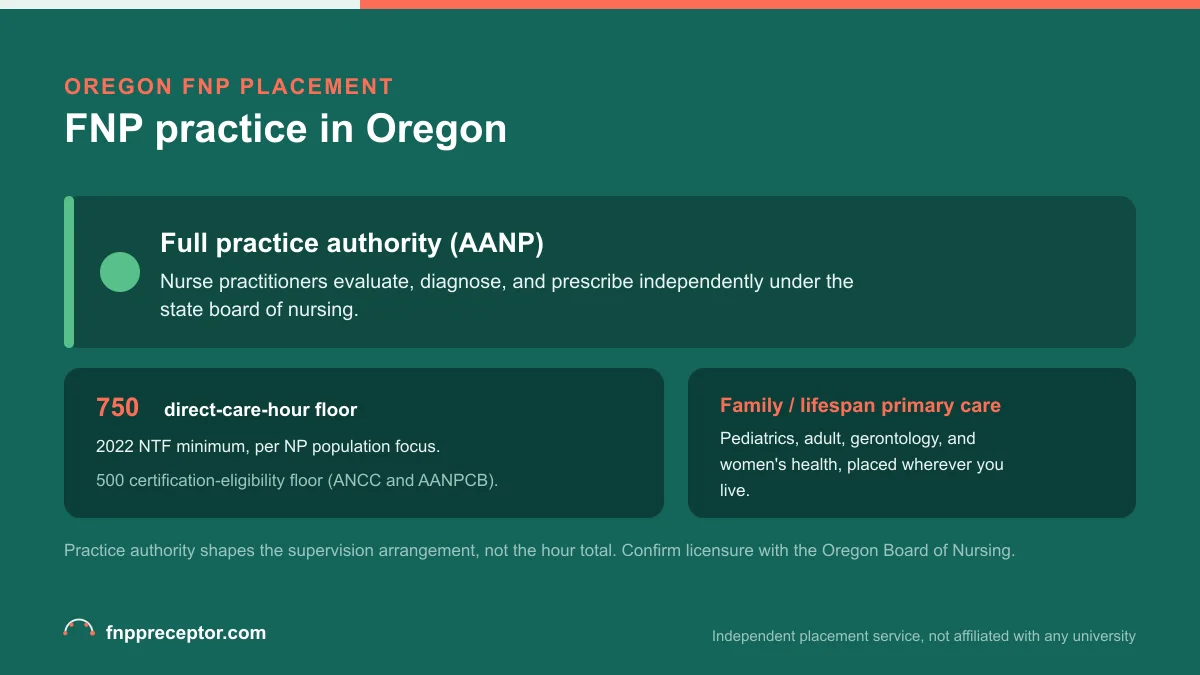
The American Association of Nurse Practitioners places Oregon in its full practice category, and the state license directory describes nurse practitioners as licensed by the board to independently assume responsibility and accountability for the care of clients. No collaborating physician is required as a condition of practice, so an experienced Oregon NP can precept on her own authority.
What it does not change is everything else. Your program still sets preceptor criteria, commonly a year or more in practice, current national certification and a population match. The preceptor must hold an active Oregon license and practice in the population you are logging, and an employer can still refuse students where the law would allow them. Physicians, and for women's health certified nurse midwives, often qualify too, depending on your school. Our plain reading is at preceptor requirements.
Pediatrics and women's health are the two that stall people here
These are the hardest populations to fill almost everywhere, and Oregon has its own version. Dedicated pediatric practices cluster in Portland, Salem, Eugene, Medford and Bend, and every local student calls them first. Past that ring, children are seen by family practice, so one clinic in Douglas, Umatilla or Klamath County can yield pediatric, adult and gerontology visits from a single schedule. See pediatric rotations and adult and gero rotations.
The state's certified school based health centers are underused. The health authority describes each as staffed by a primary care professional who may be a nurse practitioner, physician or physician assistant, doing well child and sports physicals, immunizations, mental health and reproductive health care. They run on school terms, so summer is usually out.
For women's health, the routes that work here are county family planning clinics, health center prenatal programs and midwifery practices. If your program accepts a certified nurse midwife, your options widen. More at women's health rotations.
Hours, lead time, and how we run an Oregon search
Know your own number before you start calling. The 2022 National Task Force standards recommend a minimum of 750 direct patient care hours per population focus, while certification eligibility sits lower, at least 500 faculty supervised hours. Accredited FNP programs publish totals of roughly 540 to 800, and many sit below 750. Count what you still owe by population, and check FNP clinical hours.
Then give yourself lead time. Two to three terms is the honest window in Oregon. The affiliation agreement alone can take weeks, followed by a background check, immunization records, a drug screen and electronic record training. Our process is at how it works.
That is the part we take off your plate. Send us your county, your term dates and the populations you still owe, and we work Oregon sites until someone says yes. We never promise a placement or your program's approval of a site. Pricing sits at what it costs; start with the form at the top of this page or through contact.
Good to know
Does an FNP preceptor in Oregon need a supervising physician?
No. Oregon sits in the full practice authority category, and the state licenses nurse practitioners to independently assume responsibility and accountability for patient care, so no collaborating physician agreement is needed to practice or to precept. Your school's paperwork is separate: some programs still want a medical director signature, so read your packet first.
How many clinical hours does an Oregon FNP program require?
That depends on your program, not on the state. The 2022 National Task Force standards recommend at least 750 direct patient care hours per population focus, and certification eligibility requires a minimum of 500 faculty supervised hours. Totals at accredited FNP programs run roughly 540 to 800, and a fair number fall below 750. Confirm your own number and your split by population.
Can a physician or a certified nurse midwife precept me in Oregon?
Often yes, but your school decides. Many programs accept an MD or DO for primary care hours and a certified nurse midwife for women's health. The constant is that the preceptor must be licensed in Oregon and practicing in the population you are logging. Get the written criteria before you approach anyone.
Do I have to be near Portland to find a placement?
No, and the metro is often the harder place to land one. Preceptor supply is better in Central Oregon, on the coast, in the Columbia Gorge and east of the Cascades, where fewer students compete for the same schedules. The cost is travel and sometimes short term housing.
How far ahead should I start looking?
Two to three terms before the rotation begins. Affiliation agreements take weeks, and larger Oregon systems add background checks, immunization verification and record system training on top. Starting a month out is how rotations slide.
Plan the FNP practicum across the lifespan
Tell us your school, city, course, and remaining objectives. We will organize an independent search for possible preceptors and primary care sites, subject to program approval.