How FNP Students Get Placed Across Pennsylvania
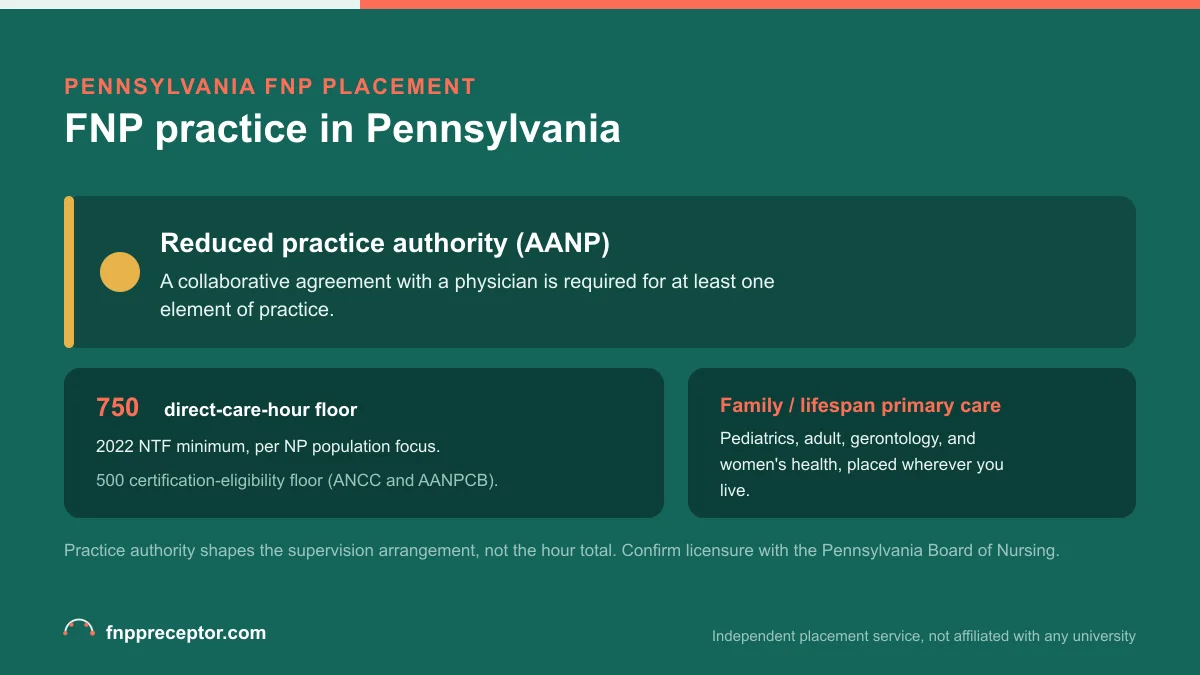
Pennsylvania sits in the reduced practice category of the AANP State Practice Environment, so the nurse practitioners you would precept with work under a written collaborative agreement with a physician. That affects your paperwork more than your day in clinic. The harder problem here is geography: Philadelphia and Pittsburgh hold enormous clinical volume and equally heavy competition for slots, while the northern and western counties often have a willing preceptor with a long drive attached.
Where FNP hours actually get logged here
Family practice is the backbone of FNP placement in Pennsylvania, but few students finish in one office. Most use two or three sites, because a single family panel rarely carries enough pediatric and prenatal volume to close every log.
- Independent and small-group family practice. Common in the mid-size cities and rural counties, and usually the most flexible about students.
- Federally qualified health centers. In city neighborhoods and small towns alike, with the mixed-age panels an FNP log needs.
- Rural health clinics. Built around non-physician providers; federal rules require an NP, physician assistant, or nurse midwife to furnish services at least half the time.
- Health system primary care and urgent care. High volume near the metros, with formal agreements and long lead times.
- Campus student health, occupational, and correctional clinics. Narrow age ranges, so they supplement rather than carry a rotation.
Student policy is set office by office, not statewide. A practice that took someone last spring may already be committed this fall, so confirm every lead.
The metro squeeze and the rural trade
Southeastern Pennsylvania, meaning Philadelphia and the collar counties of Bucks, Montgomery, Delaware, and Chester, has the most primary care sites and the most students chasing them. Allegheny County and the Pittsburgh suburbs run the same pattern. Your competition is not your classmates; it is every nursing program within an hour's drive.
The mid-size cities are the sweet spot more often than students expect: Allentown, Bethlehem, and Easton in the Lehigh Valley, then Harrisburg, Lancaster, York, and Reading across the south-central belt, Scranton and Wilkes-Barre in the northeast, Erie in the northwest, and Altoona, Johnstown, State College, and Williamsport.
The rural tier runs from northern counties like Potter, Tioga, and Bradford through the Appalachian southwest in Fayette, Greene, and Somerset. Many carry federal shortage or medically underserved designations, and preceptors there are often glad for help. You pay in mileage, so price the drive across a full semester first.
Pediatrics and women's health are the bottleneck
Adult and gerontology hours largely fill themselves in Pennsylvania. Pediatrics and women's health are what stall people, and each one fails in its own way here.
Pediatrics in the two big metros lives mostly in dedicated pediatric practices and children's health networks, which tend to have student pipelines running years deep. Outside the metros it is folded into family practice, usually the easier route: one site, mixed panel, children included. If peds is blocked in the city, look one county out. The pediatric rotation page covers what gets documented.
Women's health is tighter still. It sits in OB-GYN offices, in midwifery services attached to hospital systems, and in prenatal and family planning programs at community health centers. Certified nurse midwives can often precept this portion when your program allows it. See the women's health page and the adult and gero page.
What reduced practice authority changes, and what it does not
Pennsylvania requires a certified registered nurse practitioner to work under a written collaborative agreement with a physician, and prescriptive authority runs through an agreement filed with the state. Under 49 Pa. Code 21.285 it must be written, name a substitute physician, identify the CRNP's certification specialty and the drug categories involved, stay on file at the practice, and be reviewed at least every two years. The Pennsylvania State Board of Nursing regulates CRNPs.
Students misread what that means for them. A collaborative agreement governs how the nurse practitioner practices, not whether they may teach. Who signs off on your hours is set by your program and its accreditor. What the reduced category changes is the shape of the arrangement: a collaborating physician is already attached to the practice, so that physician is often part of the decision to take you, and some schools want them named on the affiliation paperwork. In a full practice state, an experienced NP can more often say yes alone.
Categories are not permanent. Confirm the current AANP listing, and take licensure questions to the board rather than to any page, including this one.
Border counties and multi-state systems
Pennsylvania touches six states: New York, New Jersey, Delaware, Maryland, West Virginia, and Ohio. Health systems and physician groups cross those lines freely, so a site twenty minutes from a house in Bucks County or Beaver County can sit on the other side.
Two rules decide whether that works. Your preceptor must hold an active license in the state where you actually see patients, and your school must approve the site, which usually means an affiliation agreement with that organization in that state. Some programs handle out-of-state placements routinely; others will not start. Ask your coordinator before you get attached to a site.
A workable order of operations
Start with your own number. The 2022 NTF Standards from AACN recommend a minimum of 750 direct patient care hours per NP track, AANP and ANCC certification eligibility rests on at least 500 faculty-supervised hours, and accredited FNP programs commonly publish totals of roughly 540 to 800, many below 750. Only your handbook governs graduation; the clinical hours page explains the difference.
Then get your school's preceptor packet in hand before you ask anyone. Practices say yes faster when the request arrives complete: dates, hours, populations, forms, and who at your school signs. The requirements page lists what gets checked.
If you have worked your own contacts and the calendar is closing in, that is our job. We are independent, we work with students at any university, and we search Pennsylvania by county and by population rather than blasting emails. Use the match form on this page or the contact page, after reading how it works and what it costs. We assist with placement and never guarantee it; your school makes the final call on any preceptor or site.
Good to know
Can a nurse practitioner precept me in Pennsylvania, or does it have to be a physician?
A nurse practitioner can precept you. The reduced practice category describes how a CRNP practices, not who may teach. FNP students here are precepted by NPs, by physicians (MD or DO), and for women's health often by certified nurse midwives. Your program sets which credentials it accepts, and the preceptor must be licensed in the state where you log hours and practicing in that population.
How many clinical hours will I need in Pennsylvania?
The state does not set it; your program does. The 2022 NTF Standards recommend a minimum of 750 direct patient care hours per NP track, certification eligibility through AANP or ANCC rests on at least 500 faculty-supervised hours, and accredited FNP programs commonly publish totals of roughly 540 to 800, many below 750. Confirm your total with your school.
Is it easier to find a preceptor in Philadelphia or in a rural county?
It depends which problem you would rather have. Philadelphia and Pittsburgh have the most sites and the most competition, so lead time decides everything. Rural counties often have capacity but cost you mileage. Students frequently do best in the mid-size cities: the Lehigh Valley, Harrisburg, Lancaster, York, Reading, Erie, Scranton and Wilkes-Barre.
Can I do part of my hours across the state line?
Sometimes, and it is worth asking early. Pennsylvania borders six states and the systems cross those lines. Your preceptor must be licensed where you see the patients, and your school needs an affiliation agreement with that site. Some programs do this routinely, others decline, so check with your placement office first.
Which rotation should I lock in first?
Pediatrics and women's health, every time. Adult and gerontology hours are the easiest to fill in Pennsylvania. Book the scarce populations two or three terms ahead, and treat any family practice with a genuinely mixed-age panel as valuable, since it can cover more than one population at once.
Related
Plan the FNP practicum across the lifespan
Tell us your school, city, course, and remaining objectives. We will organize an independent search for possible preceptors and primary care sites, subject to program approval.