Clinical placement for FNP students across Rhode Island
Rhode Island is a full practice authority state, so an experienced nurse practitioner here can precept you on their own license, with no physician written into the arrangement. The harder part is not the law, it is arithmetic: the state runs about 48 miles by 37, and every practice in it gets asked for students by programs across southern New England. Here is where FNP students actually rotate and which populations run short.
The smallest state changes the math
Most state guides make you choose between a metro with volume and heavy competition or a rural county with preceptors and a long drive. Rhode Island deletes that choice: 1,034 square miles, five counties, 39 cities and towns, and from Providence almost any clinic is inside an hour. A student in Cranston can rotate in Woonsocket one term and Wakefield the next.
What replaces distance is density of demand. Providence, Cranston, Warwick, Pawtucket, and East Providence hold most of the population and most of the primary care offices, at the western edge of a crowded education corridor. One preceptor can field requests from programs in three states in a month.
The border question comes up fast: Westerly is minutes from Connecticut, and Pawtucket and Woonsocket sit on the Massachusetts line. Crossing is often workable, but the rule follows the site, not your address, and your school needs an affiliation agreement covering that state.
Settings that take FNP students here
The community health center network is the workhorse of Rhode Island primary care and the best channel for FNP students. The state health center association lists nine organizations with sites in Providence, Pawtucket, Central Falls, Woonsocket, West Warwick, Wakefield, Newport, Westerly, and Block Island. They see all ages and run high volume.
- Family practice and internal medicine offices, independent and system-affiliated, clustered in the Providence metro and the Route 2 corridor through Warwick.
- Community health centers and their school-based sites, the best setting for a mixed-age panel.
- Urgent care, dense in the metro, useful for episodic volume, though schools often cap those hours.
- Rural practices in the northwest towns of Burrillville, Foster, Glocester, and Scituate, and the southwest around Richmond and Hopkinton.
- College health services in Providence, Kingston, Bristol, and Newport, skewing young.
- Block Island primary care, reached by ferry from Point Judith, and correctional health in Cranston.
Urgent care and college health fill hours fast, but a full term in either leaves your log lopsided. Read your program's caps first.
Which of the four populations run short
FNP is the across-the-lifespan track, so your hours have to span pediatrics, adult, gerontology, and women's health. Adult and gerontology are the easy end here: family practice, internal medicine, urgent care, and the state's geriatrics and long-term care practices give you more adult and older adult contact than most students need. See adult and gero rotations.
Pediatrics is tighter, for a structural reason. It sits largely in dedicated pediatric practices and one hospital-based children's service rather than spread through family practice, and those practices are also the first stop for pediatric NP students. Community health centers are the workaround: at the state's largest health center organization, more than a quarter of patients are under 18. See our pediatric rotation page.
Women's health is the other tight one. Obstetrics and gynecology clusters into a few hospital-affiliated groups and a well-established nurse midwifery presence rather than scattering across independent offices. Fewer doors, but the ones that open run high volume. Certified nurse midwives can precept women's health hours under many school and state arrangements, so ask before ruling a CNM out. More in women's health.
Full practice authority and what it changes
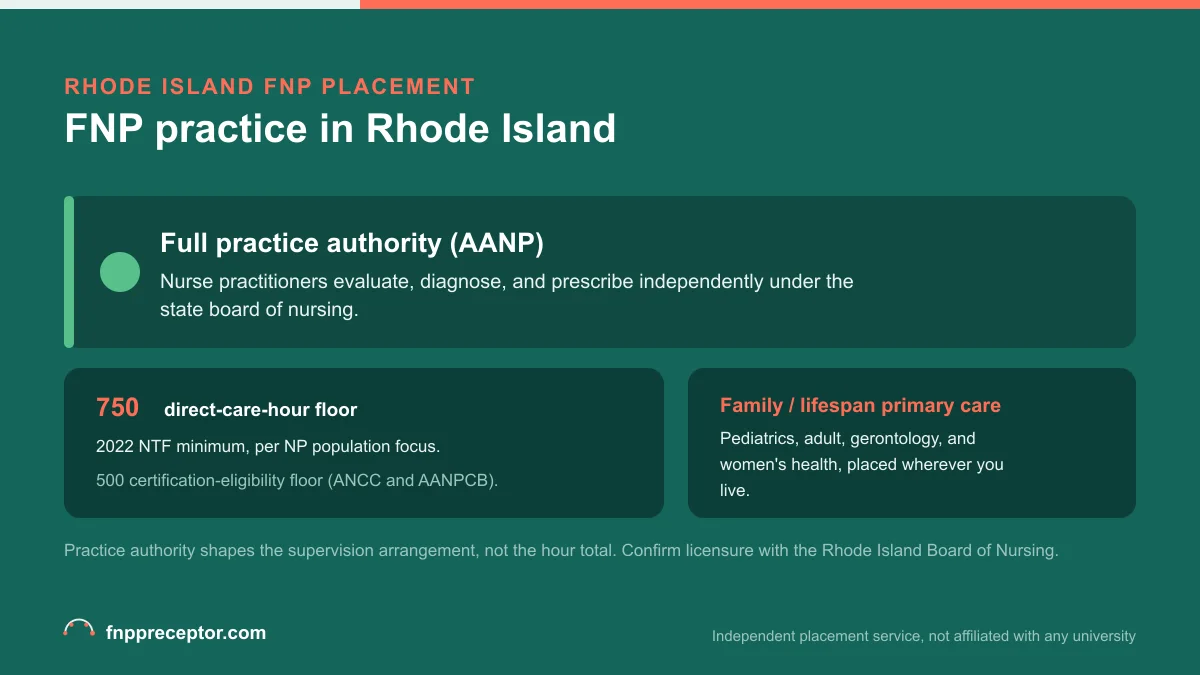
Rhode Island is classified as a full practice state in the AANP State Practice Environment. Nurse practitioners are licensed by the Board of Nurse Registration and Nursing Education inside the Rhode Island Department of Health, and may evaluate, diagnose, order and interpret testing, and prescribe without a collaborative agreement with a physician.
For placement, that changes the arrangement rather than the qualifications. In a reduced or restricted state, a physician often has to be formally attached before an NP can take a student. Here an experienced NP precepts on their own authority: fewer signatures, faster yes. Physicians precept too, statewide.
What does not change is what your school wants: an active Rhode Island license, current national certification, practice in the population you are logging, and usually one to two years in the role. Rhode Island rejoined the Nurse Licensure Compact in 2024, but that covers RN licensure and not the APRN license, so a preceptor here needs Rhode Island APRN licensure regardless. Our requirements page has the checklist.
Hours, seasons, and when to ask
Hours catch students out. The 2022 National Task Force standards recommend a minimum of 750 direct patient care hours per population focus, while AANP and ANCC certification eligibility requires at least 500 faculty-supervised hours. Accredited FNP programs publish totals of roughly 540 to 800, and plenty sit below 750. Pull your number from your program handbook, not a forum thread. Our clinical hours page has the detail.
Rhode Island also has a seasonal wrinkle. Newport County and the South County shore towns, Narragansett, Wakefield, Charlestown, and Westerly, plus Block Island, swell with summer residents and thin sharply after Labor Day. A summer shore rotation is strong on acute volume and weak on continuity.
Start asking two to three terms out; the ones who say yes have usually committed their spring by early fall.
Where we come in
We are an independent placement service for FNP students at any university. We work independently of any school, and we do not guarantee placement or that your school will approve a given preceptor or site. What we do is the outreach and vetting: working our Rhode Island contacts, confirming license and population fit, and handing you a site with the paperwork your clinical office wants.
Send your city, your program's required hour total, the populations you still need, and your term dates through the form on this page or via contact. Process on how it works, pricing on cost.
Good to know
Does my Rhode Island preceptor need a supervising physician?
No. Rhode Island is a full practice authority state, so a licensed NP can precept with no collaborating or supervising physician in the arrangement. Your school may still add conditions, such as a minimum time in practice. Physicians precept FNP students here too.
Can I do part of my rotation in Massachusetts or Connecticut?
Often yes, and it is a fair question where Westerly borders Connecticut and Pawtucket borders Massachusetts. The rule follows the clinic, not your home address: the preceptor needs an active license in the state where the site sits, and your school needs an affiliation agreement covering it.
Where do Rhode Island FNP students find pediatric hours?
Community health centers, most reliably, because their panels include children in volume rather than occasionally. Dedicated pediatric practices and school-based sites are the alternative, but pediatric NP students tend to get there first. If your program allows it, pair a family practice block with a shorter pediatric one.
How many clinical hours will I need in Rhode Island?
Your program sets that, not the state. The 2022 National Task Force standards recommend at least 750 direct patient care hours, and certification through AANP or ANCC requires a minimum of 500 faculty-supervised hours. Accredited FNP programs commonly publish totals of about 540 to 800, and many sit below 750. Confirm your own total in your handbook.
How early should I start looking for a preceptor here?
Two to three terms ahead. Rhode Island has a small preceptor pool and many programs pointed at it, including programs in neighboring states, so the same offices field the same request repeatedly.
Plan the FNP practicum across the lifespan
Tell us your school, city, course, and remaining objectives. We will organize an independent search for possible preceptors and primary care sites, subject to program approval.