Finding an FNP preceptor in South Carolina, county by county
South Carolina is a workable state for family nurse practitioner clinicals if you start early and think in regions rather than one city. Most FNP students here log hours in small family practices, community health centers, and rural clinics, with pediatrics and women's health arranged separately. Because state law ties nurse practitioner practice to a written agreement with a physician, the person who approves your rotation is sometimes that physician, not the NP you work beside.
The state works as four regions, not one market
South Carolina is small enough to cross in a day and varied enough that a search failing in one corner can succeed in another. South Carolina AHEC, the state health workforce agency, works through four regional centers, which is a useful map for a clinical search. The Upstate runs through Greenville, Spartanburg, Anderson, and Rock Hill. Mid-Carolina covers Columbia, Lexington, Sumter, and Orangeburg. The Pee Dee reaches from Florence to Marion and Dillon and picks up the Grand Strand around Myrtle Beach. The Lowcountry holds Charleston, Summerville, Beaufort, and Bluffton.
The trade is predictable. Clinics in Charleston, Columbia, and Greenville have the volume you want and already field requests from medical, physician assistant, and nursing students at once. Counties along the I-95 corridor and the inner Pee Dee, places like Allendale, Hampton, and Marlboro, often have clinicians who welcome a student, and the price is your commute.
Settings that host FNP students here
Nearly every completed South Carolina rotation comes out of a short list of setting types.
- Independent and small group family practice. The backbone of primary care in smaller counties, and often the fastest yes because the decision maker is in the room.
- Federally qualified health centers. HRSA counted 23 health center organizations serving about 441,933 patients in South Carolina in 2024. Broad patient mix, good for lifespan hours.
- Rural health clinics. Common in the Pee Dee and Lowcountry interior, often staffed by an NP with a collaborating physician.
- Urgent and convenient care. Strong for acute adult volume, weaker for chronic disease.
- College student health. Columbia, Charleston, Greenville, and Rock Hill, mostly young adult care.
- County public health and family planning clinics. A realistic route to women's health hours outside a metro OB-GYN office.
- Correctional health. Adult and gerontology only, with unusually good chronic disease exposure.
- Federal and military affiliated clinics near Charleston, Beaufort, Sumter, and Columbia, on their own credentialing timeline, so plan months.
Tribal health barely figures here, since the Catawba Indian Nation near Rock Hill is the state's only federally recognized tribe.
Pediatrics and women's health are the two that stall
FNP is the across the lifespan track, so your hours must span pediatrics, adult, gerontology, and women's health. Adult and gerontology fill themselves in South Carolina. The other two are where searches go quiet.
Pediatrics concentrates in dedicated practices in Greenville, Columbia, Charleston, and Florence, which every program in the region is also asking. The workaround that functions here is rural: family practices and health centers in smaller counties see children all day because they are the only office in town, so one preceptor can cover a real pediatric block. More on our pediatric rotation page.
Women's health is tighter for a structural reason. Obstetric care has consolidated into regional hospitals, leaving several rural counties without a delivering hospital nearby, so those hours cluster in metro OB-GYN offices, midwifery practices, and public family planning clinics. Certified nurse midwives can precept women's health in many arrangements, subject to your school's rules. See women's health rotation and adult and gero rotation.
What restricted practice changes, and what it does not
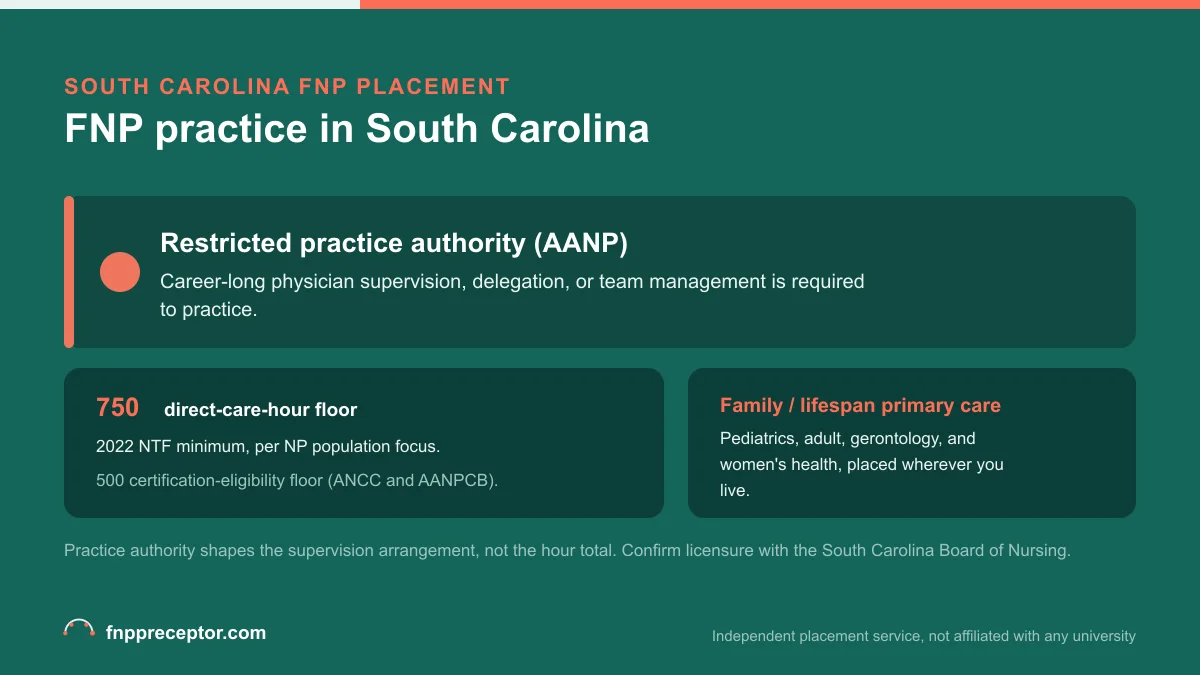
The AANP State Practice Environment lists South Carolina as a restricted practice state. State law requires nurse practitioners to perform medical acts under a written practice agreement with a physician, covering the conditions and drug therapies involved and how consultation happens when the physician is off site. That agreement is signed at least annually and must be available to the Board of Nursing on request.
For your rotation, that changes the approval chain more than the teaching. An experienced NP can precept you, but the practice may want the collaborating physician to sign off on hosting a student, which adds a signature and sometimes a week. Physicians precept FNP students here regularly for the same reason. The standard itself does not move: your preceptor must hold current South Carolina licensure and practice in the population you are logging, and your school approves both the person and the site. Our preceptor requirements page lists what schools ask for, and the South Carolina Board of Nursing holds the license lookup.
Why South Carolina clinicians agree to teach
Precepting is unpaid work for most clinicians here, so it helps to know what motivations already exist. South Carolina has used an income tax credit to encourage physicians, physician assistants, and nurse practitioners to precept required clinical rotations. The conditions matter: it has historically applied to rotations of a set minimum length for students enrolled at South Carolina institutions, and only where the preceptor is not otherwise paid. Terms have been amended more than once, so confirm current rules with the state Department of Revenue.
The read for you: if you attend an online or out of state program, do not assume the credit applies, and never pitch it as a benefit. The stronger motivator is simpler. Rural clinicians here are openly worried about who replaces them, and the state AHEC network exists partly to put students into rural and underserved communities.
Confirm your own hour total before booking anything
The 2022 National Task Force standards recommend a minimum of 750 direct patient care hours per nurse practitioner population focus, and certification eligibility through AANP or ANCC requires at least 500 faculty supervised hours. Accredited FNP programs publish totals commonly between roughly 540 and 800, and many sit below 750. Do not assume your number from a classmate's.
Get your total, your per population minimums, and your paperwork deadlines in writing before committing to a site. Affiliation agreements between a school and a clinic are the most common reason a confirmed South Carolina placement slips a term. Our FNP clinical hours page covers counting and documenting them.
If you would rather not cold call the whole state
We place FNP students at any university across South Carolina and do the outreach: finding clinicians who match your remaining population hours, confirming licensure and willingness, and handing your school a site it can approve. We assist with placement and do not guarantee it.
Send your county, remaining hours, and term dates through the form at #match, or read how it works and cost. You can also start a preceptor search or compare other states.
Good to know
Can a physician be my preceptor in South Carolina?
In most arrangements yes, and it is common here. Family medicine practices in smaller counties are often physician led, and state law already ties NP practice to a physician agreement, so MDs and DOs are used to the role. Your school makes the final call, so send credentials to your coordinator early.
Do I have to attend a South Carolina school to rotate here?
No. We work with FNP students at any university, including online programs. What matters is that your preceptor holds current South Carolina licensure and practices in the population you are logging, and that your school can put an affiliation agreement in place with the site.
How far will I realistically have to drive?
It depends which population you still need. Adult and gerontology hours are often available inside your own metro. Pediatrics and women's health frequently mean a longer trip, and students who accept roughly 45 to 75 minutes each way tend to get confirmed weeks earlier.
Can one family practice cover all four populations?
Sometimes partly. A busy rural family practice or health center can give you adult, gerontology, and a genuine share of pediatrics, especially where it is the only clinic in the county. Dedicated women's health hours usually need a second site.
Does restricted practice mean an NP cannot precept me?
No. It changes the supervision arrangement behind your preceptor, not their qualifications. An experienced South Carolina NP working under a practice agreement can teach and sign for your hours. The practical effect is an extra approval, so allow time for signatures.
Plan the FNP practicum across the lifespan
Tell us your school, city, course, and remaining objectives. We will organize an independent search for possible preceptors and primary care sites, subject to program approval.