How FNP students find preceptors across South Dakota
South Dakota is a full practice authority state, so an established certified nurse practitioner here can take a student and sign hours without a physician in the arrangement. The harder part is arithmetic: fewer than a million residents across roughly 77,000 square miles, two real metros, and many clinics that host one student a year if any. This page covers where family nurse practitioner students actually rotate here, which populations run thin, and what state rules change about who can precept you.
Where FNP students actually rotate in South Dakota
Clinical supply is a mix of two hospital centered metros and a wide rural network of small clinics. The sites that work for FNP students are built around primary care volume rather than specialty referral.
- Family and internal medicine clinics attached to the large nonprofit systems based in Sioux Falls and the Black Hills.
- Federally funded community health centers. HRSA reports four health center organizations in South Dakota serving about 124,433 patients in the 2024 reporting year, with sites in both metros and small towns.
- Rural health clinics and outpatient departments of critical access hospitals in towns such as Winner, Mobridge, Milbank, Redfield, and Custer.
- Tribal and Indian Health Service clinics serving reservation communities, where one family practice hallway covers every age group.
- Urgent care in Sioux Falls, Rapid City, Aberdeen, Brookings, and Watertown.
- Student health services on campuses in Vermillion, Brookings, Spearfish, and Aberdeen.
- Correctional health, steady adult primary care with real chronic disease depth.
- Long term care rounds, usually the simplest gerontology exposure in the state.
Federal and tribal sites are genuine options, and they carry their own intake: background checks, immunization packets, and appointment paperwork that runs weeks longer than a private clinic. Start that before you have a signed preceptor.
Two metros, 350 miles of interstate, and the drive question
Sioux Falls anchors the east, Rapid City anchors the west, and about 350 miles of Interstate 90 sit between them. Aberdeen, Watertown, Brookings, Mitchell, Yankton, Huron, Pierre, and Spearfish are the regional centers with enough primary care to host a student, each serving a county radius far larger than its population suggests.
The tradeoff repeats everywhere. The metros hold the most clinics and the most competition, including medical, physician assistant, and nursing students booked a year ahead. Rural clinics more often have a willing provider and no waiting list, but the drive runs 45 to 90 minutes each way and depends on weather from November into March. Many counties outside the metros carry federal primary care shortage designations, which is why a clinic can want a future provider badly and still have no spare exam room.
Which of the four populations run thin here
FNP is the across the lifespan track, so your hours must cover pediatrics, adults, gerontology, and women's health. Adults and older adults are rarely the obstacle here: panels skew older and long term care exists in nearly every county seat, which makes adult and gerontology hours the block to schedule first.
Pediatrics is the first pinch point. Dedicated pediatric practices sit almost entirely in Sioux Falls and Rapid City, and those few sites are what every program in the region asks about. Elsewhere children are seen inside family practice, legitimate exposure but uneven: a rural clinic might give you six pediatric visits in a day or none. Community health centers and tribal clinics carry younger panels and are worth asking about early. See our pediatric rotation notes.
Women's health is the second, and it is a supply story rather than a rules story. Obstetric and gynecologic services have consolidated into the larger towns, so a rural family clinic may handle prenatal intake, contraception, and screening while deliveries happen an hour away. Certified nurse midwives and OB-GYN practices, where your program accepts them, cluster in those same communities. Family planning and health center women's clinics are usually the most realistic route to steady visits, and the women's health page covers what counts.
What full practice authority changes about your preceptor
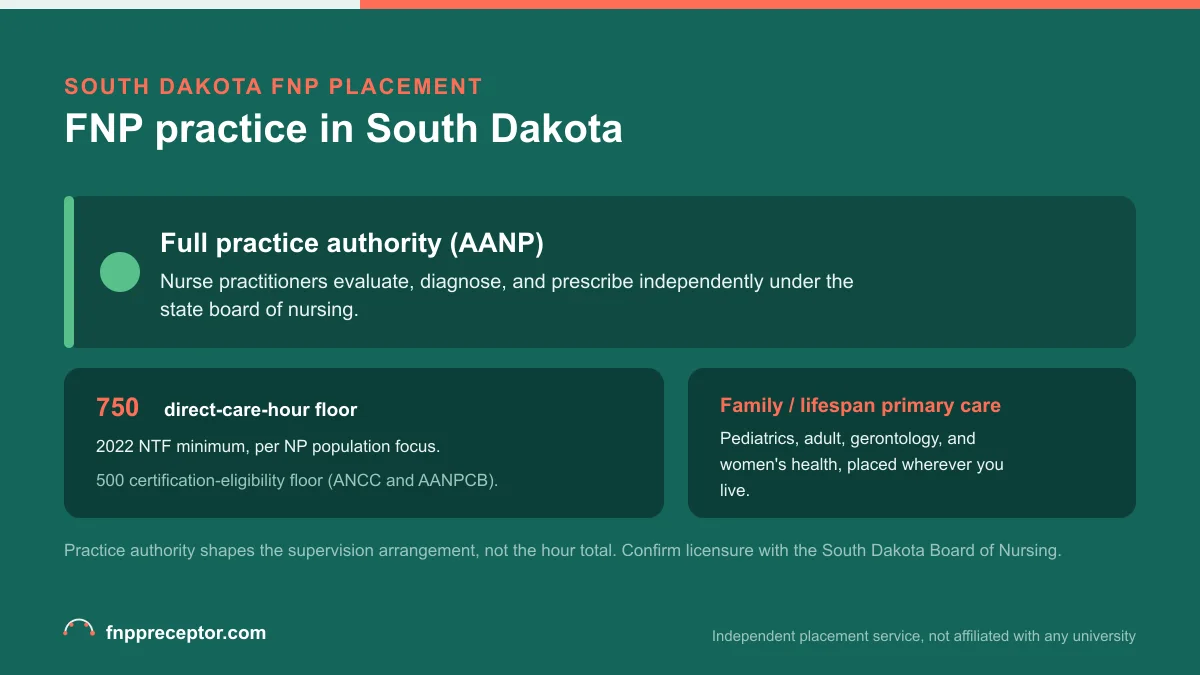
The AANP State Practice Environment lists South Dakota as a full practice state: a licensed certified nurse practitioner evaluates patients, diagnoses, orders and interprets tests, and prescribes under the licensure authority of the state board of nursing. For you that means an established CNP can precept and sign hours with no physician attached, unlike reduced or restricted states where a collaborating or supervising physician joins the arrangement.
One local detail matters before you approach someone. The South Dakota Board of Nursing requires a newly licensed CNP to practice under a written collaborative agreement until documenting a minimum of 1,040 licensed practice hours in the role, after which a practice verification form may be filed and the agreement retired. Since most programs also want a preceptor with a year or more of experience, that question tends to answer itself.
Core qualifications do not change with practice authority. Whoever signs must hold a current South Dakota license in the role they are precepting and be practicing in the population you are logging. Nurse practitioners qualify, physicians (MD or DO) commonly do, and certified nurse midwives are often accepted for women's health, but your school's rules govern. Checklist on preceptor requirements.
Hours, and the number your own program actually uses
Never borrow another student's hour total. The 2022 National Task Force standards recommend a minimum of 750 direct patient care hours per NP population focus, while AANP and ANCC certification eligibility requires at least 500 faculty supervised hours. Accredited FNP programs publish totals of roughly 540 to 800, and many sit below 750. Your program's own number, and how it splits across the four populations, is the figure to plan around. Our clinical hours breakdown covers the difference.
Whatever the total, this state rewards early work: a confirmed site four to six months out, an affiliation agreement opened before the term, and a second name in reserve for pediatrics and women's health. Clinics here are small, and one provider leaving in August can erase a spring placement.
Where we fit in
We are an independent placement service, separate from any university, and we work with FNP students wherever they are enrolled. In South Dakota that means calling clinics on both sides of the river, matching you with a preceptor licensed and practicing in the population you still need, and handing your program its documentation. We cannot guarantee a placement, and your school holds final approval.
Tell us your city, the populations you still need, your term dates, and how far you will really drive, at #match or on our contact page. Our process is on how it works, pricing on the cost page, other states under states.
Good to know
Can a nurse practitioner precept me in South Dakota without a physician involved?
Usually yes. South Dakota is a full practice authority state, so an established certified nurse practitioner can precept on their own licensure. The exception is a newly licensed CNP still under a written collaborative agreement until 1,040 licensed practice hours are documented. Your school may set its own experience minimum too.
Can a physician or a certified nurse midwife sign my FNP hours?
Often. Many FNP programs accept physicians (MD or DO), and certified nurse midwives are commonly accepted for women's health. The constants are a current South Dakota license in the role and active practice in the population you are logging. Your program's policy decides, so confirm before committing.
How many clinical hours will I need for my FNP program?
It depends on your program. The 2022 National Task Force standards recommend at least 750 direct patient care hours per population focus, and AANP or ANCC certification requires a minimum of 500 faculty supervised hours. Accredited programs publish totals from roughly 540 to 800, and many fall below 750. Confirm yours in writing.
Is placement easier in rural South Dakota than in Sioux Falls or Rapid City?
Availability is often better outside the metros, since competition is lighter and rural providers are frequently willing to teach. The cost shows up as 45 to 90 minute drives, winter weather, and pediatric or women's health volume that can be thin on a given day.
Do you guarantee a placement in South Dakota?
No, and be cautious of anyone who does. We search, contact sites, and organize paperwork for you. We do not control whether a clinic has capacity in your term, and we cannot approve a preceptor or site for your school. Final approval rests with your program.
Plan the FNP practicum across the lifespan
Tell us your school, city, course, and remaining objectives. We will organize an independent search for possible preceptors and primary care sites, subject to program approval.