Finding FNP clinical preceptors across Tennessee
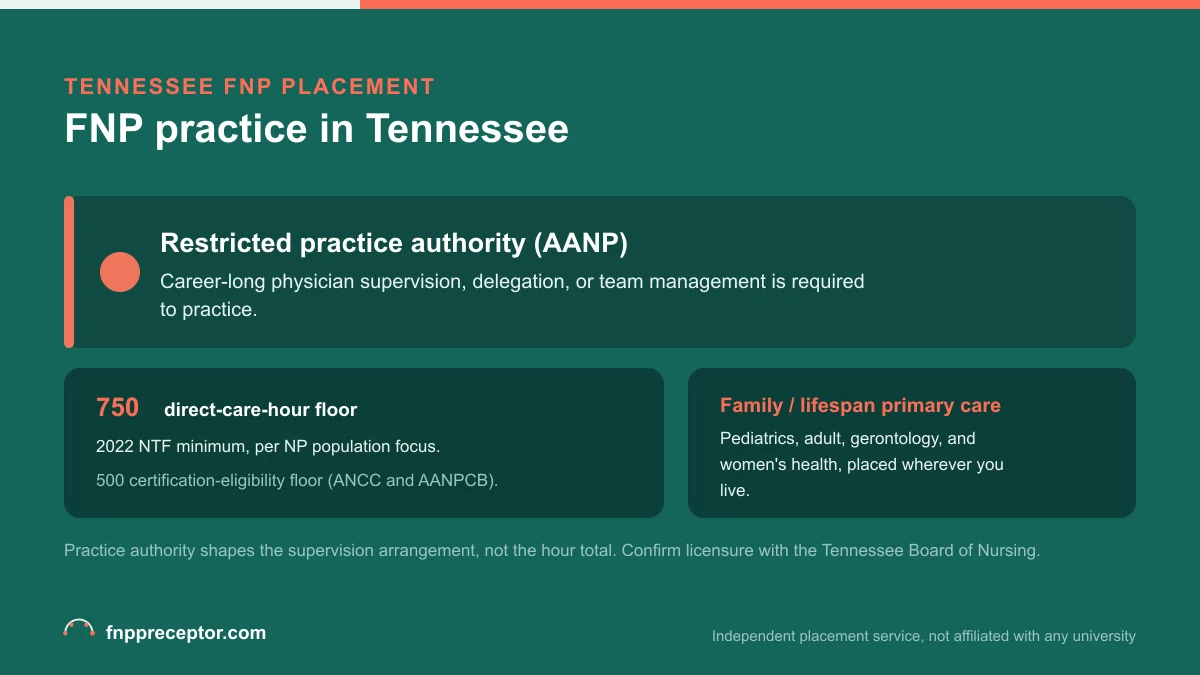
Tennessee sits in the restricted category of the AANP State Practice Environment. That shapes how a practice is structured, not whether the nurse practitioner inside it can teach you. FNP students here fill lifespan hours in family practice, community health centers, county health departments, rural clinics and urgent care, and the blocks that usually stall are pediatrics and women's health rather than adult primary care.
Where FNP students land in Tennessee
Most FNP hours here are logged in ordinary outpatient primary care: independent family practice groups and hospital affiliated offices, in every metro and most county seats. Past that core, a few settings recur.
- Community health centers. Safety net reporting describes roughly 30 federally funded health center organizations plus a look alike running close to 190 sites, and more than 400,000 Tennesseans get primary care from one each year. They see the full lifespan in a single room.
- Local health departments. All 95 counties have one and about half have offered primary care, putting a site in towns with little else. Family planning work there can open women's health exposure.
- Rural health clinics in shortage counties, often one or two providers who know the whole panel.
- Urgent care for acute volume, student health at the public universities, and correctional health, which is easier to enter and heavy on chronic disease.
Check your program's rules first. Many schools cap urgent care hours toward primary care, and some will not take correctional health at all.
Three grand divisions, three different searches
Tennessee runs about 440 miles end to end, and its three grand divisions behave like separate placement markets. West Tennessee is anchored by Memphis, with Jackson, Dyersburg and Union City as secondary hubs and real provider shortages in Delta counties such as Lauderdale, Haywood and Hardeman. Memphis offers volume and a deep safety net, plus the most competition.
Middle Tennessee is the crowded one. Nashville, Franklin, Murfreesboro, Clarksville and Columbia pull students from local campuses and from online programs nationwide. Push out to Cookeville, the Upper Cumberland or the Cumberland Plateau and the competition drops while the drive grows.
East Tennessee splits between Knoxville, Chattanooga and the Tri Cities of Johnson City, Kingsport and Bristol, with Morristown, Cleveland and Sevierville filling in around them. Appalachian counties like Claiborne, Campbell, Scott and Hancock often have willing preceptors and very few students asking. That is the rural trade everywhere: better supply, worse mileage.
What restricted practice changes, and what it does not
AANP classifies Tennessee as restricted practice, meaning state law requires career long supervision, delegation or team management by another provider for at least one element of NP practice. The mechanics run through the Tennessee Board of Nursing, which issues the certificate of fitness authorizing an advanced practice registered nurse to diagnose, build a plan of care and prescribe. Board rules tie that authority to a collaborating physician, whose name must be on file before the APRN prescribes.
For your rotation the effect lands on the arrangement, not the teaching. In a full practice state an experienced NP can often sign on as preceptor alone. Here a collaborating physician usually sits somewhere in the structure, so permission to host a student may run through that physician or a group policy, and some schools want the physician's signature on the paperwork too. What does not change is who qualifies to teach you: a current Tennessee license and active practice in the population you log.
Pediatrics and women's health are the bottleneck
The FNP track spans the lifespan, so hours must cover pediatrics, adult, gerontology and women's health. Adult and gero are rarely the problem here. Almost any family practice or health center fills them, and rural panels skew older, which makes geriatric exposure easy in the smaller counties.
Pediatrics is harder. Much of it sits in dedicated pediatric practices that tend to prefer pediatric NP students, and children's hospital outpatient clinics cluster in Memphis, Nashville, Knoxville and Chattanooga, concentrating supply where competition is worst. The usual workaround is a small town family practice that genuinely sees children, or a health center with a pediatric session. Ask what share of the daily schedule is under 18 before you commit, and read our pediatric rotation page.
Women's health is the other tight one. OB-GYN practices often prefer midwifery or women's health NP candidates, certified nurse midwives concentrate in the larger metro systems, and prenatal capacity at county health departments varies. Depending on your school, a CNM or a physician can precept this block. Start both populations four to six months ahead and consider splitting them into two shorter placements. See women's health rotations.
Mileage, timing and border questions
Distance is the quiet cost of a Tennessee placement. Memphis to Bristol is most of a day in the car, and inside one division a rural site can still be an hour each way. Count the round trip against clinic days for the full term, and factor in winter weather on the Plateau. Timing matters too: small practices host one student at a time, so a site booked for spring may be open in summer.
Tennessee borders eight states and several metros cross the line, so a site in Bristol, Virginia or northern Mississippi may be twenty minutes away. Crossing raises two questions: whether your school holds an affiliation agreement covering that site, and whether the preceptor is licensed where the care is delivered. Get both in writing first.
Confirm your own hour total before you count anything
There is no Tennessee specific clinical hour count for FNP students. Your number comes from your program. The 2022 NTF Standards published through AACN recommend a minimum of 750 direct patient care hours per NP population focus, while AANP and ANCC certification eligibility requires at least 500 faculty supervised hours. Accredited FNP programs commonly publish totals of roughly 540 to 800, and plenty of them sit below 750.
Pull your clinical handbook and write down four things: total hours, the minimum per population, what counts as direct patient care, and the deadline to submit a preceptor for approval. That last one sinks more students than scarcity does. Our clinical hours guide and preceptor requirements cover the rest.
If you would rather not cold call every clinic in the state
We are an independent placement service for FNP students at any university. We work independently of a school, and we do not guarantee placement or that your program will approve a given preceptor or site. What we do is work the Tennessee market for you: find practices in your division that host students, confirm license and population fit, and hand you a candidate with the paperwork your school expects.
Tell us your county, term dates, and which populations are open. Use the form at #match, read how it works, or reach us through contact. Fees are on the cost page.
Good to know
Does my Tennessee preceptor have to be a nurse practitioner?
Not necessarily. Depending on your school's policy and the population, an NP, a physician (MD or DO), or for women's health a certified nurse midwife can precept you. The constants are a current Tennessee license and active practice in that population.
If NPs here are supervised, can one still precept me?
Yes. The restricted classification describes the NP's own practice arrangement, not their ability to teach, and NPs across Tennessee precept FNP students routinely. Expect a collaborating physician in the structure, who sometimes also approves hosting you.
How many clinical hours will I need in Tennessee?
Tennessee sets no number for students. The 2022 NTF Standards recommend a minimum of 750 direct patient care hours per NP track, and AANP or ANCC certification requires at least 500 faculty supervised hours. Accredited FNP programs commonly publish totals of roughly 540 to 800, and many sit below 750. Confirm your own program's total.
How early should I start looking for a preceptor here?
Four to six months out for pediatrics and women's health, three to four for adult and gerontology. Nashville, Memphis and Knoxville fill first because several programs compete for the same offices. Flexibility on county speeds things up, since rural practices are asked far less often.
Can I complete part of my hours just across a state line?
Sometimes. Tennessee touches eight states and several metros cross the border. It depends on whether your school holds an affiliation agreement covering that site and whether the preceptor is licensed where the care happens. Confirm both in writing first.
Plan the FNP practicum across the lifespan
Tell us your school, city, course, and remaining objectives. We will organize an independent search for possible preceptors and primary care sites, subject to program approval.