Finding an FNP preceptor across 254 Texas counties
Texas has more primary care sites than almost any other state and still runs short of FNP preceptors, because the pool of students competing for them is just as large. The placements that come together fastest are family practices, community health centers, and clinics outside the four biggest metros, and the rotations that hold students up are pediatrics and women's health. Texas is also a restricted practice state, so a physician sits somewhere in your preceptor's supervision structure.
The settings that actually take FNP students here
Family practice is the backbone. Independent family medicine offices in mid-sized Texas cities and small towns are usually the quickest yes, because one clinician can decide without routing the request through an education office.
- Federally qualified health centers. State figures count 71 FQHC organizations across more than 700 service delivery sites. One clinic day there can include a toddler, a pregnant patient, a working adult, and an elder.
- Rural health clinics. Small, often nurse practitioner staffed, and common through East Texas, the Panhandle, and the Coastal Bend.
- Urgent care and retail clinics. High volume and a wide age range, though some programs cap episodic hours.
- Correctional health. The state prison system's contracted providers run a large adult clinic network with its own credentialing timeline.
- Military and veterans health. Texas carries one of the largest military footprints in the country, and federal sites need long onboarding lead times.
Tribal health is a small piece here: only three federally recognized tribes are based in Texas, near Livingston, Eagle Pass, and El Paso.
Big metros versus everywhere else
Houston, Dallas and Fort Worth, San Antonio, and Austin hold most of the state's clinical capacity, and most of its nurse practitioner, physician assistant, and medical students. A busy family practice there may already be booked several terms out. Competition, not supply, is the limit.
Outside them the math flips. Lubbock, Amarillo, Midland and Odessa, San Angelo, Tyler, Beaumont, Waco, Killeen, Corpus Christi, Laredo, and the Rio Grande Valley cities of McAllen and Brownsville have clinics that rarely see students and are often glad to. The cost is distance: Texas spans 254 counties and roughly 800 miles in either direction, so a rural site can mean a 90 minute drive twice a week. Price that against another semester of delay.
Pediatrics and women's health are the Texas bottleneck
FNP is an across the lifespan track, so your hours have to reach pediatrics, adult, gerontology, and women's health. Adult and gerontology is the easy quarter here, supplied by family practices, urgent care, internal medicine, and skilled nursing facilities.
Pediatrics is harder. Dedicated pediatric practices in the metros run tight schedules and are usually committed to programs they have hosted for years. The better route is a community health center or a family practice with a young panel, where children come in alongside their parents. School based health centers are worth asking about too. Our pediatric rotation page covers the ask.
Women's health is tightest. In Texas those visits concentrate in obstetrics and gynecology practices, county health department clinics, state funded women's health programs, and midwifery practices rather than in general family medicine. Certified nurse midwives can precept women's health hours under many school policies, so look past physicians and nurse practitioners. Clinics along the Rio Grande and in the colonias carry heavy prenatal loads, which makes them productive if you can reach them. See women's health rotations.
What restricted practice changes, and what it does not
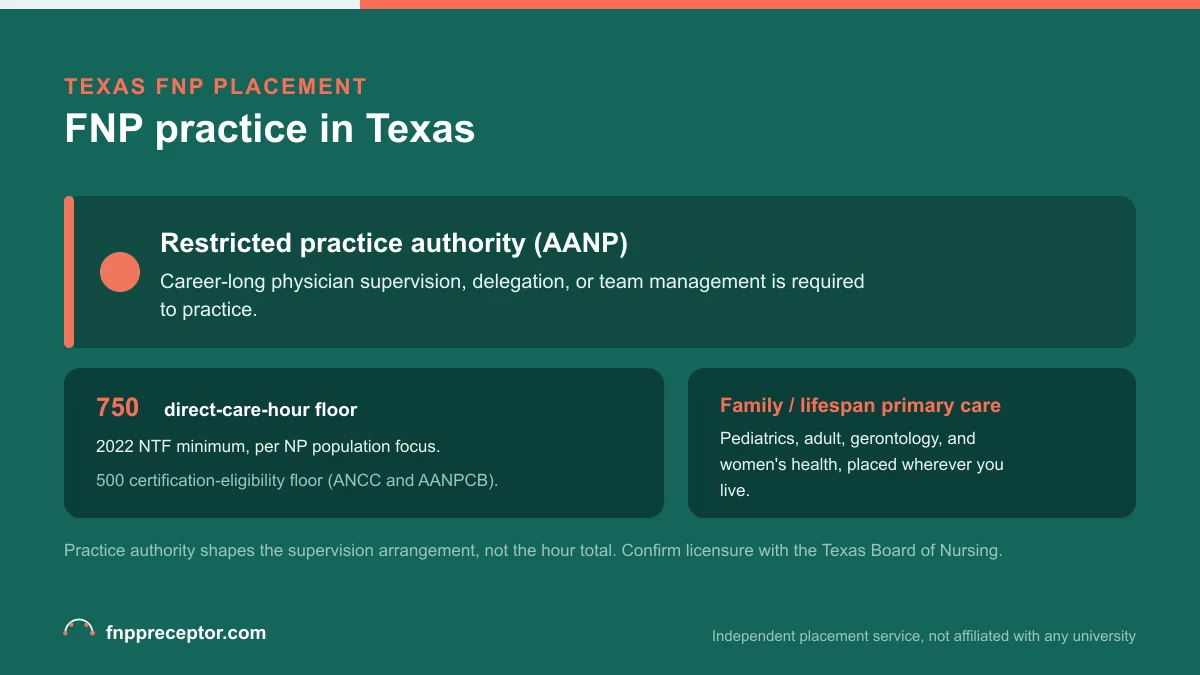
The American Association of Nurse Practitioners classifies Texas as restricted: state law requires career long supervision, delegation, or team management by another health provider for a nurse practitioner to provide patient care. A Texas nurse practitioner works under a written delegation arrangement with a physician, with prescriptive authority running through an agreement under Board Rule 222.5 or facility based protocols under Rule 222.6.
That changes the shape of your arrangement, not the quality of the teaching. The practice's physician often has a say in whether a student comes aboard, even when the nurse practitioner you would work with is keen. Sign off may need two signatures depending on how the practice runs. Ask in week one, not week ten.
One Texas rule surprises people. The Board of Nursing licenses advanced practice nurses to a specific role and population focus area rather than generically, so a Texas licensed FNP is the cleanest match for your hours. Any preceptor must hold a current Texas license and practice in the population you are logging.
How many hours you are actually chasing
Do not start a Texas search without your own number. The 2022 National Task Force standards recommend a minimum of 750 direct patient care hours per nurse practitioner track, and national certification requires at least 500 faculty supervised hours. Accredited FNP programs publish totals that commonly fall between roughly 540 and 800, and plenty sit below 750. Only your program's total governs your graduation, so confirm it first.
The split across the four populations is set by your school, not by Texas. Ask for the minimum per population, whether telehealth counts, and whether urgent care hours are capped. See clinical hours for the arithmetic and preceptor requirements for credentials.
Getting a Texas site to say yes
Lead time predicts success better than anything else. Large Texas health systems route requests through a central education office with fixed submission windows that close months before a term starts, while independent practices decide in a week. Start two terms out for a system, six weeks for a small practice.
Two things move a Texas request faster than any email. One is a school affiliation agreement already executed with the site, since a clinic facing a fresh contract negotiation will usually decline. The other is conversational Spanish, which makes a student immediately more useful along the border, in South Texas, and across the big metros.
Have the packet ready before you ask: resume, immunization and background check records, your school's malpractice confirmation, clinical objectives, and the exact dates you need. Sites decline vague requests more often than students.
Where we come in
We place FNP students from any university anywhere in Texas and work independently of any school. We do the outreach, verify licensure and population focus, and hand you a site that has already agreed to your dates. We assist; we never guarantee placement or your school's approval of a preceptor or site. Send your city, remaining populations, and term dates through the form at match me with a Texas preceptor, or via contact. Pricing sits on the cost page.
Good to know
Can a nurse practitioner precept me in Texas without a physician involved?
Not quite. Texas is a restricted practice state, so your nurse practitioner preceptor works under a delegation arrangement with a physician. That physician is rarely part of your day, but may need to agree before you start.
How many clinical hours will my FNP program require?
Check your own handbook. The 2022 National Task Force standards recommend at least 750 direct patient care hours per track and certification requires a minimum of 500 faculty supervised hours, but accredited FNP programs commonly publish totals from roughly 540 to 800, and many sit below 750.
Which Texas rotation should I line up first?
Women's health, then pediatrics. Both concentrate in specialty practices rather than general family medicine, and both fill early. Adult and gerontology hours are available almost everywhere in the state and can wait.
Can a physician or a nurse midwife precept my hours?
Often yes. Many schools accept an MD or DO for any population and a certified nurse midwife for women's health. The preceptor must hold a current Texas license and practice in the population you are logging. Your school's policy decides.
Do I have to find a placement in my own city?
No, and in Texas it is often faster not to. Clinics in the Panhandle, West Texas, East Texas, and the Rio Grande Valley see students far less often than the big metros, so they say yes more readily.
Related
Plan the FNP practicum across the lifespan
Tell us your school, city, course, and remaining objectives. We will organize an independent search for possible preceptors and primary care sites, subject to program approval.