Finding an FNP Preceptor in Utah, From the Wasatch Front to the Rural Counties
Utah is a full practice authority state, so an experienced nurse practitioner can take a family nurse practitioner student on their own license, with no physician attached to the arrangement. That widens the pool, but it does not fix the real Utah problem, which is geography. Most clinics sit on one narrow corridor where student demand is heavy, and the rest are scattered across counties hours from your door.
What full practice authority changes for your search
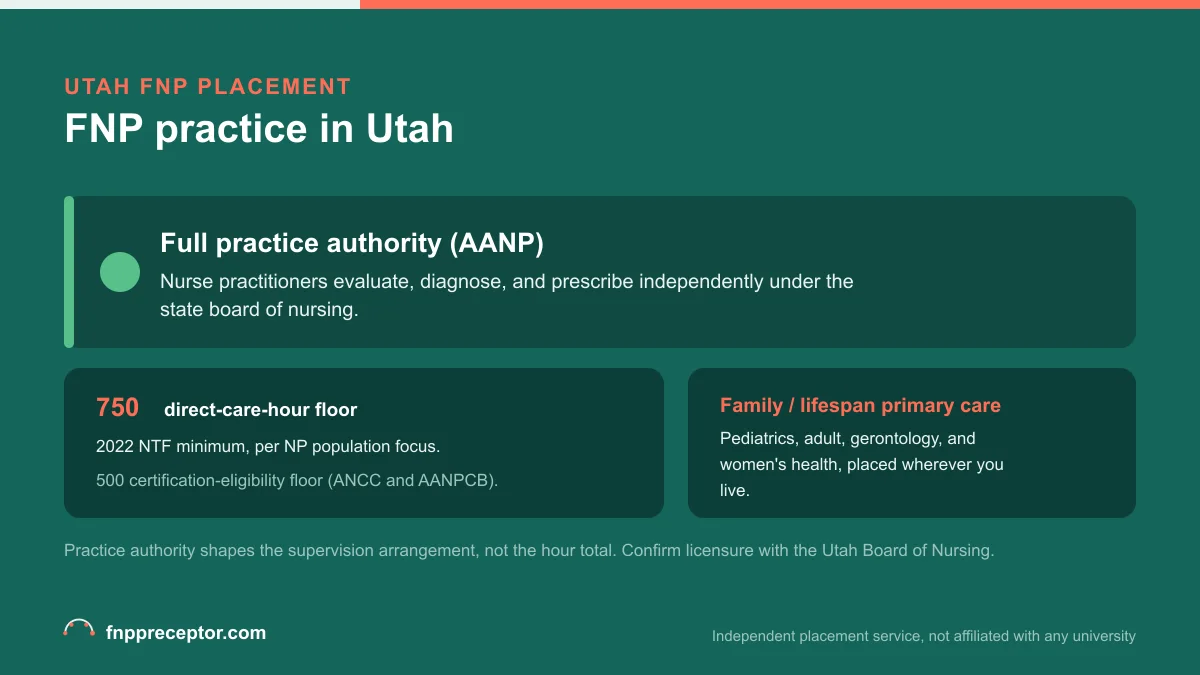
The American Association of Nurse Practitioners classifies Utah as a full practice state. Licensed NPs here evaluate patients, diagnose, order and interpret tests, and manage treatment including prescriptions under the licensure authority of the state board of nursing. Utah joined that column in March 2023, when Senate Bill 36 removed the state mandated physician contract from APRN licensure.
That reshapes the arrangement rather than the qualifications. In reduced and restricted states a collaborating physician is usually written into the paperwork even when an NP does the teaching. In Utah an experienced NP can precept alone, so NP owned practices and single provider clinics are real options. Your preceptor still needs a current Utah license and active practice in the population you are logging, plus whatever your school adds. See our preceptor requirements page.
Where FNP hours actually get logged in Utah
Utah's primary care base is wider than the Wasatch Front systems suggest. The Rural Health Information Hub counts 26 federally qualified health centers, 22 rural health clinics and 13 critical access hospitals statewide, and those safety net and small town sites host a good share of FNP students.
- Family practice groups, independent and system owned, the default setting statewide.
- Community health centers and FQHC sites, with Medicaid heavy panels that see every age in one afternoon.
- Rural health clinics, and the primary care clinics attached to critical access hospitals.
- Urgent care, good for volume and acute complaints, weak if your program grades continuity.
- College student health centers, strong for young adults, thin for pediatrics and gerontology.
- Correctional health, a steady adult and gerontology setting some programs accept and others refuse.
- Tribal and Indian Health Service affiliated clinics in San Juan County and on the Uintah and Ouray lands.
Site type beats the name on the building. One rural clinic seeing children, adults, elders and prenatal patients covers more of a lifespan track than a metro practice narrowed to adults.
One corridor, and a lot of open country
Roughly 12 percent of Utahns, about 409,000 people, live outside metro areas. Everyone else clusters on one strip. The Wasatch Front, meaning Salt Lake City, West Valley City, Sandy, Ogden, Layton, Provo, Orem and Lehi, holds most of the clinics and most of the competition, including students placed by campus based programs.
Away from the corridor the math changes. St. George, Cedar City, Logan, Tooele, Vernal and Roosevelt in the Uinta Basin, Price, Moab, and Blanding and Monticello in San Juan County all hold sites that field fewer student requests in a year than one Salt Lake City practice sees in a month. Rural Utah trades competition for drive time, fuel and sometimes lodging. Decide which you can absorb before you start calling, because students who keep both doors open place slowest.
Which of the four populations run tight here
FNP is the across the lifespan track, so your hours have to span pediatrics, adult, gerontology and women's health. Adult and gerontology rarely stall in Utah. Rural clinics and critical access practices carry heavy older panels, and long term care sites exist in most counties, so adult and gero hours tend to arrive together.
Pediatrics is the interesting one. Outside the corridor, Utah primary care is genuinely general, with one clinic seeing the newborn, the parent and the grandparent, so a well chosen rural family practice can produce real pediatric hours without a second placement. The trouble starts when your program demands a dedicated pediatric site, which sends you back to the metro peds groups where the queue is longest.
Women's health is usually the tightest. Obstetric and gynecologic care concentrates in the larger Wasatch Front systems and the bigger southern Utah groups, and many small rural clinics refer prenatal patients out. Certified nurse midwives are often the practical answer, and many programs accept a CNM for these hours. Confirm that yours does, and start this search before the other three.
Hours, licenses and the paperwork that sets your timeline
Know your own number first. The 2022 National Task Force standards recommend a minimum of 750 direct patient care hours per nurse practitioner track, and AANP and ANCC certification eligibility calls for at least 500 faculty supervised hours. Accredited FNP programs commonly publish totals of roughly 540 to 800, and many sit below 750, so do not assume a national figure describes yours. Pull your program's published total and plan against it. Our FNP clinical hours page explains how those totals get divided.
Two Utah items belong on the calendar early. Verify a preceptor's license through the state licensing division before you submit the name, since a lapsed or wrongly classified license found in week one costs you a term. Then leave room for the affiliation agreement, which takes longer when a clinic has never hosted a student from your program, and that is common in the smaller counties.
- Fix your dates and hours by population first, so you can ask for something specific.
- Choose metro or rural before outreach, and price rural travel across the whole rotation.
- Try all ages family practice and community health sites before narrow ones.
- Expect to split across two or three sites. That is normal here.
If you would rather not run this search alone
Cold outreach to Utah clinics between shifts is how students lose a semester. We work with FNP students at any university, independent of every school, and we know which parts of the state are worth calling for which population. We do not guarantee placement, and no honest service can, because your school approves the preceptor and the site. Send your dates and remaining populations through the match form or contact us. Pricing is on the cost page.
Good to know
Is Utah a full practice authority state for nurse practitioners?
Yes. AANP classifies Utah as full practice, and Senate Bill 36, signed in March 2023, removed the state mandated physician contract from APRN licensure. An experienced NP can therefore precept without a supervising physician attached, though your school's own preceptor rules still apply.
Can a physician or a nurse midwife precept my FNP hours in Utah?
Often, yes. Many programs accept an MD or DO, and many accept a certified nurse midwife for women's health hours. The preceptor must hold a Utah license and practice in the population you are logging. Credential rules vary more between programs than between states, so confirm with your placement office.
How many clinical hours will I need for an FNP program?
It depends on your program. The 2022 National Task Force standards recommend a minimum of 750 direct patient care hours per track, and AANP and ANCC certification eligibility requires at least 500 faculty supervised hours. Accredited FNP programs commonly publish totals of roughly 540 to 800, and many sit below 750, so check your own.
Which FNP population is hardest to place in Utah?
Women's health, usually, because obstetric and gynecologic care clusters in the Wasatch Front systems and the larger southern Utah groups while small rural clinics refer prenatal patients out. Pediatrics is often easier here than elsewhere, provided your program allows peds hours inside a general family practice.
Should I search Salt Lake City or rural Utah?
The Wasatch Front has the most clinics and the most competition, so ask early and expect waiting lists. Rural counties such as the Uinta Basin, Carbon County, Moab and San Juan County field fewer requests and offer a broader patient mix, at the cost of travel. Our state guides cover placement elsewhere.
Plan the FNP practicum across the lifespan
Tell us your school, city, course, and remaining objectives. We will organize an independent search for possible preceptors and primary care sites, subject to program approval.