Lining up family nurse practitioner rotations across the Commonwealth
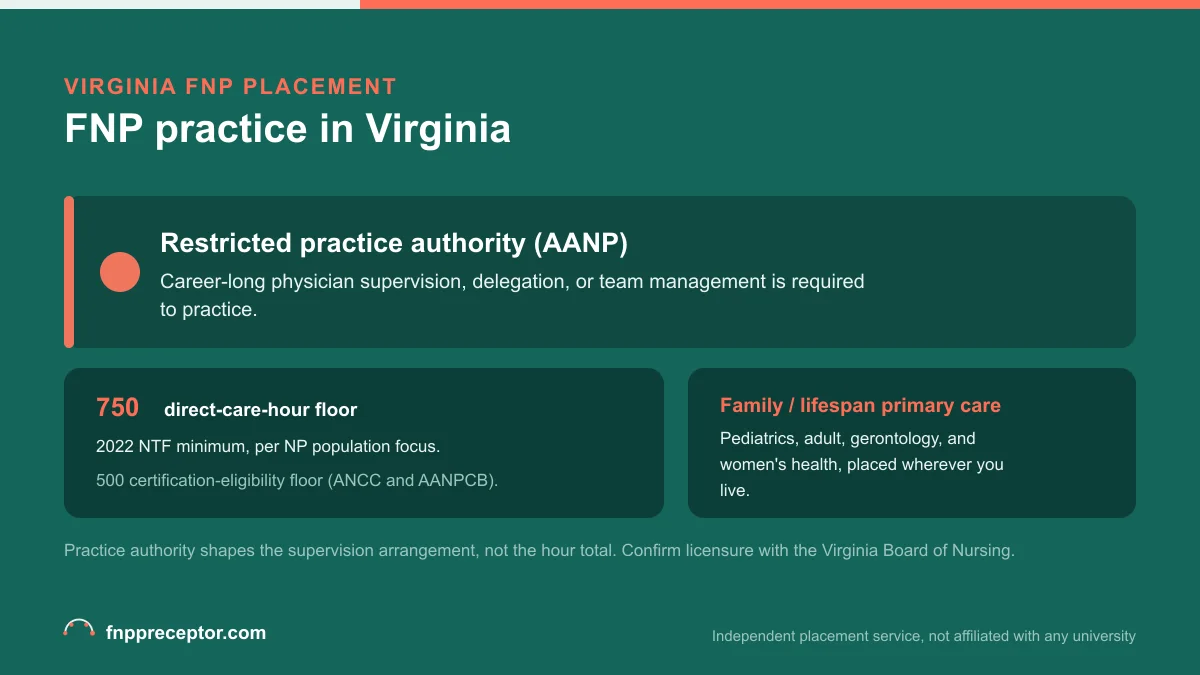
Virginia sits in the restricted category on the AANP State Practice Environment, so most nurse practitioners here keep a written practice agreement with a patient care team physician until they qualify for autonomous practice. For an FNP student that is a paperwork fact more than a teaching one: your preceptor still needs a current Virginia license and an active panel in the population you log. What shapes the rotation more is which part of the state you search.
What restricted status changes, and what it does not
Virginia asks nurse practitioners to keep collaboration and consultation in place through a written practice agreement with at least one patient care team physician. After the equivalent of three years of full-time clinical experience, plus the attestation the boards require, that agreement is no longer needed and the NP holds autonomous practice designation. The threshold was five years until July 1, 2024.
For you this shows up narrowly. If your preceptor still works under an agreement, a physician sits on that care team and your school's preceptor form may need to reflect it. If she holds autonomous practice designation, the paperwork is shorter. Neither changes what she can teach or whether the hours count. One quieter rule affects supply: a patient care team physician may not hold agreements with more than six nurse practitioners at once, which is part of why a large group can look full from outside.
Where FNP students actually land here
Family practice is the backbone, but rarely the whole picture for a lifespan track. The settings that carry FNP students in Virginia:
- Primary care and family medicine groups, independent and system employed, which cover adult and geriatric volume easily.
- Federally qualified health centers. The state primary care association represents 30 member organizations running more than 180 clinic sites, and those see the widest age range under one roof.
- Free and charitable clinics, an unusually developed network here, staffed heavily by volunteers and often generous about teaching even when hours fall on evenings.
- Rural health clinics and local health district offices, handling family planning, prenatal intake, immunizations, and communicable disease work.
- Urgent care and convenient care: strong acute volume and pediatric sick visits, thin on continuity.
- College student health, long term care, correctional health, and occupational medicine for adult and gerontology hours.
Hampton Roads and Northern Virginia both carry large military and veterans health footprints. Those sites do real primary care, but placing a student inside one runs through separate federal agreements and clearance, on a timeline your program may not meet.
Several markets, not one state
Northern Virginia, from Arlington and Alexandria out through Fairfax, Loudoun, and Prince William, has the highest clinic density and the fiercest competition. Programs on both sides of the Potomac recruit into the same corridor, so preceptors book early.
Richmond and its counties combine academic medicine, a deep safety net, and enough independent practices for real continuity. Hampton Roads, from Norfolk and Virginia Beach through Chesapeake and Newport News, reads bigger than it is for students because so much primary care sits inside federal facilities. The Shenandoah Valley around Winchester, Harrisonburg, and Staunton mixes small-town family practice with community health serving agricultural and immigrant populations, which usually means broad panels.
Southwest Virginia (Roanoke, Blacksburg, Abingdon, Bristol, Wise), Southside (Danville, Martinsville, South Boston), and the Eastern Shore are where willingness runs highest and competition lowest. The trade is travel: before accepting a site three hours out, price the drive, the lodging, and the weeks involved.
Which of the four populations gets tight
FNP is the across-the-lifespan track, so your hours must span pediatrics, adult, gerontology, and women's health. Adult and gerontology are the easy two here: almost any primary care, urgent care, or long term care setting fills them, and most students overshoot without trying.
Pediatrics is harder in the metros than in the mountains. Around Northern Virginia, Richmond, and Hampton Roads, children are largely seen in dedicated pediatric practices and children's hospital networks rather than mixed family offices, so a metro family block can yield few pediatric encounters. In the far southwest and on the Eastern Shore, a rural family practice is often the only office in the county and carries newborns through elders in one afternoon.
Women's health is the tightest almost everywhere. Obstetric and gynecologic care concentrates in hospital-affiliated groups in the population centers, and several rural counties have lost delivery services, pushing routine gynecology, contraception, and prenatal intake into community health centers and health district clinics. Those are often your most realistic sites. Certified nurse midwives are worth pursuing too, and Virginia puts their authority on a separate track, letting a CNM practice without an agreement after 1,000 hours. Whether a CNM may sign your hours is your program's question. Detail lives in pediatric, women's health, and adult and gerontology rotations.
Hours, and why a number you heard is not enough
The 2022 National Task Force standards published through AACN recommend a minimum of 750 direct patient care hours per NP track. Certification eligibility through AANP or ANCC sits lower, at 500 faculty-supervised hours. Accredited FNP programs publish totals in roughly the 540 to 800 range, and plenty sit below 750.
So do not build a Virginia calendar around a figure a classmate quoted. Open your own clinical handbook, find the program total and the per-population minimums, and work backward from graduation. Our clinical hours page walks the arithmetic; preceptor requirements covers what schools want on file.
Setting up the rotation without losing a semester
Two checks come first. Confirm the preceptor holds a current Virginia license in the role and population you plan to log, verifiable through the Virginia Board of Nursing under the Department of Health Professions. Then confirm your school will accept the site, because affiliation agreements take weeks and are the most common reason a confirmed preceptor falls through. After that it is calendar work: days per week offered, whether that holds all term, and who covers you when your preceptor is away.
That search is the part students run out of time for, and it is what we do. We are independent, we work with FNP students at any university, and we search Virginia by population and region rather than sending everyone one list. Send your term dates, remaining hours, and travel radius through the match form or contact us. We assist with placement; we do not guarantee a placement or your school's approval of any preceptor or site.
Good to know
Can an NP precept me in Virginia without autonomous practice designation?
Yes. Working under an agreement with a patient care team physician is normal for Virginia NPs below the three-year threshold and disqualifies no one from teaching. The difference is administrative: your school may want that relationship noted on its form.
My program is online and based in another state. Does my preceptor need a Virginia license?
Yes, if the patients are in Virginia. The preceptor must be licensed where the hours happen and practicing in the population you log; your school's location does not change that. Many schools also need authorization to place students here.
Can a physician or a nurse midwife sign my FNP hours?
Often, though that is your school's call more than the state's. Many programs accept MD and DO preceptors for family practice and CNMs for women's health, while some reserve part of the hours for NP preceptors. Check the handbook early.
Is a rural placement worth the drive?
Sometimes, and it is worth doing the math rather than guessing. Rural family practices in the far southwest and on the Eastern Shore often carry the full age range in one office, closing peds gaps a metro practice would leave open.
Plan the FNP practicum across the lifespan
Tell us your school, city, course, and remaining objectives. We will organize an independent search for possible preceptors and primary care sites, subject to program approval.