How FNP students in Washington find clinical preceptors
Washington grants nurse practitioners full practice authority, so an experienced ARNP can precept you without a supervising physician attached to the arrangement. What actually slows FNP students here is geography: the I-5 corridor has the patient volume and the crowded clinics, while eastern and coastal Washington has willing sites and long drives. Below is where students really log hours in this state, and which populations take the longest to fill.
Two placement markets, split by the Cascades
West of the crest sits the I-5 corridor: Seattle, Everett, Tacoma, Olympia, Bellingham and Vancouver, plus the Olympic Peninsula. East of it are Spokane, the Yakima Valley, the Tri-Cities of Kennewick, Pasco and Richland, Wenatchee, Walla Walla, Pullman and the small towns of Okanogan and Stevens counties. The metros hold the volume, which is why they are hard: a family practice in King or Pierce County may already host students year round from several nursing, physician assistant and medical programs.
Outside the metros the ratio flips. A clinic in Colville, Omak, Othello or Port Angeles may field one or two student requests a year and treat yours as a real conversation. The cost moves to logistics: Snoqualmie and Stevens passes close in winter, the Peninsula and islands add ferry schedules, and a Yakima rotation from Seattle is a lodging decision rather than a commute. Students willing to take short term housing get better sites.
Where Washington FNP students actually get hours
These settings carry most of the family practice hours logged in this state. Which are realistic depends on your county and on what your program counts as primary care.
- Community health centers and FQHCs. Washington had 27 federally funded health center organizations serving more than 1.2 million patients in 2024. Strongest single lane for FNP students, since children, adults, elders and well woman visits move through one building. Spanish is a genuine asset in the Yakima Valley and Columbia Basin.
- Rural health clinics and critical access hospital outpatient clinics across Okanogan, Ferry, Stevens, Adams and Grays Harbor counties, frequently NP staffed.
- Family and internal medicine offices along I-5 and around Spokane.
- Urgent care and convenient care, broad in age, though ask how many episodic hours your program counts.
- Tribal health clinics and urban Indian health programs, which run their own credentialing.
- Student health centers in Pullman, Cheney, Ellensburg and Bellingham.
- Correctional health at state facilities, chronic disease dense and rarely crowded.
- Home based and long term care around Sequim and the Tri-Cities.
Veterans and military facilities in Puget Sound, Spokane and Walla Walla are worth asking about, but they run their own onboarding and background checks. Start those conversations a full term earlier than you would with a private practice.
What full practice authority changes about the ask
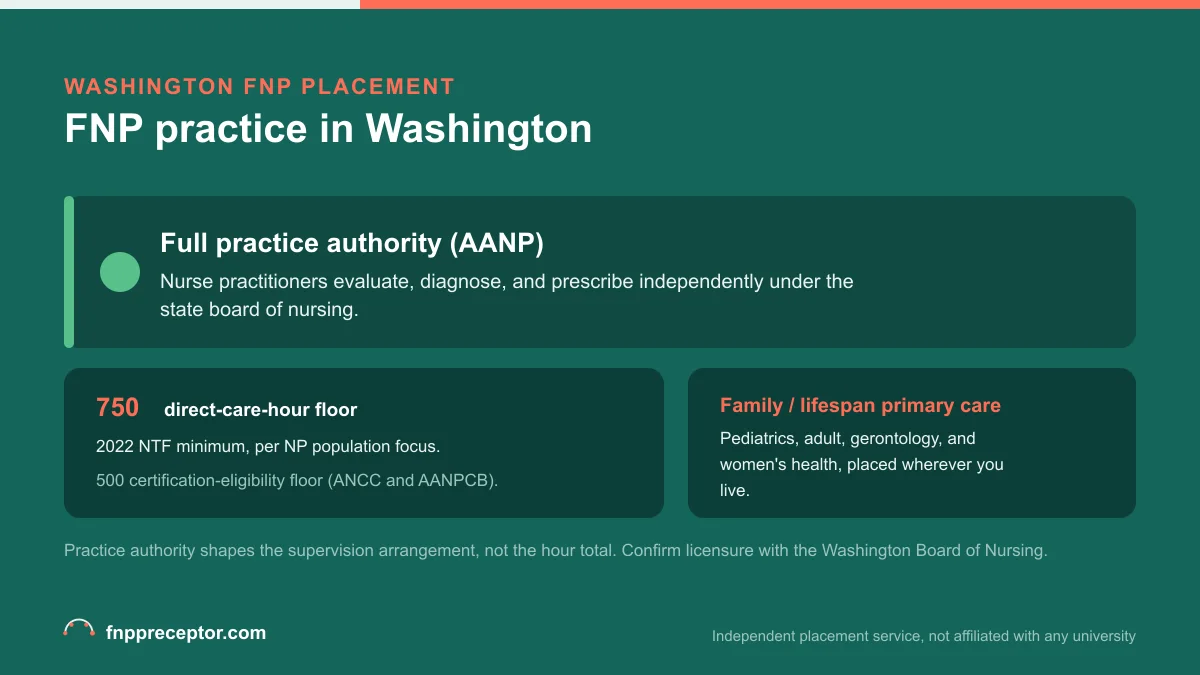
The AANP State Practice Environment places Washington in the full practice category: state law lets NPs evaluate patients, diagnose, order and interpret tests, and start and manage treatment including prescribing, under the state board of nursing. The practical effect is one fewer signature. An experienced ARNP can take you on alone, and nobody has to produce a collaborating physician agreement.
Washington titles the license ARNP, short for Advanced Registered Nurse Practitioner, so that is what appears on a candidate's credential. Verify it early: the Washington State Board of Nursing points to Nursys for nursing credentials, and the Department of Health provider credential search covers other license types and posts disciplinary actions.
It changes nothing else on the checklist. Your preceptor still has to be licensed where you log hours and practicing in the population you are logging, and your school sets its own bar on top of that, usually national certification plus a year or two of practice. See preceptor requirements.
Pediatrics and women's health are the two that cost you time
FNP is an across the lifespan track, so your hours have to span pediatrics, adults, gerontology and women's health. Adult and geriatric hours largely take care of themselves here; family practice, urgent care and long term care hand you more of those patients than you need. See adult and gero rotations.
Pediatrics is where schedules break. Dedicated pediatric practices cluster in the metros that already host medical and physician assistant students, and many cap student volume. What works more often is a family practice with a genuinely young panel, easier to find in the Yakima Valley, the Columbia Basin and smaller Peninsula towns than in central Seattle, an FQHC running pediatric sessions, or a school based health center. See pediatric rotations.
Women's health is the other bottleneck. OB-GYN offices in Seattle, Tacoma, Spokane and Yakima often sit beside residency programs and fill student slots early. Reachable alternatives: family practices that still do prenatal and well woman visits, which survive better in rural Washington than in the metros, publicly funded reproductive health clinics, and certified nurse midwives where your program accepts them. Lock these two populations first and let adult and gero fill in around them. See women's health rotations.
Border towns, agreements and booking windows
Three Washington metros sit on a state line and each tempts students the same way. Vancouver looks across the river at Portland, Clarkston faces Lewiston, and Spokane is minutes from Coeur d'Alene. A clinician on the other side holds that state's license, and yours must be licensed where you log hours, so check with your program before committing to an Oregon or Idaho clinic.
On timing, start asking six to twelve months out; fall and January starts are the crunch. The affiliation agreement between your school and the site is usually the long pole, and behind it come the background check, immunizations, drug screen, chart access and orientation, which can take a month.
A nonprofit consortium also coordinates student placements between member schools and health organizations in Washington and northern Idaho, centered on acute care. Most FNP primary care preceptorships are still arranged directly with the practice, but if your school belongs, onboarding may run through that system.
Hours to plan for, and where we fit
Do not take an hour count from a forum. The 2022 NTF Standards recommend a minimum of 750 direct patient care hours per NP population focus, while AANP and ANCC certification eligibility requires at least 500 faculty supervised hours. Accredited FNP programs publish totals that commonly run from roughly 540 to 800, and plenty sit below 750. Your own handbook is the number that governs you. Background at FNP clinical hours.
Distribution matters as much as the total. Your log has to show all four populations, and a preceptor only counts for the population they actually practice in. A fine family physician in Spokane does not turn your time into pediatric hours because a few children came through.
We place FNP students independently, at any university. Tell us your county, your start date and which populations are still open, and we will work our Washington contacts. Use the request form on this page or reach us through contact. We cannot guarantee a placement or your school's approval of any preceptor or site.
Good to know
Does a Washington preceptor need a collaborating physician?
No. Washington sits in the full practice category of the AANP State Practice Environment, so a licensed ARNP precepts without a collaborative or supervisory agreement. Your school can still add conditions, and many employers require internal approval before a clinician takes a student.
Can a physician or nurse midwife precept my FNP hours here?
Often yes. Many programs accept an MD or DO for family practice hours and a certified nurse midwife for women's health, provided the clinician is licensed in Washington and practicing in the population you log. Acceptance varies by school, so get your program's written list first.
How do I confirm a Washington preceptor's license is active?
Ask for the full name and credential number, then check it yourself. The Washington State Board of Nursing points to Nursys for nursing credentials, and the Department of Health provider credential search covers other license types and shows disciplinary actions taken after July 1998.
I live in Vancouver. Can I rotate across the river in Portland?
Do not assume so. A Portland clinician holds an Oregon license, and your preceptor generally has to be licensed where you log hours. The same caution applies to Idaho sites near Spokane and Clarkston. Ask your placement office in writing first.
How many clinical hours does Washington require of FNP students?
The state sets no total; your program and its accreditor do. Certification through AANP or ANCC requires at least 500 faculty supervised hours, the 2022 NTF Standards recommend a minimum of 750 per population focus, and published program totals commonly land between roughly 540 and 800.
Plan the FNP practicum across the lifespan
Tell us your school, city, course, and remaining objectives. We will organize an independent search for possible preceptors and primary care sites, subject to program approval.