Where FNP students log clinical hours in West Virginia
West Virginia sits in the reduced practice category, so the nurse practitioner who precepts you here often works under a written collaborative agreement with a physician. That shapes paperwork more than teaching. The harder problem is distribution: family practice hours are easy to find, but pediatric and women's health encounters cluster in a handful of towns. This page maps where FNP hours actually exist here.
The community health center is the spine of placement here
Learn one thing about this state and make it this: the federally qualified health center network carries an outsized share of West Virginia primary care. The state association counts more than 550 community health center sites, and roughly one in three West Virginians receives care through one. That cuts in your favor twice. These clinics see the full age range in a day, and they employ nurse practitioners heavily, so the preceptor pool sits where the volume already is.
The settings that realistically take FNP students:
- Family practice and general internal medicine, from solo county seat offices to hospital affiliated networks in the cities.
- Federally qualified health centers and rural health clinics, covering most small towns.
- School based health centers, of which the state has 253.
- Urgent and convenient care, good for acute volume, thin on continuity.
- Student health at the state's colleges, mostly young adults.
- Correctional health, adult heavy, often open when other doors are shut.
- Veterans Affairs primary care, strong for adult and gerontology.
Two of your four populations will decide your timeline
The FNP track runs across the lifespan, so hours must span pediatrics, adult, gerontology and women's health. The adult and gerontology halves are easy here. Panels skew older, and between family practice, long term care and Veterans Affairs primary care those columns fill themselves.
Pediatrics is tighter than students expect. Outside the larger cities there are few pediatrics only practices, so most children are seen in family practice, in community health centers, which report serving over 100,000 children in a recent year, and in school based health centers. That last category is the opening most students overlook, and it can produce a dense block of pediatric encounters. It runs on the academic calendar, so ask for fall or spring. See our pediatric rotation guide.
Women's health is the real bottleneck. The board's own license counts tell it plainly: roughly 5,600 nurse practitioners are licensed here against fewer than 100 certified nurse midwives. Obstetric and gynecologic services have consolidated toward regional hospitals, leaving a number of rural counties without a local labor and delivery unit. Expect that exposure to come from a community health center or a family practice that still does it, and treat a dedicated OB or midwifery block as upside. Our women's health rotation page covers what counts.
Several population centers, and a lot of mountain in between
There is no single dominant metro, which changes how you search. Placement clusters around separate centers: the Kanawha Valley around Charleston, Huntington and the western Ohio River corridor, Morgantown and the north central belt through Clarksburg and Fairmont, Parkersburg in the Mid Ohio Valley, Wheeling in the Northern Panhandle, Martinsburg in the Eastern Panhandle, the southern coalfields around Beckley and Princeton, and the Greenbrier Valley near Lewisburg.
The rural and urban trade is sharper here than in flatter states. Around Morgantown, Huntington and Charleston you get clinic density and specialty exposure plus real competition, since the academic medical centers there host students from many health professions programs at once. An hour out, competition thins and preceptors are often more willing, but the roads are the catch: mountain routes turn a short map distance into a long commute, and winter weather is a scheduling risk.
The Eastern Panhandle behaves differently. Berkeley and Jefferson counties sit in the Washington and Baltimore commuter belt, which brings more clinics and more out of state students chasing them. Apply earlier there.
Reduced practice, translated to what happens at the site
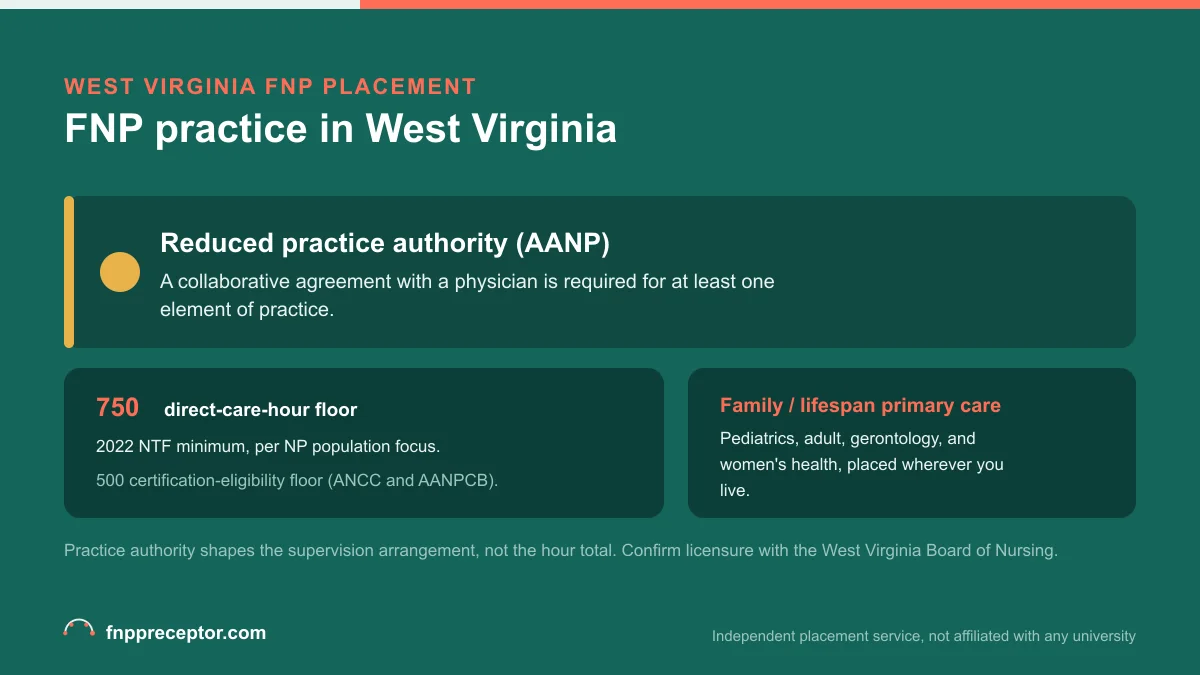
AANP places West Virginia in the reduced practice category. In practice, a nurse practitioner with prescriptive authority generally works under a written collaborative agreement with a physician, notarized and filed with the state board. There is a route out: an NP who has held prescriptive authority for at least three years in that relationship may apply to prescribe without ongoing collaboration.
For you this changes the arrangement, not the education. Where your preceptor has a collaborating physician, the decision to host a student often runs through the practice as well as the individual NP, so expect an extra signature and sometimes an extra week. Where the NP holds independent prescriptive authority, that layer falls away. The core requirements do not move: a current license where the care happens, practice in the population you are logging, and your school's final approval of the site. Verify current rules with the board.
Your hour total, and who is allowed to sign for it
Get your own number first. The 2022 NTF Standards recommend a minimum of 750 direct patient care hours per NP track, while AANP and ANCC certification eligibility requires at least 500 faculty supervised clinical hours. Accredited FNP programs commonly publish totals between roughly 540 and 800, and many sit below 750. Do not assume yours is 750. Pull the figure from your own clinical handbook, since the gap between 540 and 800 is an entire extra rotation to source. See FNP clinical hours.
Most programs also cap how many hours one site or preceptor may supply, and that cap is usually what forces a second site here. On who may precept: nurse practitioners are the common answer, physicians (MD or DO) are accepted in many arrangements, and certified nurse midwives are often right for women's health. Your school decides, and rules vary on whether a physician counts at all. Check preceptor requirements with your clinical coordinator.
If you would rather not cold call the whole state
We are independent and work with FNP students at any university, so what we bring is site relationships and the patience to keep asking. Send your county or honest drive radius, the populations still open on your log, and your term dates, and we will work the family practices, community health centers and school based sites for a fit. We assist with placement and do not guarantee it, and no service can promise your school approves a given preceptor. Start at #match.
Good to know
What does West Virginia's reduced practice status mean for my preceptor?
An NP who prescribes generally does so under a notarized collaborative agreement with a physician filed with the state board, though one with three or more years of prescriptive authority in that relationship may apply to prescribe without it. It shapes the supervision structure at the practice, not whether a nurse practitioner can teach you.
Can I finish all my hours in one rural family practice?
Rarely. Even a practice seeing the whole age range runs short on pediatrics and women's health, and most programs cap hours per site. Plan on a primary site plus one or two supplemental blocks.
Where do students here usually find pediatric hours?
Community health centers and school based health centers are the two most productive answers, and the state has 253 school based sites. Pediatrics only practices sit mainly in the larger cities. Because school based centers follow the academic year, request that block for fall or spring.
How far will I actually have to drive?
Around Charleston, Huntington, Morgantown, Parkersburg and Martinsburg, most students place within about 30 minutes. In rural counties, 45 to 75 minutes each way is normal, and mountain roads make the map look optimistic. Give us your true radius, not your hopeful one.
I live close to a state line. Does that help or hurt?
Usually it helps, since West Virginia touches five states and it widens the search into Ohio, Kentucky, Virginia, Maryland or Pennsylvania. The conditions: your preceptor is licensed where care is delivered, and your school approves placement in that state. Confirm both early.
Plan the FNP practicum across the lifespan
Tell us your school, city, course, and remaining objectives. We will organize an independent search for possible preceptors and primary care sites, subject to program approval.