Where Wisconsin FNP students actually log clinical hours
Most FNP students in Wisconsin close out their adult and geriatric hours without much trouble, then lose half a semester hunting for pediatrics or women's health. The state has real capacity in family practice, community health centers, urgent care and rural clinics, but it sits unevenly between the Milwaukee and Madison corridors and the counties north and west. Here is where students actually get hours, which populations run short, and how state supervision rules shape the arrangement.
The settings that take FNP students here
Primary care in Wisconsin splits between a handful of large integrated systems and a long tail of independent practices. Both host students. Family practice is the anchor, because a clinician who sees infants, working adults and nursing home residents in one week covers several populations at once, and those slots go early.
Community health centers deserve more attention than students give them. Eighteen federally qualified health centers operate in Wisconsin and see close to 300,000 patients a year, in places as far apart as Appleton and Ashland. They cover the full lifespan, teaching is built into how they staff, and most run a written student process rather than an informal favor.
- Family practice and internal medicine, system-owned and independent
- Federally qualified health centers and free clinics in the larger cities
- Rural health clinics attached to critical access hospitals
- Urgent care and convenient care, useful for acute volume
- Campus health services at public and private universities
- Correctional health in state institutions, adult heavy but dependable
- Tribal health clinics run by Wisconsin's federally recognized tribes
- Long term care and geriatric practices
The Milwaukee and Madison squeeze
Southeastern Wisconsin holds the most clinics and the most students. Milwaukee, Waukesha, Racine and Kenosha have volume in every population plus the specialty depth that makes dedicated pediatric and women's health placements possible. The catch: every program within driving distance asks the same practices in the same months, and many already carry medical, PA and NP learners on a calendar set a year out.
Madison and Dane County work the same way at a smaller scale, with academic primary care absorbing much of the capacity. Green Bay, Appleton, Oshkosh, Eau Claire, La Crosse and Sheboygan sit in a useful middle: enough volume to fill your logs, fewer competing cohorts. Students willing to look one city out from home get confirmed faster.
Rural counties trade competition for mileage
The Wisconsin Office of Rural Health counts roughly 1.5 million people across 45 rural counties. Preceptor supply there is genuinely better, because a clinic in Rhinelander, Hayward, Viroqua or Prairie du Chien is not fielding six student requests a week. The cost shows up as travel: an hour each way, or a rented room for a block of weeks.
Rural family practice has a second advantage. The panel is unfiltered, so one clinic day can hold a well child check, a prenatal visit, a diabetic follow up and a question about a ninety year old on home oxygen. If your program allows multiple populations at one site, a rural practice is often the most efficient placement in the state. Ask faculty first, since some programs insist on separate sites.
Which of the four populations will slow you down
Adult and gerontology hours are the straightforward part. Family practice, internal medicine, urgent care and long term care all count, and northern counties carry older populations than the metros, so geriatric volume is easy to reach. See adult and gero rotations.
Pediatrics is the first real bottleneck. Dedicated pediatric practices cluster around Milwaukee, Madison and the Fox Valley. Outside those pockets children are seen inside family practice, where the daily count can fall short of what a program wants. Community health centers and school based clinics help. Start early, and read how pediatric FNP rotations work.
Women's health is the other one. Obstetric and gynecologic care here has consolidated toward regional hospitals and larger multispecialty groups, so the sites exist but sit in fewer towns. Certified nurse midwives can precept these hours under many program rules, and midwifery practices are often more open to students than physician OB groups. More in women's health rotations.
What reduced practice authority means for your preceptor
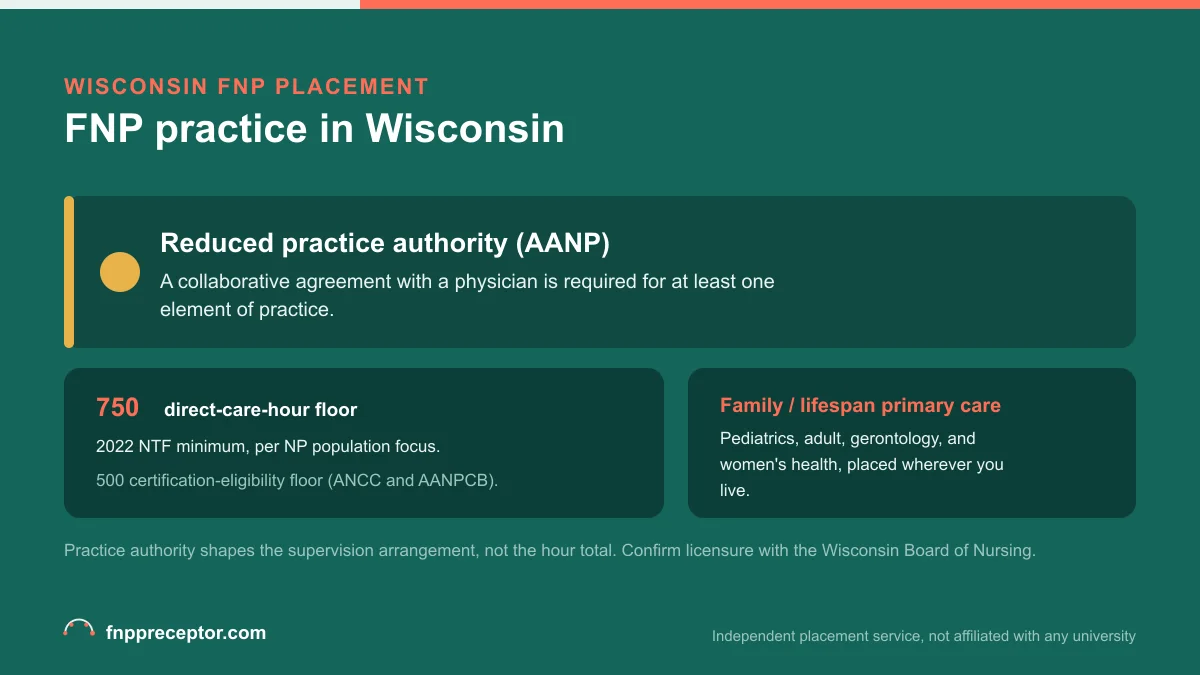
The AANP State Practice Environment lists Wisconsin as a reduced practice state. A nurse practitioner here has held the advanced practice nurse prescriber credential and worked under a documented collaborative relationship with a physician or dentist for prescribing. That is a licensure arrangement, not a verdict on teaching. An experienced Wisconsin NP can precept you.
It changes paperwork more than your day. Your school's affiliation agreement may ask for the collaborating physician's name, a site may want that physician to approve hosting a student, and some clinics prefer a physician co-signature on evaluations. Raise all three in the first conversation.
Wisconsin is also mid-change. Under 2025 Wisconsin Act 17, the APRN Modernization Act, the state moves to a distinct APRN license on September 1, 2026, and qualified APRNs with 3,840 clinical hours in their role and 24 months of practice may work without a collaborating physician. Employers can still require collaboration on their own terms. Verify current rules with the Wisconsin Board of Nursing, and see what a preceptor has to hold.
Hours, school rules, and where we come in
Pin down your own hour total first. The 2022 NTF Standards recommend a minimum of 750 direct patient care hours per nurse practitioner track, while certification sets a lower floor: ANCC requires at least 500 faculty supervised hours inside an FNP program. Accredited programs publish totals across a wide band, roughly 540 to 800, and plenty sit below 750. Your program's number governs your schedule, so check how FNP clinical hours are counted.
A Wisconsin preceptor must hold a current Wisconsin license and practice in the population you are logging. Everything past that comes from your school: years in practice, certification match, site type, evaluation format. Two schools can look at one clinic and reach opposite answers.
That legwork is what we take on. We work with FNP students at any university and approach Wisconsin sites directly, so you are not cold calling clinics that turned down three students last month. Send your city, open populations and term dates through the form on this page or our contact page; pricing sits on the cost page. We assist with placement and never guarantee a site or a school's approval of it.
Good to know
Can a nurse practitioner precept me in Wisconsin, or does it need to be a physician?
A nurse practitioner can. Wisconsin's collaboration rule governs the NP's own prescribing arrangement, not their ability to teach. Physicians (MD or DO) precept FNP students here too, and certified nurse midwives commonly cover women's health hours. The binding limits come from your school, so read its preceptor criteria first.
Which populations should I search for first in Wisconsin?
Pediatrics and women's health. Both concentrate in the larger metros and in regional hospital systems, and both book further ahead than adult primary care. Adult and gerontology hours can usually be arranged later.
Does the September 1, 2026 law change who is allowed to precept me?
Not directly. 2025 Wisconsin Act 17 creates a separate APRN license and lets qualified APRNs practice without a collaborating physician from that date. Precepting rules still come from your school and the site. What may shift is paperwork, since fewer preceptors will have a named collaborating physician on file. Confirm with the Wisconsin Board of Nursing.
How many clinical hours will I actually need?
It depends on your program. The 2022 NTF Standards recommend at least 750 direct patient care hours per track, while certification eligibility starts at 500 faculty supervised hours. Accredited FNP programs publish totals from roughly 540 to 800, and many land below 750. Ask for your exact total and per population breakdown.
Is it worth looking outside Milwaukee or Madison?
Frequently, yes. Rural and small city clinics field far fewer student requests, and one rural family practice may cover more of your populations in a single placement. Weigh that against the drive and lodging cost.
Plan the FNP practicum across the lifespan
Tell us your school, city, course, and remaining objectives. We will organize an independent search for possible preceptors and primary care sites, subject to program approval.