FNP preceptor support for University of Arizona students
We help University of Arizona FNP students look for eligible preceptors and primary care practicum sites across the lifespan. The search starts with the requirements the student confirms, and every proposed clinician and setting remains subject to the program's approval because FNP Preceptor is independent.
University of Arizona FNP pathway snapshot
- Program: Family Nurse Practitioner
- School: University of Arizona
- Directory location: Tucson, Arizona
- Verified pathways: DNP
- Official evidence checked: July 22, 2026
- Clinical focus: family and individual primary care across the lifespan
- Potential setting landscape: family practice, community health, pediatric primary care, internal medicine, adult and older adult primary care, reproductive or women's health, school or student health, and other approved primary care settings
- Approval authority: the student's current program
Treat the pathway list as an evidence boundary, not a summary of school policy. The official pages establish the FNP credential routes shown here, while the current handbook, syllabus, and program contact remain the authorities for hours, sites, preceptors, forms, and deadlines.
What the official University of Arizona evidence confirms
As of July 22, 2026, the official links below identify DNP for the FNP specialty at University of Arizona. That supports directory inclusion and pathway labeling only. It does not authorize us to infer a practicum rule from a degree or certificate name.
- Official FNP source 1, DNP: The current official institution or catalog source identifies the FNP DNP pathway evidence.
These citations are included for verification, not as an endorsement of our service. Read the current official page and ask the program to confirm any requirement that affects the proposed preceptor or site.
Define the FNP population and setting fit
The proposed experience should reflect family and individual primary care from childhood through older adulthood. That does not mean every student needs the same population split or that every all-ages clinic fits. The patient mix and supervised activities must support the approved objectives.
Start with the missing competencies, then choose a setting. Family practice can offer breadth, pediatrics can strengthen child health, internal medicine can support adult care, and community or reproductive health may fill defined gaps. Formal eligibility still belongs to University of Arizona.
Turn the University of Arizona pathway label into a clinical brief
The record identifies DNP. Those credential labels help route the inquiry, but they do not reveal the student's entry point, course sequence, remaining hours, clinical dates, or placement responsibility. Bring the exact course and current plan of study into the search.
Course objectives are the bridge between a pathway label and a workable placement. Pair each objective with the population, setting, primary care activity, and supervision it requires, then ask the program whether the proposed combination is eligible before treating it as final.
Confirm hours and preceptor eligibility
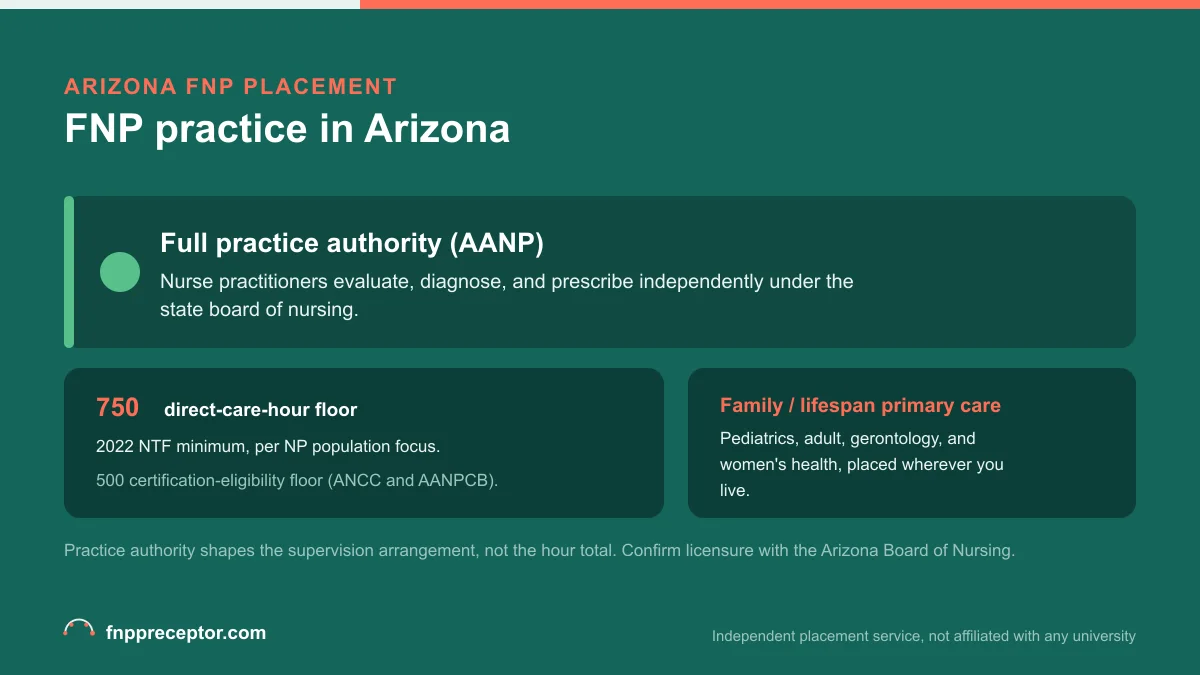
Hour language needs careful attribution. NTF recommends at least 750 direct patient care hours for an NP population focus, while ANCC and AANPCB FNP eligibility sources set a minimum of 500 faculty-supervised clinical hours. Only the program can translate those standards into this student's current course need.
Use the FNP clinical hours guide for national context and the preceptor requirements guide for screening questions. Neither guide replaces the program's current instructions.
A useful candidate combines a relevant license or certification with day-to-day work in family practice, pediatrics, internal medicine, adult or older adult care, community health, reproductive health, or another approved primary care setting. Only University of Arizona can accept the proposed match.
Plan the primary care search from Tucson
The directory lists University of Arizona in Tucson, Arizona. That is a planning anchor, not a statement about where students may complete clinical work. Confirm the student's authorized geography before outreach, since licensure, travel, site access, and program rules can change the practical search area.
Use the FNP placement guide for Arizona for broader family practice, community health, pediatric, adult, older adult, and reproductive health context. Any actual candidate and site must still pass the student's current program review.
Prepare a complete proposal for University of Arizona review
- The exact course, clinical objectives, term dates, and remaining approved hours
- The approved geography, lifespan populations, primary care setting, and required experiences
- The proposed clinician's license, certification, specialty, primary care role, and availability
- The site's practice setting, patient mix, and opportunities tied to the objectives
- Every current preceptor, site, compliance, and submission form supplied by the program
Before submission, assemble the candidate's license and certification details, role, site, population mix, clinical opportunities, schedule, and fit with each objective. The program may request more information or decline the proposal. A complete file is never presented as a guarantee.
Independent FNP placement support
The first useful step is a complete clinical brief rather than a broad request for any preceptor. Share the student's approved requirements through the matching form. We can then search for primary care fit without claiming authority we do not have.
This is independent placement support, not a school service or endorsement. We can source and organize a candidate file for University of Arizona to review, but we cannot promise placement, acceptance, contracts, credentialing, or a timeline.
Good to know
Which FNP pathways are verified for University of Arizona?
The official source set checked July 22, 2026 identifies DNP. Those labels do not establish clinical hours, delivery format, placement responsibility, admissions, tuition, or approval steps. Confirm the active pathway and course requirements directly with the program.
How many FNP clinical hours does University of Arizona require?
This page does not assign an exact school total. NTF recommends at least 750 direct patient care hours for an NP population focus, while FNP certification eligibility sources use a minimum of 500 faculty-supervised clinical hours. Programs vary, so confirm the student's exact current requirement with University of Arizona.
Who can precept an FNP student from University of Arizona?
A currently licensed and appropriately certified primary care nurse practitioner or an appropriately licensed physician in a matching role is a reasonable search target. Other clinician types may fit only when the program permits them. The program decides whether a particular candidate and site meet the course rules.
Which clinical settings can support FNP objectives?
A primary care service may fit if the student can meet the approved patient population and clinical activities under an eligible preceptor. The current program makes that determination.
Is FNP Preceptor affiliated with University of Arizona?
No. FNP Preceptor is an independent service and does not represent or receive endorsement from University of Arizona. We cannot guarantee placement, a timeline, paperwork completion, or program approval.
Related
Plan the FNP practicum across the lifespan
Tell us your school, city, course, and remaining objectives. We will organize an independent search for possible preceptors and primary care sites, subject to program approval.