FNP preceptor support for University of Texas at El Paso students
FNP students connected with University of Texas at El Paso can ask us to search for clinicians and primary care settings that match their remaining lifespan objectives. The program decides what is eligible; our independent work is to source and document a possible match against confirmed requirements.
University of Texas at El Paso FNP pathway snapshot
- Program: Family Nurse Practitioner
- School: University of Texas at El Paso
- Directory location: El Paso, Texas
- Verified pathways: MSN, DNP, and post-graduate certificate
- Official evidence checked: July 22, 2026
- Clinical focus: family and individual primary care across the lifespan
- Potential setting landscape: family practice, community health, pediatric primary care, internal medicine, adult and older adult primary care, reproductive or women's health, school or student health, and other approved primary care settings
- Approval authority: the student's current program
Current official pages support the program and pathway labels below. They do not establish the student's curriculum, admissions status, tuition, modality, or clinical approval process, so those details must be confirmed directly with the program.
What the official University of Texas at El Paso evidence confirms
Official University of Texas at El Paso sources checked July 22, 2026 support the MSN, DNP, and post-graduate certificate pathway record. Public program evidence answers whether the pathway is represented here, but the program must answer the separate questions about objectives, geography, hours, eligibility, placement ownership, and approval.
- Official FNP source 1, MSN, DNP, and post-graduate certificate: The current official institution or catalog source identifies the FNP MSN, DNP, post-graduate certificate pathway evidence.
These citations are included for verification, not as an endorsement of our service. Read the current official page and ask the program to confirm any requirement that affects the proposed preceptor or site.
Define the FNP population and setting fit
A strong FNP practicum supports clinical reasoning across ages rather than relying on a single broad label. Patient population, health promotion, common illness, chronic condition management, development, aging, and follow-up can all matter, but the program decides which experiences belong in this course.
No site category is automatically suitable. A community health center may offer broad age diversity, a pediatric practice may fill child health objectives, and an adult or reproductive health setting may address another need. The student's program must evaluate the complete proposal.
Turn the University of Texas at El Paso pathway label into a clinical brief
The published pathway set is MSN, DNP, and post-graduate certificate. Before sourcing, separate that public fact from the student's individual clinical need. Confirm the active course, required outcomes, patient populations, remaining approved hours, location boundaries, and candidate credentials.
Translate each objective into observable primary care work before outreach. One course may emphasize pediatric prevention, another adult chronic care, older adult assessment, reproductive health, or common episodic concerns. An objective map helps avoid a willing candidate whose daily role cannot support the required experience.
Confirm hours and preceptor eligibility
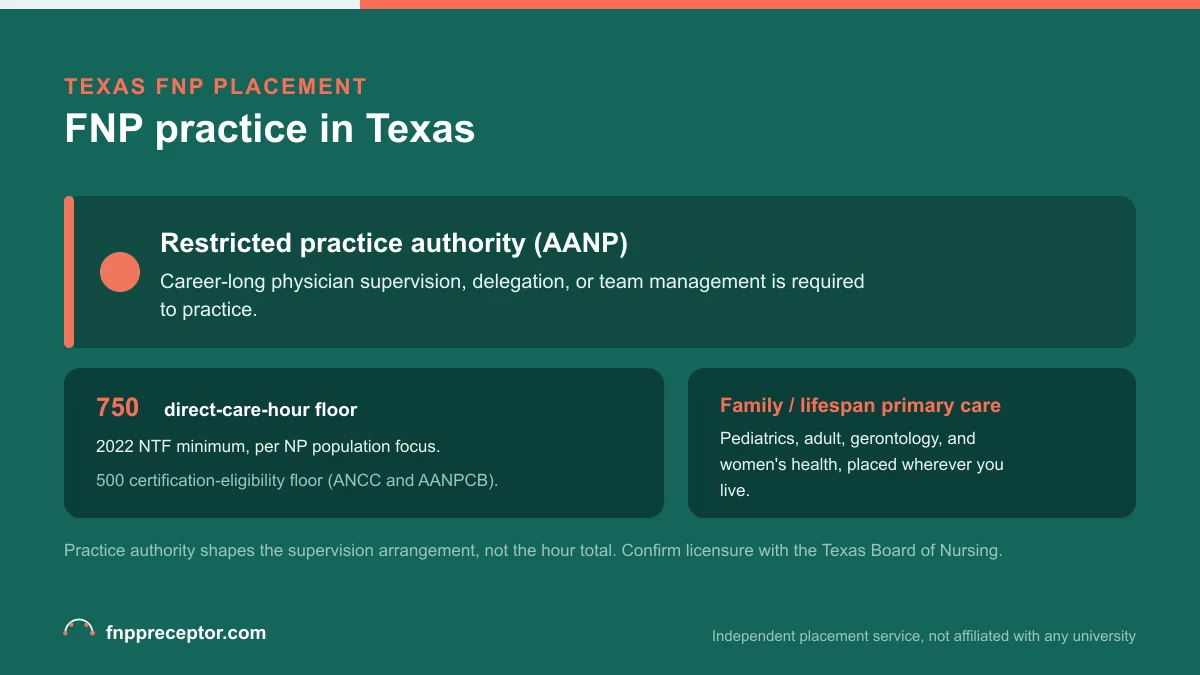
National figures are context, not a University of Texas at El Paso requirement. The 2022 NTF standards recommend at least 750 direct patient care hours for an NP population focus. ANCC and AANPCB FNP certification eligibility materials use at least 500 faculty-supervised clinical hours. Programs may set different totals and distributions, so confirm the student's exact requirement.
Use the FNP clinical hours guide for national context and the preceptor requirements guide for screening questions. Neither guide replaces the program's current instructions.
Preceptor screening asks whether the clinician's credential and real work align with the approved FNP objectives. Primary care nurse practitioners and physicians may be search candidates, but the program controls the final eligibility rules and may define additional acceptable roles.
Plan the primary care search from El Paso
Use El Paso as directory context only. Residence, state authorization, licensure, commuting limits, and course instructions may produce a different search radius. No city or state reference on this page promises availability.
Our FNP placement guide for Texas explains where primary care across different ages may be found across the state. It does not establish a clinical boundary or acceptance rule for this school.
Prepare a complete proposal for University of Texas at El Paso review
- The exact course, clinical objectives, term dates, and remaining approved hours
- The approved geography, lifespan populations, primary care setting, and required experiences
- The proposed clinician's license, certification, specialty, primary care role, and availability
- The site's practice setting, patient mix, and opportunities tied to the objectives
- Every current preceptor, site, compliance, and submission form supplied by the program
Document the match in the program's own terms. The file should show candidate qualifications, primary care role, population and site context, objective alignment, dates, and availability. The school can require additional review or documents that we cannot approve.
Independent FNP placement support
Bring the current syllabus or checklist, the student's schedule and geography, the lifespan primary care objectives, the remaining approved hours, and the candidate forms. That evidence keeps the search aligned and gives the program a clear proposal to consider.
This is independent placement support, not a school service or endorsement. We can source and organize a candidate file for University of Texas at El Paso to review, but we cannot promise placement, acceptance, contracts, credentialing, or a timeline.
Good to know
Which FNP pathways are verified for University of Texas at El Paso?
The official source set checked July 22, 2026 identifies MSN, DNP, and post-graduate certificate. Those labels do not establish clinical hours, delivery format, placement responsibility, admissions, tuition, or approval steps. Confirm the active pathway and course requirements directly with the program.
How many FNP clinical hours does University of Texas at El Paso require?
This page does not assign an exact school total. NTF recommends at least 750 direct patient care hours for an NP population focus, while FNP certification eligibility sources use a minimum of 500 faculty-supervised clinical hours. Programs vary, so confirm the student's exact current requirement with University of Texas at El Paso.
Who can precept an FNP student from University of Texas at El Paso?
A currently licensed and appropriately certified primary care nurse practitioner or an appropriately licensed physician in a matching role is a reasonable search target. Other clinician types may fit only when the program permits them. The program decides whether a particular candidate and site meet the course rules.
Which clinical settings can support FNP objectives?
Family practice, community health, pediatric primary care, internal medicine, adult and older adult primary care, reproductive or women's health, school health, and other approved primary care settings may fit when the patient mix, activities, and preceptor role align with the course. The program must review the actual proposal.
Is FNP Preceptor affiliated with University of Texas at El Paso?
No. FNP Preceptor is an independent service and does not represent or receive endorsement from University of Texas at El Paso. We cannot guarantee placement, a timeline, paperwork completion, or program approval.
Related
Plan the FNP practicum across the lifespan
Tell us your school, city, course, and remaining objectives. We will organize an independent search for possible preceptors and primary care sites, subject to program approval.