FNP preceptor support for Weber State University students
FNP students connected with Weber State University can ask us to search for clinicians and primary care settings that match their remaining lifespan objectives. The program decides what is eligible; our independent work is to source and document a possible match against confirmed requirements.
Weber State University FNP pathway snapshot
- Program: Family Nurse Practitioner
- School: Weber State University
- Directory location: Ogden, Utah
- Verified pathways: DNP
- Official evidence checked: July 22, 2026
- Clinical focus: family and individual primary care across the lifespan
- Potential setting landscape: family practice, community health, pediatric primary care, internal medicine, adult and older adult primary care, reproductive or women's health, school or student health, and other approved primary care settings
- Approval authority: the student's current program
Treat the pathway list as an evidence boundary, not a summary of school policy. The official pages establish the FNP credential routes shown here, while the current handbook, syllabus, and program contact remain the authorities for hours, sites, preceptors, forms, and deadlines.
What the official Weber State University evidence confirms
The directory uses the official FNP pages available on July 22, 2026. They support DNP as the pathway set for this record. Any detail not explicit in those pages remains unclaimed and must be confirmed with the program.
- Official FNP source 1, DNP: The current official program page identifies the Family Nurse Practitioner DNP emphasis.
These citations are included for verification, not as an endorsement of our service. Read the current official page and ask the program to confirm any requirement that affects the proposed preceptor or site.
Build the FNP lifespan primary care spine
Keep lifespan primary care at the center of the FNP request. The student may need supervised care involving pediatric, adult, older adult, preventive, chronic, episodic, and reproductive health objectives. The program's current course materials determine the required mix and how it must be documented.
The search can span family medicine, community clinics, pediatric offices, internal medicine, adult and geriatric primary care, reproductive health, and other settings that deliver genuine primary care. We screen what happens there, while Weber State University decides whether the actual preceptor and site satisfy the course.
Turn the Weber State University pathway label into a clinical brief
The record identifies DNP. Those credential labels help route the inquiry, but they do not reveal the student's entry point, course sequence, remaining hours, clinical dates, or placement responsibility. Bring the exact course and current plan of study into the search.
Break the practicum into the competencies and lifespan populations that remain unmet. The search can then prioritize the right service and clinician instead of asking broadly for any FNP preceptor. The program still reviews the combined picture and may request a different arrangement.
Confirm hours and preceptor eligibility
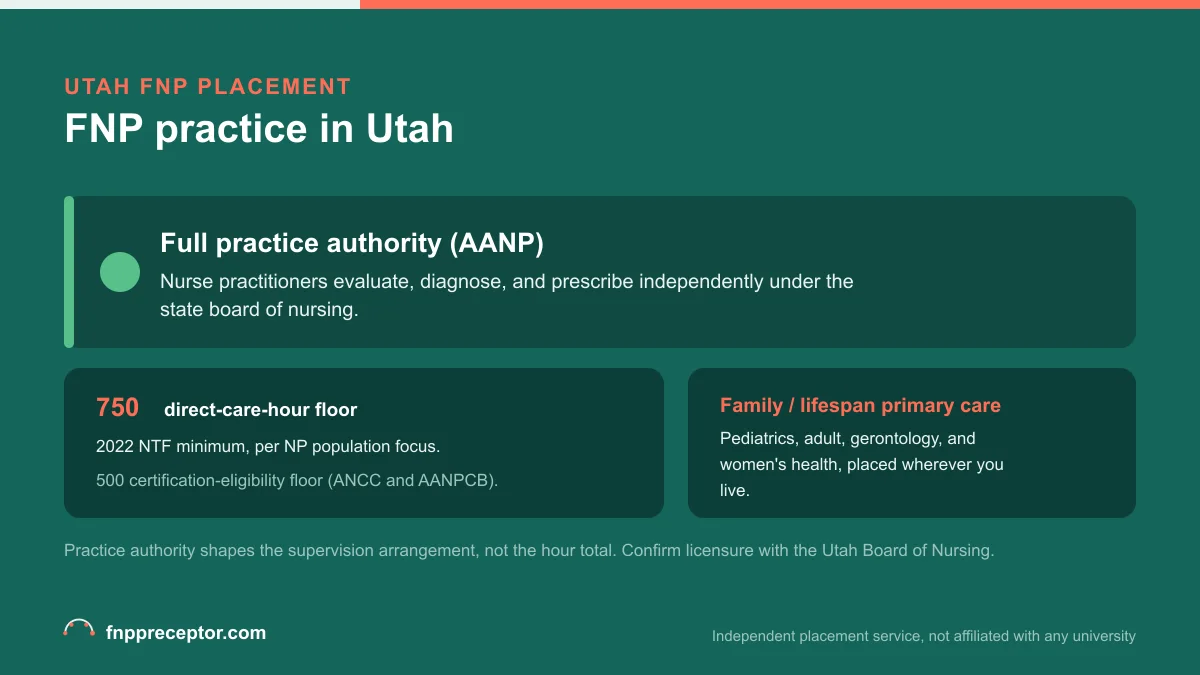
Hour language needs careful attribution. NTF recommends at least 750 direct patient care hours for an NP population focus, while ANCC and AANPCB FNP eligibility sources set a minimum of 500 faculty-supervised clinical hours. Only the program can translate those standards into this student's current course need.
Use the FNP clinical hours guide for national context and the preceptor requirements guide for screening questions. Neither guide replaces the program's current instructions.
Preceptor screening asks whether the clinician's credential and real work align with the approved FNP objectives. Primary care nurse practitioners and physicians may be search candidates, but the program controls the final eligibility rules and may define additional acceptable roles.
Plan the primary care search from Ogden
Ogden, Utah identifies the school record but does not define a clinical territory. A student may be able to consider nearby or distant practices only if the program permits it. We confirm those boundaries before screening candidates.
Use the FNP placement guide for Utah for broader family practice, community health, pediatric, adult, older adult, and reproductive health context. Any actual candidate and site must still pass the student's current program review.
Prepare a complete proposal for Weber State University review
- The exact course, clinical objectives, term dates, and remaining approved hours
- The approved geography, lifespan populations, primary care setting, and required experiences
- The proposed clinician's license, certification, specialty, primary care role, and availability
- The site's practice setting, patient mix, and opportunities tied to the objectives
- Every current preceptor, site, compliance, and submission form supplied by the program
Give the program a proposal it can evaluate without guessing: who the clinician is, where that person practices, which ages and needs are served, what the student could do, when supervision is available, and which current forms apply.
Independent FNP placement support
Do the confirmation work before outreach: course and dates, approved location, clinical objectives, patient populations, remaining hours, candidate credentials, and required forms. We use those facts to source carefully and submit a potential match for program review.
This is independent placement support, not a school service or endorsement. We can source and organize a candidate file for Weber State University to review, but we cannot promise placement, acceptance, contracts, credentialing, or a timeline.
Good to know
Which FNP pathways are verified for Weber State University?
The official source set checked July 22, 2026 identifies DNP. Those labels do not establish clinical hours, delivery format, placement responsibility, admissions, tuition, or approval steps. Confirm the active pathway and course requirements directly with the program.
How many FNP clinical hours does Weber State University require?
This page does not assign an exact school total. NTF recommends at least 750 direct patient care hours for an NP population focus, while FNP certification eligibility sources use a minimum of 500 faculty-supervised clinical hours. Programs vary, so confirm the student's exact current requirement with Weber State University.
Who can precept an FNP student from Weber State University?
A currently licensed and appropriately certified primary care nurse practitioner or an appropriately licensed physician in a matching role is a reasonable search target. Other clinician types may fit only when the program permits them. The program decides whether a particular candidate and site meet the course rules.
Which clinical settings can support FNP objectives?
A primary care service may fit if the student can meet the approved patient population and clinical activities under an eligible preceptor. The current program makes that determination.
Is FNP Preceptor affiliated with Weber State University?
No. FNP Preceptor is an independent service and does not represent or receive endorsement from Weber State University. We cannot guarantee placement, a timeline, paperwork completion, or program approval.
Related
Plan the FNP practicum across the lifespan
Tell us your school, city, course, and remaining objectives. We will organize an independent search for possible preceptors and primary care sites, subject to program approval.